ON THIS PAGE
Progress0%





Our Global Presence :


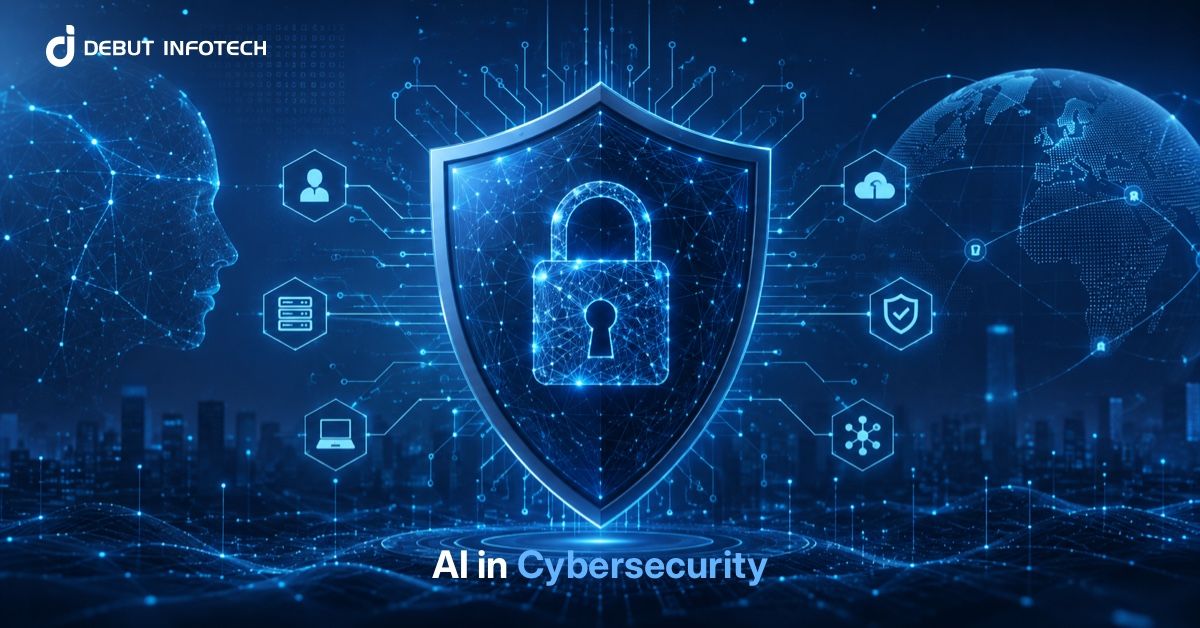


AI strengthens enterprise cybersecurity by detecting anomalies, automating threat response, and reducing breach detection time beyond traditional rule-based security.
Successful AI adoption requires more than technology organizations need quality data, governance, human oversight, and integration with existing security workflows.
Business value extends beyond threat prevention, with AI improving operational efficiency, reducing analyst workload, and lowering breach related costs through faster incident response.
AI complements rather than replaces cybersecurity professionals, allowing security teams to focus on investigation, decision-making, and strategic risk management while AI handles repetitive tasks.
Enterprises must address AI-specific risks, including adversarial attacks, governance gaps, over-reliance on automation, and model security to build resilient cyber defenses.
Choosing the right AI cybersecurity solution depends on platform compatibility, explainable AI, deployment flexibility, total cost of ownership, and long-term scalability rather than vendor marketing claims.
Every enterprise security team is being asked the same question right now: what do we actually do with AI? It is the biggest shift in cybersecurity in a decade, and it cuts both ways, sharpening defenses and arming attackers in the same breath. This guide works through it all: how AI protects the enterprise, the risks of leaning on it too hard, and the trends set to shape the next few years.
We have spent the past couple of years at Debut Infotech building secure systems for companies that take defense seriously, and one thing keeps striking us: the very models that help catch an intruder in seconds are the ones attackers now use to craft sharper phishing. We are all shopping from the same shelf.
On defense, though, AI in cybersecurity is the best thing to land for an overstretched security team in years. It learns what normal traffic and logins look like on your network, then flags the odd behavior in seconds, not the weeks it used to take a person to notice. That saving is real money and priceless time.
Three pressures are turning AI cybersecurity for enterprises from a nice-to-have into a budget line, and they’re all getting worse at once.
The first is speed and volume. Attacks now move faster than humans can triage, and alert queues are drowning security teams. The second is the talent gap: there simply aren’t enough analysts to go around, and there haven’t been for years. The third is money, and this is where the case gets easy to make.
Organizations using AI and automation extensively saved roughly $1.9 million per breach in 2025, paying about $3.62 million versus $5.52 million for non-users.
That figure comes from IBM’s 2025 Cost of a Data Breach report, which also clocked the global average breach at $4.44 million and the breach lifecycle at a nine-year low. Faster detection is doing a lot of that work, and AI is what makes it fast.
The market reflects the shift. Analysts at Grand View Research put the AI in cybersecurity market at around $25 billion in 2024, on track for roughly $94 billion by 2030. Banking and finance lead adoption, which tracks, they have the strictest rules and the data worth stealing.
Traditional security is mostly rule-based. It knows a threat because someone already wrote a signature for it, so it catches what it has seen before and misses what it hasn’t. AI-driven cybersecurity works the other way around. It learns a baseline of normal behavior and flags deviations, which means it can catch something genuinely new.
The difference is easier to see side by side.
Aspect | Traditional cybersecurity | AI-driven cybersecurity |
| Detection basis | Known signatures and fixed rules | Learned behavior and anomalies |
| New (zero-day) threats | Often missed until a signature exists | Can flag on abnormal behavior alone |
| Speed | Human-paced triage | Seconds, at machine scale |
| Alert volume | Floods analysts, high fatigue | Prioritizes and correlates, less noise |
| Upkeep | Constant manual rule updates | Models retrain as behavior shifts |
One honest caveat. AI isn’t a replacement for the fundamentals. You still need firewalls, patching, and access control. AI sits on top and makes the whole stack faster and sharper.
The attacker side is exactly why this stopped being optional. Generative AI didn’t just help defenders; it supercharged offense.
AI-written phishing reads clean, personalizes at scale, and lands far more often than the clumsy stuff we all learned to spot. Deepfakes have moved from novelty to fraud tool, with voice-cloned executives authorizing wire transfers that never should have gone out.
Deepfake-driven CEO fraud rose sharply through 2025, and AI-enabled attacks climbed roughly 47% globally over the year.
Fighting machine-speed attacks with human-speed defense is a losing setup. That’s the real argument for AI here. Not that it’s trendy, but that the other side is already automated, and matching them is the only way to stay level.
Under the hood, most AI-powered cybersecurity leans on a handful of techniques, each doing a specific job.
None of these is magic. They’re pattern engines, very fast ones, trained on enormous volumes of security data.
Look across all those use cases and the same handful of advantages keep surfacing.
Put together, that’s what real cyber resilience looks like in practice: not one silver bullet, but faster, broader, smarter defense across the board.
This is where it gets concrete. These are the jobs we see AI doing inside real security teams right now.
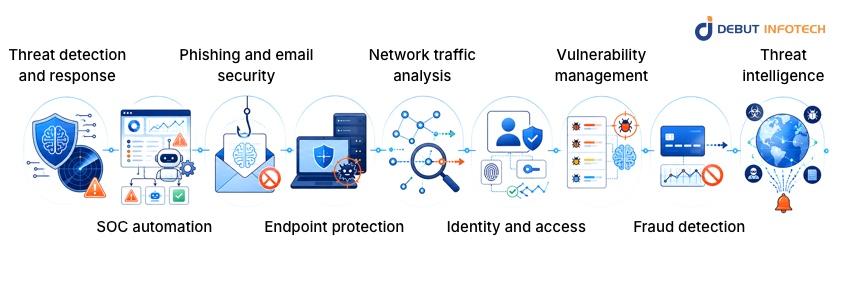
The same tools land differently depending on the industry and what it’s protecting.
No. And anyone selling you that is overpromising. What AI lifts off your team is the grind, the endless triage and log-sifting that swallow whole shifts. It also takes the tedious first-pass investigation off their hands. Judgment is another matter entirely.
A model can flag that something looks wrong. Working out what it actually means still needs a person who knows your business, someone who can weigh how serious it is and decide what happens next. So the realistic future isn’t an empty SOC. It’s a leaner team doing far more, with AI playing the analyst that never sleeps and never gets bored, working for the ones who do.
None of this is plug-and-play, and pretending otherwise sets projects up to fail.
Challenges are about getting AI to work. Risks are about what happens when AI itself becomes the weak point.
In IBM’s 2025 data, 97% of organizations that had an AI-related breach lacked proper AI access controls, and most had no governance policy to rein in shadow AI.
In our experience, the teams that get value from this tend to follow a similar path.
When you’re comparing AI-powered cybersecurity solutions, the vendor claims all sound identical, so judge them on the things that actually differ.
Here’s a quick AI cybersecurity tools comparison, the platforms security teams reach for most in 2026 and what each is strongest at.
| Tool | Best known for |
| Microsoft Security Copilot | Generative AI analyst across the Defender and Sentinel ecosystem |
| CrowdStrike Falcon (Charlotte AI) | Endpoint and identity protection with natural-language investigation |
| Darktrace | Self-learning network detection with autonomous response |
| SentinelOne (Purple AI) | Autonomous endpoint response and fast SOC triage |
| Vectra AI | Network and identity threat detection |
Strong AI security isn’t one product. It’s models, clean data, integration with what you already run, and controls around the AI itself. That mix of AI engineering and security-grade rigor is exactly where we work.
Being an AI development company, we have a team of AI developers and ML engineers who build and secure these systems end to end, from data pipelines and model development through secure deployment and monitoring. Whether the goal is anomaly detection, fraud scoring, or an AI assistant for your SOC, we design AI-powered cybersecurity solutions to hold up in production, not just in a demo.
A few shifts are already underway, and from where our team sits, they point the same direction.
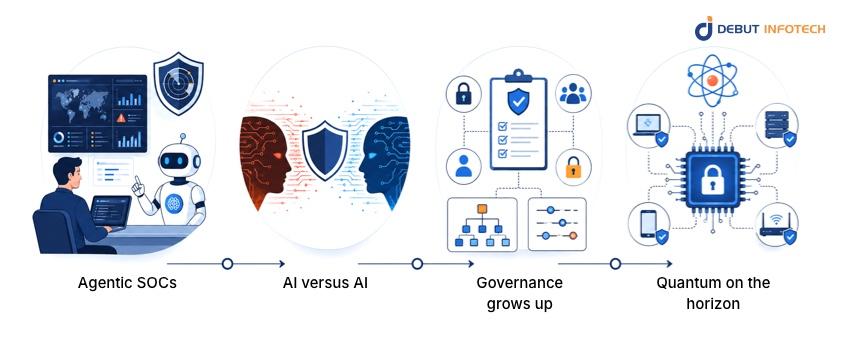
So is AI the future of cybersecurity? It’s already the present. The open question is only how fast teams adapt around it.
Mostly to spot and respond to threats faster than people can. AI learns what normal looks like across your systems and flags anomalies, automates the repetitive triage in a SOC, catches AI-written phishing, and scores transactions for fraud in real time. Under the hood it’s machine learning and, increasingly, generative AI doing the heavy lifting.
No. It replaces the repetitive parts, log-sifting, first-pass triage, and frees analysts for the judgment calls. Deciding what a threat means and how to respond still needs a human who knows the business. The realistic outcome is a smaller team doing much more, not an empty security desk.
It’s better at different things, and the two work best together. Traditional tools reliably catch known threats through signatures and rules. AI catches the new and the subtle by learning behavior. Drop the fundamentals and lean only on AI and you’ll have gaps, so treat AI as a powerful layer on top, not a replacement.
Accurate enough to be worth it, but not perfect. Early on it can throw false positives until it learns your environment, and a well-tuned system gets sharp over time. It will still miss the occasional novel attack and can be fooled by adversarial input, which is exactly why human oversight stays in the loop.
The clearest number comes from breach costs. IBM found organizations using AI and automation extensively paid about $1.9 million less per breach than those that didn’t, mostly from catching and containing incidents faster. Add the analyst hours saved on triage and the math usually works out quickly.
Banking and finance lead by a wide margin, thanks to strict compliance and high-value data. Healthcare, government, retail, and manufacturing follow, each protecting something specific, patient records, critical infrastructure, payment flows, or connected factory equipment.
More autonomy and more governance at the same time. Expect agentic systems that investigate and respond on their own under human supervision, an escalating AI-versus-AI dynamic, stronger rules around how AI is deployed, and early moves toward post-quantum cryptography.

Our Latest Insights
USA

2501 Chatham, Rd Suite R Springfield, IL 62704
+1-708-515-4004
info@debutinfotech.com
UK

7 Pound Close, Yarnton, Oxfordshire, OX51QG
+44-770-304-0079
info@debutinfotech.com
Canada

154 Eden Oak Trail, Kitchener, ON N2A 0H9
+1-708-515-4004
info@debutinfotech.com
INDIA

Sector 101-A, Plot No: I-42, IT City Rd, JLPL Industrial Area, Mohali, PB 140306
9888402396
info@debutinfotech.com

9001:2015
Quality Certified

ISO 27001
Security Certified

A+ Rating
Accredited Business

Certik
Security & Audit


Copyright © 2026, Debut Infotech. All rights reserved. | Privacy Policy