ON THIS PAGE
Progress0%






Our Global Presence :





Selecting the wrong P2P crypto exchange development company can turn a well-planned project into a costly rebuild. Founders often focus on initial development quotes from top p2p crypto exchange development companies, only to later discover that security gaps, compliance oversights, scalability limitations, and poor architectural decisions require expensive rework. In many cases, fixing a poorly built exchange costs 2 to 3 times as much as getting it right the first time.
Security alone can become a major financial burden in peer-to-peer trading platform development. According to Immunefi research, the average crypto hack now costs approximately $25 million per incident, highlighting the financial consequences of inadequate security implementation.
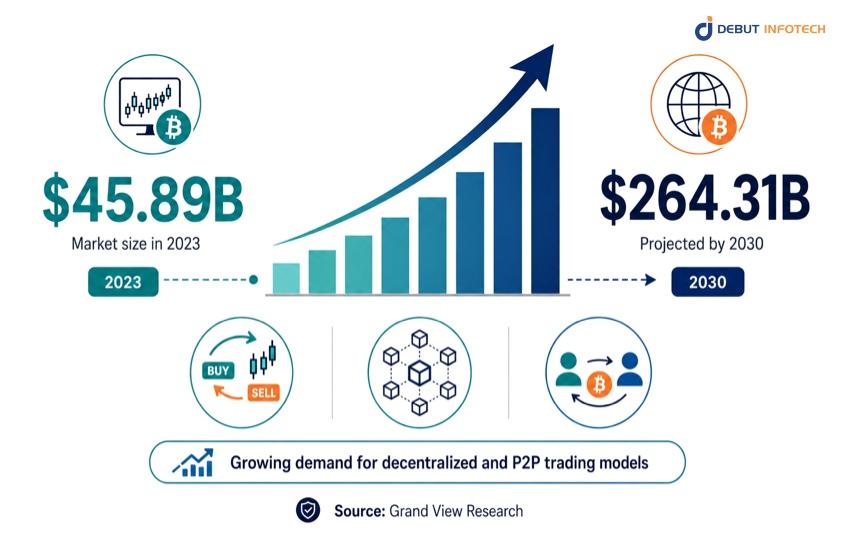
The market opportunity remains substantial. Per Grand View Research, the global cryptocurrency exchange platform market size was valued at $45.89 billion in 2023 and is projected to reach $264.31 billion by 2030. Industry forecasts indicate continued growth in demand for crypto trading infrastructure, particularly for decentralized and peer-to-peer trading models as users seek greater control, privacy, and flexibility.
P2P platforms have evolved far beyond simple escrow marketplaces and now support multi-chain trading, automated dispute management, advanced compliance systems, and institutional-grade security. Institutional P2P trading volume alone reached $47 billion in Q1 2026, reflecting the growing adoption of peer-to-peer trading infrastructure.
This guide examines the leading P2P crypto exchange development companies in 2026, their estimated pricing ranges, service strengths, and evaluation criteria. The focus is vendor comparison rather than feature-level development costing.
If you’re looking for a detailed breakdown of development expenses, infrastructure costs, compliance budgets, and maintenance requirements, see our Cost to Build a P2P Exchange guide for a deeper analysis.
AI Overview Box
Debut Infotech, Antier Solutions, Suffescom Solutions, SoluLab, Openware, Blockchain App Factory, LeewayHertz, Inoru, Clarisco Solutions, and PixelPlex rank among the top P2P crypto exchange development companies in 2026. Development costs typically range from $20,000–$300,000+, depending on platform complexity, compliance requirements, security scope, customization level, and long-term support needs.
If you’re wondering: How do I choose a P2P crypto exchange development company?
Choose a P2P crypto exchange development company by evaluating three critical factors first: technical stack, compliance track record, and post-launch support capabilities. Then assess security expertise, escrow architecture, portfolio quality, pricing transparency, scalability planning, mobile development experience, and client reviews. Companies with proven P2P exchange deployments and compliance expertise typically provide lower long-term project risk.
Here’s a more detailed breakdown of what sets the best P2P Crypto exchange development company apart from average ones:
A strong development partner should have hands-on experience building P2P exchanges rather than general cryptocurrency platforms. P2P trading requires specialized escrow mechanisms, dispute-resolution workflows, smart contract development, wallet integrations, and secure transaction management.
Assess the company’s expertise with blockchain networks, trading infrastructure, scalability planning, and security architecture. Teams that have previously delivered live P2P platforms are often better equipped to avoid costly technical mistakes and deployment delays. This is why it’s crucial to review the p2p exchange development company portfolio examples.
Regulatory compliance has become a core requirement for crypto exchanges operating across multiple jurisdictions. Evaluate whether the company has experience in KYC AML compliance integration, sanctions monitoring, transaction surveillance, FATF Travel Rule compliance, and MiCA-related requirements.
A provider offering p2p cryptocurrency exchange development services with proven compliance delivery capabilities can help reduce legal risks, streamline onboarding processes, and prepare the platform for evolving regulatory expectations without requiring significant post-launch modifications. That’s why it’s crucial to partner with a reputable p2p exchange development agency with compliance expertise.
A company’s client portfolio and case studies provide valuable insight into its technical capabilities and delivery standards. Look beyond screenshots and marketing claims by reviewing live exchange platforms, transaction functionality, user experience quality, and platform performance.
Verifiable case studies, client testimonials, and independent reviews on platforms such as Clutch can help validate expertise. Strong references from previous clients often indicate reliability, professionalism, and the ability to complete complex projects successfully.
Clear pricing structures reduce the likelihood of budget overruns and project disputes. Experienced p2p blockchain exchange developers should explain whether they operate under fixed-price, time-and-materials, or dedicated-team engagement models. Request detailed proposals that outline project scope, deliverables, milestones, payment schedules, and change-request procedures.
Transparent vendors also disclose potential additional expenses related to third-party integrations, compliance services, infrastructure upgrades, security audits, and long-term maintenance requirements before development begins.
Exchange development does not end when the platform goes live. Ongoing maintenance is required to address security vulnerabilities, update the blockchain network, improve performance, enhance features, and address compliance changes. Evaluate the company’s support structure, response times, SLA commitments, and dedicated account management options. A provider with a strong post-launch support framework can help ensure operational stability and reduce downtime as user activity and transaction volumes grow. This is why the best p2p exchange development company for startups offers post-launch support and maintenance.
Security remains one of the most important evaluation criteria when selecting a development partner. The company should offer smart contract audits, penetration testing, infrastructure assessments, code reviews, and vulnerability management processes.
Strong exchange security practices and audits help protect user funds, reduce exposure to cyberattacks, and improve platform credibility. Ask whether security testing is performed internally, through third-party auditors, or through a combination of both approaches before deployment.
Escrow functionality forms the foundation of every successful P2P exchange. A reliable escrow architecture ensures that assets remain protected until both parties satisfy agreed transaction conditions. Review the depth of the company’s escrow system development services. Also, examine how the company handles escrow automation, dispute-resolution workflows, fraud-prevention controls, and fund-release mechanisms. Well-designed escrow systems improve trust between traders, reduce transaction disputes, and create a safer marketplace environment for buyers and sellers.
Cryptocurrency users increasingly expect access to assets across multiple blockchain ecosystems. When you hire p2p crypto exchange developers, ensure they demonstrate experience integrating networks such as Ethereum, BNB Chain, Polygon, Solana, Base, and other major blockchains. Multi-chain support improves platform flexibility and expands market reach. Companies with cross-chain development expertise can also help reduce future expansion costs while enabling broader asset compatibility and improved trading opportunities.
Although P2P exchanges facilitate direct user-to-user trading, supporting infrastructure remains important for platform success. Evaluate the company’s experience integrating payment gateways, liquidity services, price feeds, wallet systems, and external APIs. Reliable infrastructure contributes to smoother transactions, faster settlements, and better user experiences. Development partners with expertise in liquidity and market infrastructure can help create a more competitive and scalable trading ecosystem.
A platform that performs well with hundreds of users may struggle when transaction volumes increase significantly. Development companies should demonstrate expertise in cloud architecture, database optimization, load balancing, caching strategies, and high-availability systems. Scalability planning from the beginning helps prevent performance bottlenecks, unexpected infrastructure expenses, and service disruptions. It also ensures the exchange can support future growth without requiring extensive redevelopment.
Mobile devices account for a large share of cryptocurrency trading activity. A capable mobile crypto exchange app development company should provide native iOS and Android applications or high-performance cross-platform solutions that deliver consistent user experiences.
Mobile platforms should support secure authentication, wallet access, notifications, escrow management, and trading functionality. Strong mobile development capabilities help improve user engagement, retention rates, and overall platform accessibility.
The best development partners contribute more than technical implementation. They help define product requirements, monetization models, launch strategies, compliance roadmaps, and feature prioritization plans. Strategic guidance can reduce development waste and improve decision-making throughout the project lifecycle. Companies with consulting expertise often provide valuable market insights that help businesses build competitive exchanges aligned with both user expectations and commercial objectives.
You’d probably be asking: Which are the top P2P crypto exchange development companies?
The top P2P crypto exchange development companies in 2026 include Debut Infotech (full-stack P2P exchange and compliance expertise), Antier Solutions (white-label and custom exchange development), Suffescom Solutions (startup-focused blockchain solutions), SoluLab (enterprise blockchain development), Openware (exchange infrastructure), Blockchain App Factory (end-to-end Web3 development), LeewayHertz (enterprise engineering), Inoru (rapid deployment solutions), Clarisco Solutions (exchange customization), and PixelPlex (security-focused blockchain development).
Here is a detailed description of several established blockchain firms offering varied capabilities, pricing models, and delivery strengths:

Founded in 2011, Debut Infotech has grown into a well-established blockchain and software development company serving startups, enterprises, and digital asset businesses across North America, Europe, and Asia.
The company has been active in blockchain development since 2015 and has delivered more than 50 blockchain implementations spanning cryptocurrency exchanges, tokenization platforms, DeFi solutions, and enterprise blockchain systems. Its portfolio includes work with organizations such as OKX, NDAX, IntegraLedger, KoreConX, iFinca, and RVA.
Debut is particularly known for combining exchange development expertise with compliance-focused architecture, helping clients build scalable platforms designed for long-term growth. The company also reports having delivered more than 500 custom software solutions globally.
Location: United States / India
Speciality: Full-stack P2P crypto exchange development with compliance-focused implementation
Key Services: P2P exchanges, crypto trading platforms, smart contracts, escrow systems, wallets, tokenization, DeFi development
Pricing Range: $30,000–$250,000+
Notable Strength: Strong balance of custom engineering, regulatory readiness, and blockchain-native expertise
Clutch Rating: Approximately 4.8–4.9/5 (varies by service category)
Review Signal: Ranked among the Top Blockchain Development Companies Worldwide by GoodFirms in 2026.

Founded in 2005, Antier Solutions is one of the longest-running blockchain development firms in the market. As part of the top p2p crypto exchange development companies in India, the company expanded aggressively into blockchain services and has since built a substantial portfolio covering crypto exchanges, tokenization platforms, NFT marketplaces, DeFi products, custody solutions, and Web3 ecosystems.
As a blockchain development company for exchange, Antier is particularly recognized for its white-label exchange offerings and enterprise blockchain consulting services. The company serves startups, fintech firms, financial institutions, and digital asset ventures seeking faster market entry.
Antier’s extensive blockchain-focused team and broad service catalog make it a frequent choice for businesses looking to launch customized trading ecosystems while maintaining flexibility for future expansion.
Location: India
Speciality: White-label and custom crypto exchange development
Key Services: P2P exchanges, centralized exchanges, DeFi platforms, tokenization, wallet development, staking systems
Pricing Range: $25,000–$200,000
Notable Strength: Large blockchain-focused delivery team with extensive white-label experience
Clutch Rating: Approximately 4.8/5
Review Signal: Frequently appears among leading blockchain development providers in industry rankings and Clutch blockchain categories.

Founded in 2013, Suffescom Solutions has evolved from a mobile application development company into a major provider of blockchain, AI, and Web3 development services. The company reports serving more than 1,250 clients globally, delivering over 200 blockchain projects and hundreds of digital products across multiple industries.
Its blockchain portfolio includes crypto exchanges, wallets, NFT platforms, token launch solutions, and decentralized applications. Suffescom has worked with prominent organizations including Universal and NBC, while also supporting startups and mid-sized businesses worldwide. The company maintains delivery centers across India, the United States, and the UAE, giving it a broad international footprint.
Location: US / India
Speciality: Startup-friendly blockchain and crypto exchange development
Key Services: P2P exchanges, NFT marketplaces, wallets, DeFi applications, token development
Pricing Range: $20,000–$150,000
Notable Strength: Strong balance of affordability, scalability, and product diversity
Clutch Rating: 4.9/5 based on verified Clutch reviews.
Review Signal: Ranked among Clutch’s Top Global Companies for 2026 and recognized through multiple Clutch Global Awards.

Founded in 2014, SoluLab has established itself as a blockchain, AI, and enterprise software development company serving both startups and large organizations. The company is widely recognized for delivering complex digital transformation projects that combine blockchain infrastructure with broader enterprise systems. SoluLab’s portfolio spans cryptocurrency exchanges, decentralized applications, token ecosystems, supply chain solutions, and AI-powered products.
Over the years, the company has worked with organizations ranging from early-stage ventures to major global brands. Its approach emphasizes custom engineering rather than template-based deployment, making it particularly attractive for businesses that require specialized functionality and enterprise-grade scalability within their blockchain platforms.
Location: US / India
Speciality: Enterprise blockchain and custom exchange development
Key Services: P2P exchanges, blockchain consulting, smart contracts, enterprise applications, DeFi platforms
Pricing Range: $40,000–$180,000
Notable Strength: Strong enterprise development capabilities and consulting expertise
Clutch Rating: Approximately 4.9/5
Review Signal: Consistently featured among top blockchain and software development companies across industry review platforms.

Openware focuses exclusively on digital asset infrastructure and exchange technology, making it one of the most specialized firms in this comparison. Founded in 2017, the company is best known for its flagship exchange framework, OpenDAX, which powers a variety of cryptocurrency trading platforms worldwide.
Openware reports launching more than 150 crypto and fintech projects globally, ranging from startup exchanges to enterprise trading ecosystems.
Unlike many service-focused agencies, Openware combines software products with implementation services, giving clients access to battle-tested exchange infrastructure. The company is particularly attractive to organizations seeking advanced trading functionality, exchange scalability, custody integrations, and institutional-grade market infrastructure from a provider dedicated primarily to exchange technology.
Location: United States
Speciality: Exchange infrastructure and trading platform technology
Key Services: P2P exchanges, exchange software, custody systems, matching engines, liquidity infrastructure
Pricing Range: $50,000–$300,000+
Notable Strength: Proven exchange technology stack with extensive deployment history
Clutch Rating: Approximately 4.7–4.8/5
Review Signal: More than 150 crypto and fintech projects launched globally, with a strong reputation in exchange infrastructure development.

Founded in 2017, Blockchain App Factory is one of the most recognizable names in the blockchain development sector. The company specializes in cryptocurrency exchanges, tokenization platforms, DeFi protocols, NFT ecosystems, metaverse projects, and enterprise blockchain solutions.
Over the years, it has delivered hundreds of blockchain-focused projects for startups, fintech firms, crypto businesses, and enterprises looking to launch digital asset products.
Unlike companies that focus primarily on exchange development, Blockchain App Factory has built a broad Web3 portfolio spanning fundraising platforms, token launches, staking ecosystems, and decentralized applications. Its extensive service range makes it a popular choice for businesses seeking multiple blockchain products under a single technology partner.
Location: India
Speciality: End-to-end blockchain and crypto exchange development
Key Services: P2P exchanges, DeFi platforms, NFT marketplaces, tokenization, wallet development, metaverse solutions
Pricing Range: $30,000–$220,000
Notable Strength: Broad Web3 service portfolio covering nearly every blockchain business model
Clutch Rating: Approximately 4.6–4.8/5
Review Signal: Widely recognized across blockchain industry rankings and frequently featured among leading cryptocurrency development firms.

Founded in 2007 in San Francisco, LeewayHertz is one of the earliest technology companies to enter both the blockchain and AI development markets.
The company has worked with more than 30 Fortune 500 organizations, including Siemens, 3M, Procter & Gamble (P&G), and Hershey’s, while delivering enterprise-grade blockchain, AI, and digital transformation solutions.
Rather than focusing exclusively on crypto startups, LeewayHertz serves large enterprises that require secure, scalable, and highly customized systems. Its blockchain portfolio includes cryptocurrency platforms, smart contract applications, tokenization systems, and decentralized solutions.
The company’s enterprise pedigree makes it particularly attractive for businesses seeking complex exchange infrastructure supported by mature engineering and consulting processes.
Location: United States
Speciality: Enterprise blockchain engineering and digital transformation
Key Services: Crypto exchanges, blockchain consulting, AI integration, smart contracts, enterprise applications
Pricing Range: $60,000–$300,000+
Notable Strength: Extensive experience working with Fortune 500 companies
Clutch Rating: Approximately 4.8–4.9/5
Review Signal: Strong reputation among enterprise clients and large-scale technology initiatives.

Inoru has spent more than 12 years developing blockchain, AI, and Web3 solutions for startups, growing businesses, and enterprise clients worldwide. The company operates across multiple regions, including the United States, the United Kingdom, the UAE, Singapore, and India, giving it a broad international delivery presence. Its blockchain portfolio includes cryptocurrency exchanges, decentralized exchanges, NFT marketplaces, tokenization platforms, blockchain wallets, and fundraising solutions.
One distinguishing characteristic is its focus on combining Web3 development with digital growth and go-to-market support. This approach appeals to businesses that require both technical implementation and strategic guidance during product launches.
Location: India
Speciality: White-label and custom blockchain platform development
Key Services: P2P exchanges, DEX platforms, token creation, NFT development, wallets, Web3 applications
Pricing Range: $20,000–$120,000
Notable Strength: Strong international presence and broad Web3 expertise
Clutch Rating: Approximately 4.7–4.8/5
Review Signal: Known for supporting startups seeking faster deployment and lower development costs.

Clarisco Solutions was founded under the leadership of Priyadharshini Suriyanarayanan and has built a strong reputation in cryptocurrency exchange, blockchain, AI, and Web3 development.
The company reports delivering more than 500 digital solutions globally, while recent materials reference involvement in over 650 product launches across the blockchain, AI, DeFi, NFT, and tokenization sectors. Its cryptocurrency portfolio includes centralized, decentralized, hybrid, derivative, and P2P exchange development services.
Clarisco places significant emphasis on rapid deployment, AI-enhanced trading functionality, and compliance-ready exchange architectures. The company is particularly active in serving entrepreneurs and startups seeking customizable exchange infrastructure with relatively fast launch timelines.
Location: India
Speciality: Cryptocurrency exchange development and Web3 platforms
Key Services: P2P exchanges, centralized exchanges, hybrid exchanges, DeFi solutions, blockchain applications
Pricing Range: $20,000–$140,000
Notable Strength: Fast deployment models and extensive exchange development offerings
Clutch Rating: Approximately 4.7–4.8/5
Review Signal: Reports experience delivering blockchain solutions across more than 30 countries.

Founded in 2007, PixelPlex is a blockchain-focused software engineering company with offices across the United States, Europe, and the Middle East. As a top p2p crypto exchange developers for hire in USA, the company has completed more than 450 successful projects, helped clients raise over $500 million, and contributed to the creation of several high-growth technology ventures.
Its blockchain portfolio includes projects for organizations such as Qtum, Peerplays, Blockcerts, Echo, and eXeBlock, alongside numerous enterprise blockchain initiatives.
PixelPlex is a crypto exchange software development firm known for deep technical expertise across Ethereum, Solana, Polkadot, and other blockchain ecosystems. Unlike many competitors, the company maintains a strong focus on advanced blockchain engineering, consulting, and security-driven development.
Location: United States / Europe
Speciality: Custom blockchain engineering and enterprise-grade solutions
Key Services: Crypto exchanges, smart contracts, tokenization, blockchain consulting, Web3 development
Pricing Range: $50,000–$250,000+
Notable Strength: Deep technical expertise and strong security-oriented development practices
Clutch Rating: 4.9/5 based on verified Clutch reviews.
Review Signal: Recipient of multiple Clutch awards, including Top Blockchain Company, Top Smart Contract Development Company, and Top Blockchain Consulting Company.
However, understanding p2p exchange development company pricing differences helps businesses align budget expectations with development scope, feature complexity, and compliance needs. The comparison below highlights estimated costs, engagement models, and core specialties across leading providers. Let’s take a look at the p2p cryptocurrency exchange development cost by company:
| Company | Location | Pricing Range | Engagement Model | Speciality |
| Debut Infotech | US / India | $30K–$250K+ | Fixed / T&M | Full-stack P2P + compliance |
| Antier Solutions | India | $25K–$200K | Fixed / T&M | White-label + custom |
| SoluLab | US / India | $40K–$180K | T&M | Enterprise blockchain |
| Suffescom Solutions | India | $20K–$150K | Fixed / T&M | Startup-focused solutions |
| Openware | Global | $50K–$300K+ | Custom | Exchange infrastructure |
| Blockchain App Factory | India | $30K–$220K | Fixed / T&M | Blockchain ecosystems |
| LeewayHertz | US / India | $60K–$300K+ | T&M | Enterprise engineering |
| Inoru | India | $20K–$120K | Fixed | White-label p2p exchange solution deployment |
| Clarisco Solutions | India | $20K–$140K | Fixed / T&M | Exchange customization |
| PixelPlex | US / Europe | $50K–$250K+ | T&M | Security-focused blockchain |
Development costs vary substantially depending on exchange complexity, compliance requirements, supported blockchains, security scope, and customization levels.
If you’re asking yourself: how much do P2P crypto exchange development companies charge?
P2P crypto exchange development companies typically charge between $30,000 and $250,000+ depending on platform complexity, compliance requirements, feature count, and development location. Basic MVP exchanges often start around $20,000–$50,000, while enterprise-grade platforms can exceed $250,000. For a detailed factor-by-factor analysis, see our Cost to Build a P2P Exchange guide.
Pricing for P2P crypto exchange development depends on several interconnected factors, including product scope, compliance obligations, infrastructure design, and team location. Each element significantly influences total project cost and delivery timeline.
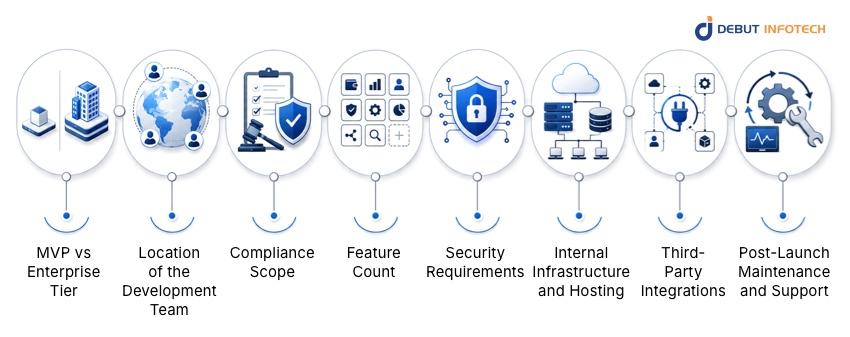
The scope of the exchange has the greatest influence on overall development costs. A minimum viable product typically includes core features such as user registration, wallet integration, escrow functionality, and dispute management.
Enterprise-grade platforms require advanced security controls, compliance systems, analytics dashboards, liquidity integrations, mobile applications, and high-performance infrastructure. As functionality expands, development complexity, testing requirements, and deployment costs increase significantly.
Development rates vary considerably depending on where the vendor’s engineering team is based. Companies operating primarily in North America and Western Europe generally charge higher rates than firms with delivery centers in India and other cost-efficient regions.
However, pricing should not be evaluated in isolation. Technical expertise, communication quality, project management processes, and blockchain experience often have a greater impact on long-term project outcomes than hourly development rates.
Compliance requirements can represent a significant portion of the overall project budget. Features such as KYC verification, AML screening, sanctions monitoring, transaction surveillance, FATF Travel Rule compliance, and legal consulting add both development and operational expenses.
The cost increases further when exchanges target multiple jurisdictions with different regulatory requirements. Early compliance planning helps reduce the likelihood of costly redesigns, delays, or regulatory challenges after launch.
Every additional feature contributes to development effort, testing requirements, and maintenance obligations. Basic exchanges typically focus on trading, escrow, and wallet functionality. At the same time, advanced platforms may include multi-chain support, staking services, fiat payment gateways, referral systems, merchant modules, analytics tools, and AI-powered fraud detection.
As the feature set grows, development timeline benchmarks become longer, and infrastructure requirements become more sophisticated, leading to higher overall project costs.
Security investments directly impact exchange development budgets because protecting user assets is a business-critical requirement. Costs often include smart contract audits, penetration testing, infrastructure hardening, wallet security implementation, encryption systems, and ongoing vulnerability monitoring.
While security measures increase initial development costs, they help reduce the risk of financial losses, reputational damage, and operational disruptions from security breaches or exploitation attempts.
Infrastructure costs vary based on expected transaction volume, storage requirements, and platform architecture. Cloud hosting, database management, load balancing, content delivery networks, backup systems, and disaster recovery planning all contribute to ongoing expenses.
Exchanges designed for large-scale user adoption require more robust infrastructure investments than smaller MVP deployments. Proper infrastructure planning supports performance, reliability, and future scalability while minimizing service interruptions and operational risks.
Most modern P2P exchanges rely on external service providers to deliver critical functionality. These integrations may include KYC vendors, AML monitoring platforms, payment gateways, blockchain data providers, liquidity services, notification systems, and analytics tools.
Each integration adds implementation effort, testing requirements, and recurring subscription costs. The number and complexity of third-party services can substantially affect both development budgets and long-term operational expenditures.
Ongoing maintenance is often overlooked during budgeting discussions, despite being a necessary part of operating a crypto exchange. Regular software updates, blockchain compatibility upgrades, bug fixes, security patching, performance monitoring, and compliance adjustments require continuous investment.
Companies that include structured support packages may appear more expensive initially, but they often reduce long-term operational risks and help maintain platform reliability as the business grows.
Debut Infotech has built a strong presence in blockchain and cryptocurrency exchange development through years of experience delivering trading platforms, blockchain applications, and digital asset solutions. The company combines technical expertise with business-focused consulting to help clients move from concept validation to production deployment.
Its development capabilities span smart contract engineering, escrow architecture, multi-chain integration, wallet development, web and mobile applications, administrative dashboards, and enterprise-grade security implementation. This enables businesses to launch scalable P2P exchanges tailored to their operational requirements.
Compliance readiness remains one of Debut Infotech’s strongest differentiators. The company supports KYC integration, AML workflows, FATF Travel Rule implementation, transaction monitoring, and MiCA-aligned compliance planning, helping clients navigate increasingly complex regulatory expectations.
Clients also benefit from ongoing maintenance, security upgrades, infrastructure optimization, and product enhancement services after launch. This long-term support model helps reduce operational risk while supporting sustainable platform growth.
Choosing a P2P crypto exchange development company is about more than comparing price tags. The real difference lies in how well a provider handles security, compliance, scalability, and long-term platform stability.
Companies like Debut Infotech, Antier Solutions, SoluLab, and others each bring different strengths, from enterprise engineering to white-label speed and cost efficiency. Pricing typically ranges from $20,000 to over $300,000 depending on features, infrastructure, and regulatory scope.
Businesses that prioritize technical depth, proven delivery, and post-launch support tend to avoid expensive rebuilds later. A structured evaluation process helps reduce risk and improves the chances of launching a reliable, compliant, and scalable P2P trading platform that can grow with market demand.
The best P2P crypto exchange development company depends on your goals, budget, and feature requirements. That said, Debut Infotech is widely recognized for building custom and white-label P2P exchanges with escrow systems, KYC integration, multi-currency support, strong security, and post-launch services for startups and enterprises.
Top P2P crypto exchange development companies typically charge between $15,000 and $50,000 for white-label solutions. Custom-built P2P exchanges usually start around $50,000 and can exceed $250,000. Final pricing depends on features, security requirements, blockchain integrations, compliance needs, scalability goals, and overall project complexity.
Check the company’s portfolio, client reviews, case studies, and verified testimonials. Review their blockchain expertise, security practices, and years of experience. Ask for references, explore completed exchange projects, and assess their technical team. Independent review platforms and industry recognition can also help validate credibility.
White-label P2P exchange development uses a pre-built solution that can be branded and launched quickly at a lower cost. Custom development starts from scratch and offers complete control over features, user experience, security architecture, integrations, and scalability, though it requires more time and investment.
A white-label P2P exchange can usually be deployed within two to eight weeks, depending on customization requirements. A fully custom P2P exchange can take 3 to 9 months or longer. The timeline depends on features, integrations, testing, security audits, compliance requirements, and development scope.
Yes. Many established P2P exchange development companies assist with compliance requirements, including KYC, AML, identity verification, transaction monitoring, and reporting systems. They can build compliance-ready features and provide guidance, though legal approvals and regulatory obligations ultimately remain the client’s responsibility.
Most companies offer fixed-price, dedicated team, and time-and-materials engagement models. Fixed-price works best for clearly defined projects. Dedicated teams suit long-term development needs. Time-and-materials contracts provide flexibility when project requirements may change during development, testing, or post-launch expansion phases.
Yes. Debut Infotech has experience delivering blockchain and cryptocurrency exchange solutions for businesses across different industries. The company offers white-label and custom P2P exchange development, security-focused architecture, compliance integrations, and ongoing support, making it a strong option for businesses entering the crypto market.
Yes. Most reputable P2P exchange development companies provide post-launch support that includes bug fixes, security updates, performance monitoring, feature enhancements, infrastructure management, and technical assistance. Support packages vary by provider, so it’s worth confirming service levels and response times before signing.
Several countries are known for strong blockchain development talent, including India, the United States, the United Kingdom, Singapore, Canada, and the United Arab Emirates. These regions host companies with extensive experience in crypto exchange development, regulatory compliance, security engineering, and large-scale blockchain projects.

Our Latest Insights
USA
2501 Chatham, Rd Suite R Springfield, IL 62704
+1-708-515-4004
info@debutinfotech.com
UK
7 Pound Close, Yarnton, Oxfordshire, OX51QG
+44-770-304-0079
info@debutinfotech.com
Canada
154 Eden Oak Trail, Kitchener, ON N2A 0H9
+1-708-515-4004
info@debutinfotech.com
INDIA
Sector 101-A, Plot No: I-42, IT City Rd, JLPL Industrial Area, Mohali, PB 140306
9888402396
info@debutinfotech.com