ON THIS PAGE
Progress0%






Our Global Presence :



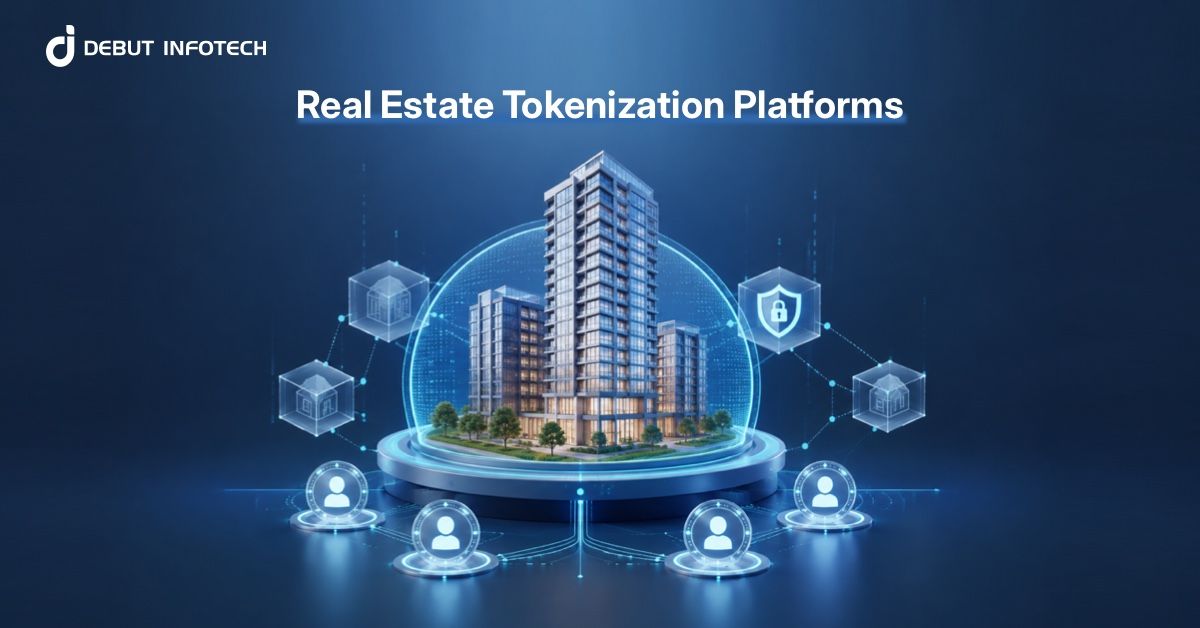


Platform selection should align with your business objective, whether investing in fractional real estate, issuing digital securities, or building a branded tokenization marketplace with compliant infrastructure.
Investor marketplaces, white-label platforms, and regulated capital-market providers serve different purposes, making use case, token rights, and jurisdiction more important than feature comparisons alone.
Compliance, investor eligibility, custody, KYC/AML, and transfer restrictions directly influence platform suitability, especially for cross-border real estate tokenization projects.
Liquidity depends on market demand and regulatory structure rather than tokenization itself, so secondary trading availability should never be treated as a guaranteed exit strategy.
Development costs and implementation timelines vary by delivery model, with existing platforms offering faster deployment, white-label solutions supporting repeat issuances, and custom development providing maximum flexibility.
Enterprise issuers should evaluate blockchain support, smart contract capabilities, integrations, and legal workflows together, since successful real estate tokenization requires both technology and regulatory execution.
Choosing the right real estate tokenization platform requires balancing compliance, scalability, investor experience, and long-term operational control rather than focusing solely on blockchain technology or investment minimums.
Choosing among the best real estate tokenization platforms requires more than comparing property listings or blockchain networks. Some platforms give eligible investors access to fractional rental or commercial assets, while others help issuers create digital securities, manage compliance, or connect assets to regulated trading infrastructure. The right option therefore depends on the user’s objective and the legal, technical, and operational model supporting the platform.
This 2026 analysis assesses existing platforms based on the rights of their tokens, types of properties and jurisdictions they are supported by, investor eligibility, the way the platform stores the tokens, fees, compliance measures, and potential exit strategies. It also separates real secondary-market access from just token transfers, which do not necessarily imply liquidity. Whether you are looking to invest in tokenized property, raise capital against a real estate portfolio or start a brand new marketplace, this analysis will assist you pinpoint the class of platform and supplier that matches your needs.
We considered platforms only when their current operating status and product information could be verified in 2026. Each option also needed to support a meaningful part of the property-token lifecycle, from issuing digital securities and onboarding investors to administering assets, providing custody or enabling permitted secondary trading.
This real estate tokenization platform comparison applies five consistent assessment areas:
Research prioritized official product pages, technical documentation, terms of service, fee schedules, offering materials and regulatory disclosures. Company-reported metrics were not treated as independent proof of quality, while unavailable pricing or liquidity information was recorded as a limitation. Because the platforms perform different functions, they are grouped by use case instead of being assigned an arbitrary numerical ranking.
The market is easier to assess when platforms are classified by the task they perform. Although some providers combine several functions, most are primarily designed for investing, issuing and administering tokens, or supporting regulated capital-market activity.
These platforms present property opportunities directly to eligible investors. Users typically create an account, complete identity verification, review offering documents and purchase tokens connected to a property or portfolio. Depending on the structure, investors may receive rental distributions, participate in selected governance decisions or list their interests for resale. Fractional real estate ownership platforms are useful for accessing individual properties with less capital, but investors must confirm the legal rights behind each token and the conditions governing transfers or withdrawals.
Property tokenization platforms within this category provide asset managers, developers and sponsors with the tools they need to launch and manage offers. These include features like token creation, smart-contract deployment, investor onboarding, KYC/AML integration, payment processing, ownership records, automated distributions and reporting dashboards. White-label products offer an underlying configuration that is branded by the issuer, while API-based systems link up tokenization functions to existing software. The technology can enforce programmed rules, but it does not replace legal structuring, valuation, disclosure or regulatory approval.
These providers support financial functions that may sit behind or alongside a tokenized property offering. Services can include broker-dealer participation, transfer-agent recordkeeping, qualified custody, primary distribution and secondary trading through authorized venues. Real estate token exchange platforms may improve access to compliant transfers, but they do not automatically create an active market. Issuers should confirm whether the provider supports their security type and jurisdiction. Investors should check eligibility, lockups, trading availability, settlement arrangements and the number of potential buyers before relying on a platform as an exit route.
The platforms below were selected for distinct, verifiable roles in property investment, token issuance, investor administration or regulated trading. Each profile explains the platform’s most suitable use case, operating model, technology, access requirements and important limitations. The order does not represent a universal ranking because an investor marketplace cannot be evaluated fairly against enterprise issuance software or regulated capital-market infrastructure.
| Platform | Primary role | Best suited for | Key consideration |
| RealT | Investor marketplace | Fractional exposure to US rental properties | Investor location and resale restrictions apply |
| Lofty | Investor marketplace | Low-entry investment in US rental properties | Marketplace demand affects successful exits |
| RedSwan | Commercial property marketplace | Accredited and international commercial-property investors | Access depends on offering eligibility |
| Honeybricks | Private-property marketplace | Tokenized commercial property opportunities | Confirm current offerings and holding periods |
| Blocksquare | White-label infrastructure | Businesses launching branded property marketplaces | Legal implementation varies by jurisdiction |
| DigiShares | Issuance and management software | Sponsors managing the complete investment lifecycle | Pricing and integrations require project assessment |
| Brickken | Configurable issuance platform | Companies digitizing property-linked equity or debt | Issuers retain significant compliance responsibility |
| Tokeny | Digital-securities infrastructure | Permissioned issuance using ERC-3643 | Primarily designed for issuers and institutions |
| tZERO | Regulated capital-markets infrastructure | US issuance, custody, and secondary trading | Available assets and eligibility may vary |
| INX One | Issuance and trading platform | Tokenized securities and asset-linked investments | Verify available property-specific opportunities |
These platforms connect eligible investors with property-linked digital interests. Some focus on residential rentals, while others provide private commercial opportunities through a tokenized real estate marketplace.

Best suited for: Investors seeking fractional exposure to income-producing US rental properties through blockchain-based tokens.
Key Highlights:
RealT offers fractional interests in income-producing US properties. Its legal structure generally places each asset within a separate series of a limited liability company. A RealToken represents an equity interest in the entity holding the property rather than replacing the property deed. Tokens commonly cost around $50, although pricing and rights depend on the individual offering.
RealT uses Ethereum-compatible infrastructure, with tokens and rental distributions available through Ethereum or Gnosis Chain wallets. Investors can also access the YAM secondary market, but wallet addresses must be registered and whitelisted for the relevant property before trading. This process preserves transfer controls but does not assure an immediate buyer. RealT’s eligibility guidance lists restricted jurisdictions and indicates limitations for US investors, so applicants should confirm current availability before registering.

Best suited for: Investors wanting low-entry fractional access to individual US rental properties and frequent income distributions.
Key Highlights:
Lofty allows investors to acquire fractional interests in US rental properties, with entry points advertised from $50. Property tokens operate on Algorand, while the platform uses smart contracts and USDC for marketplace transactions. Investors can receive rental distributions daily and participate in selected property-management decisions through the platform’s governance system.
Lofty’s marketplace uses limit orders rather than guaranteeing instant redemptions. A sell order must match available demand before the investor exits. According to Lofty’s 2026 fee information, both buyers and sellers pay a 3% marketplace fee when orders are executed. The platform may suit investors seeking smaller property-specific allocations, but every listing should be assessed independently for ownership structure, vacancy, repairs, valuation, insurance and local-market risk.

Best suited for: Accredited and international investors evaluating tokenized commercial properties and real estate funds.
Key Highlights:
RedSwan is one of the more specialized commercial real estate tokenization platforms, focusing on institutional-quality properties and private commercial funds. The platform digitizes interests such as limited-partnership shares, enabling eligible investors to participate in assets that would usually require substantially higher capital commitments.
Its investor information states that US opportunities are generally offered to accredited investors under Regulation D, while eligible international participants may access Regulation S offerings after completing KYC requirements. Property sponsors can also use the platform to present projects and raise capital. However, eligibility, minimum commitments, holding periods and transfer rights depend on the offering documents. RedSwan’s digital structure can simplify administration and distribution, but it does not remove sponsor, leverage, vacancy, valuation or secondary-market risks associated with commercial property.

Best suited for: Eligible investors seeking professionally managed US commercial real estate opportunities with digital ownership administration.
Key Highlights:
HoneyBricks operates as an intermediary technology platform for private-placement real estate offerings. Its model generally uses special-purpose vehicles or fund structures that hold interests in commercial projects. Investors receive digital securities representing ownership in the relevant vehicle rather than direct title to an apartment building or other physical asset.
US participants must ordinarily qualify as accredited investors under Regulation D, while eligible non-US investors may participate in Regulation S offerings. HoneyBricks states that investment minimums are typically around $5,000, although individual managers can require more. Its investor process includes KYC, accreditation, electronic documents, funding and portfolio monitoring. A private bulletin board may connect eligible sellers and buyers, but the platform’s terms acknowledge that a secondary market may never develop. Investors should therefore be prepared for long holding periods.
The following real estate tokenization service providers primarily help asset owners, sponsors and financial businesses create and administer tokenized offerings. They are not direct substitutes for platforms that source properties for individual investors.

Best suited for: Property businesses launching branded marketplaces with a standardized revenue-based token model.
Key Highlights:
Blocksquare provides tokenization infrastructure designed specifically for real estate operators. Its white-label system covers property structuring, token distribution, performance monitoring, revenue administration, tender offers and buybacks. Businesses can use graphical interfaces or APIs to launch a branded investment portal without engineering the entire system internally.
Blocksquare’s protocol creates an Ethereum ERC-20 PropToken contract with a maximum issuance of 100,000 tokens for each property. A signed corporate resolution is stored through IPFS and linked to the token contract, establishing the issuer’s obligations toward token holders. This makes Blocksquare particularly relevant to Ethereum real estate tokenization projects. However, its revenue-based structure does not automatically grant direct title or equity in every implementation. The issuer must still establish enforceable legal rights, comply with local securities rules and determine how investors will access transfers or exits.

Best suited for: Real estate sponsors and asset managers seeking configurable, multi-chain tokenization and investor-management software.
Key Highlights:
DigiShares offers configurable white-label software for token issuance, fundraising, investor onboarding, cap-table management, distributions, governance and internal trading. Its chain-agnostic architecture can integrate with external KYC providers, custodians, payment services and exchanges. Supported deployment options include Ethereum, Polygon and Polymesh.
The company’s DigiShares Launch product publishes a starting price of $5,000 for setup, followed by $300 per month for two projects and $200 monthly for each additional project. Larger or customized deployments require a separate assessment. DigiShares is strongest where a sponsor needs broad lifecycle administration rather than a public marketplace containing ready-made properties. Its technology overview also clarifies that custody, payment processing, identity verification and a complete regulated exchange are supplied through third-party integrations. These dependencies should be included when estimating implementation cost, responsibility and vendor risk.

Best suited for: Asset owners and investment managers that want a no-code, multi-asset issuance environment with transparent subscription pricing.
Key Highlights:
Brickken provides no-code tools for issuing and managing digital assets linked to equity, debt, funds, profit-sharing arrangements and real estate. Issuers can develop branded investor portals, automate KYC/KYB workflows, keep ownership records, control corporate action and distribute payments via a single dashboard.
The platform supports blockchains including Ethereum, BNB Smart Chain, Base and Polygon, making it relevant to businesses comparing multi-chain RWA real estate platforms. Published plans begin at €299 per month and rise according to issuance limits, functionality and enterprise requirements. Marketplace access, additional identity checks and some integrations are priced separately. Brickken can reduce the technical work required to launch an offering, but issuers still need qualified advisers to define the legal instrument, disclosures, tax treatment and marketing permissions. Its built-in compliance tools support established rules; they do not determine which rules apply.

Best suited for: Financial institutions and regulated issuers that require identity-based controls throughout a digital security’s lifecycle.
Key Highlights:
Tokeny provides institutional tokenization infrastructure built around ERC-3643 and ONCHAINID. Its T-REX Platform supports investor onboarding, token issuance, qualification rules, cap-table administration, distributions, corporate actions and controlled secondary transfers. It can therefore serve financial institutions that need a real estate security token platform with identity-based transfer restrictions.
Under this model, investor eligibility is linked to an on-chain identity rather than solely to a wallet. Only identities holding the required qualification claims can receive or transfer a particular token. This supports accreditation, jurisdiction and other restrictions while allowing wallets to function as signing tools. Tokeny is not a marketplace for discovering individual properties, and pricing is not publicly standardized. Asset owners must bring the investment structure, legal documentation and distribution strategy, while any exchange, custodian or fund administrator must be selected and integrated according to the project’s regulatory requirements.
The final platforms focus on digital capital-market functions. They may support property-backed securities, but their broader purpose includes issuing, holding or trading several classes of tokenized assets.

Best suited for: US issuers and eligible investors requiring regulated infrastructure for digital security issuance, custody, and secondary trading.
Key Highlights:
tZERO provides tokenization, brokerage, custody, transfer-agent and secondary-trading capabilities through its regulated entities. Its ecosystem includes an SEC-registered broker-dealer, a FINRA-member alternative trading system and digital-asset custody infrastructure. This makes it relevant to US issuers seeking a structured route from capital formation to potential secondary trading.
The platform is not a broad residential-property marketplace. Real estate participation usually arises through specific issuers or partners, such as the RSRV hotel-ownership project. Eligibility, custody, trading availability and transfer restrictions therefore depend on the security. tZERO’s regulated infrastructure may reduce some operational and market-structure uncertainty, but it cannot ensure that a particular token will attract sufficient trading volume. Issuers should examine listing requirements and costs, while investors should review the underlying security and order-book activity.

Best suited for: Companies seeking regulated token issuance and eligible investors wanting access to multiple digital-asset categories.
Key Highlights:
INX One, now part of Republic, combines digital-security issuance and trading with access to cryptocurrencies and tokenized real-world assets. Securities are offered through INX Securities, an SEC-registered broker-dealer and alternative trading system that is also a FINRA and SIPC member. The wider platform supports funding through fiat currency, cryptocurrencies or stablecoins, subject to availability.
For issuers, INX provides token-offering support and the possibility of listing eligible securities on its regulated trading platform. For investors, it presents multiple asset classes, including real estate, hospitality, funds and equity. However, the presence of real estate as a supported category does not mean property-specific securities will always be available. Eligibility and trading access vary by asset and jurisdiction. INX’s own disclosures emphasize that security tokens can remain illiquid and may result in substantial or complete loss, making offering-level due diligence essential.
The decision is not just about cheaper and more sophisticated technology. It is a make-or-buy decision influenced by the urgency of the launch, the amount of issuance, the level of control needed, in-house expertise, and commercial objectives for the long term. In order to decide, it is important to know whether the business needs to tokenize an asset, run a branded investment channel or incorporate tokenization as a core service.
An established platform works well when a sponsor wants to issue tokens for one property, test investor demand, or enter the market without managing the underlying software. Existing Property tokenization platforms may already provide investor verification, subscriptions, token issuance, distributions, reporting, and transfer administration.
The limitations are strategic rather than purely technical. Sponsors may have little control over branding, fees, accepted investors, token structures, supported jurisdictions, or future product changes. Vendor due diligence should therefore cover asset migration, investor-data ownership, smart-contract control, service continuity, and termination rights.
White-label infrastructure suits developers, fund managers, and asset operators that expect to launch multiple offerings. It provides reusable technology under the issuer’s brand while avoiding the time required to engineer every module independently.
The main risk is assuming that branding equals ownership. Buyers should verify whether they can configure onboarding, connect external custody or payment providers, integrate internal systems, access APIs, export data, and move to another vendor. They should also separate technology functionality from regulated services such as brokerage, custody, legal structuring, and investment advice.
Custom development is appropriate when existing products cannot support the required ownership structure, cross-border workflow, institutional integration, or investor experience. A qualified real estate tokenization development company can design the architecture around the business rather than forcing the business into a fixed product.
With increased control comes increased responsibility. The total real estate tokenization platform development cost includes business analysis, user experience, smart contracts, third-party integrations, security audits, legal review, infrastructure, maintenance, monitoring, and support. The operator should also be responsible for managing cybersecurity, upgrade, compliance changes, and recovery processes post-launch.
A one-off issuance usually favors an existing platform. Repeat issuers that value brand control should consider white labels. Custom development is justified when proprietary technology creates measurable value that configuration and integrations cannot deliver.
For a defined or one-time offering, an existing platform may provide the fastest route to market. Businesses planning repeat issuances with a consistent brand experience may benefit more from white-label infrastructure. Custom development is justified when proprietary workflows, integrations, or platform features create measurable value that standard solutions cannot provide.
The decision does not need to be made in isolation. As a technology delivery partner, Debut Infotech helps businesses evaluate these models and select from curated tokenization solutions aligned with their operational, regulatory, and commercial requirements. Whether the preferred route involves platform integration, white-label deployment, or custom development, the objective is to launch an infrastructure that works today and can evolve with the business.
The answer depends on the intended use. RealT and Lofty focus on fractional rental-property investing, while RedSwan and HoneyBricks serve commercial real estate investors. Blocksquare, DigiShares, Brickken, and Tokeny provide issuer infrastructure. tZERO and INX One support regulated digital securities issuance or trading. Compare eligibility, token-holder rights, fees, custody, compliance, and actual exit options before choosing.
A property or portfolio is typically placed within a legal entity, fund, or contractual structure. Digital tokens then represent defined equity, debt, fund, or revenue rights. The platform may handle investor verification, document signing, payments, token issuance, distributions, reporting, and approved transfers. The legal agreements establish ownership rights, while the blockchain records and helps administer token transactions.
Real World Asset (RWA) tokenization is the broader process of representing rights connected to physical or traditional financial assets on a blockchain. These assets may include property, commodities, private credit, bonds, art, or infrastructure. Real estate tokenization is one RWA category focused specifically on ownership, debt, fund interests, or revenue rights connected to property assets.
Tokenization can make property interests easier to divide and transfer through approved digital systems. Smaller investment units may expand the potential buyer pool, while programmable settlement can reduce transfer administration. However, these improvements create liquidity potential, not guaranteed liquidity. Lockups, eligibility restrictions, limited market participation, property performance, and insufficient buyer demand can still prevent an investor from selling quickly.
It can be compliant when properly structured, offered, and administered. In the US, the SEC explains that representing a security on-chain does not remove federal securities-law requirements. European issuers must determine whether the token qualifies as a financial instrument under ESMA’s classification guidelines, alongside national property, tax, AML, and investor-protection rules.

Our Latest Insights
USA
2501 Chatham, Rd Suite R Springfield, IL 62704
+1-708-515-4004
info@debutinfotech.com
UK
7 Pound Close, Yarnton, Oxfordshire, OX51QG
+44-770-304-0079
info@debutinfotech.com
Canada
154 Eden Oak Trail, Kitchener, ON N2A 0H9
+1-708-515-4004
info@debutinfotech.com
INDIA
Sector 101-A, Plot No: I-42, IT City Rd, JLPL Industrial Area, Mohali, PB 140306
9888402396
info@debutinfotech.com