ON THIS PAGE
Progress0%






Our Global Presence :



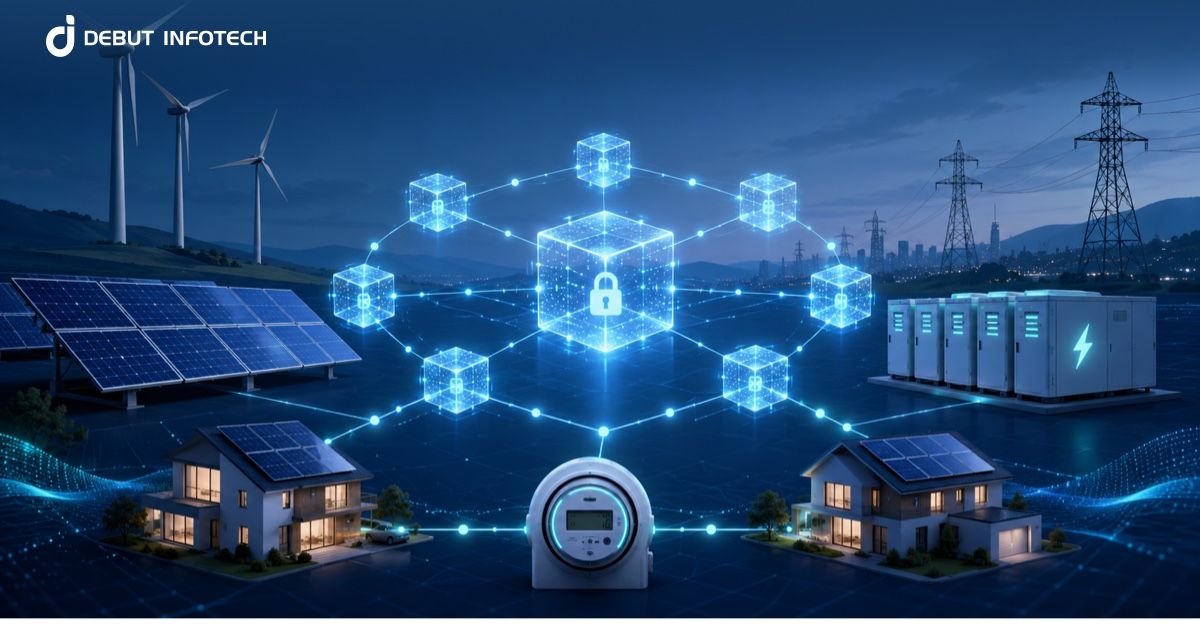


Blockchain is most valuable for multi-party energy workflows where independent organizations need a shared, tamper-resistant record for transactions, ownership, settlement, or reconciliation.
Smart contracts can automate energy settlements and business rules across peer-to-peer trading, microgrids, renewable energy certificates, distributed energy resources, and EV charging.
Blockchain does not replace physical grid infrastructure or validate meter data by itself; reliable smart meters, IoT systems, APIs, data oracles, and off-chain validation remain essential.
Permissioned and hybrid architectures often fit enterprise energy use cases because sensitive personal and operational data can remain off-chain while transaction proofs, permissions, and ownership records are shared.
Regulation, privacy, interoperability, governance, scalability, and cybersecurity are major adoption risks and must be addressed before encoding energy-market rules into smart contracts.
Blockchain energy platform development cost depends on scope and integration complexity, including smart-meter connectivity, legacy billing systems, smart contracts, security testing, compliance, infrastructure, and ongoing governance.
A focused pilot should precede large-scale deployment with measurable outcomes such as reduced reconciliation errors, faster settlement, or improved traceability, and blockchain should be selected only when it outperforms a simpler centralized architecture.
Blockchain in the energy sector provides a secure and transparent way for utilities, renewable energy producers, consumers, grid operators, and traders to share and verify energy transactions without relying on a single intermediary. By using decentralized ledgers and smart contracts, it automates settlements, improves data accuracy, reduces reconciliation efforts, and builds trust among participants.
As energy systems become more decentralized with smart grids, renewable energy, battery storage, and electric vehicles, blockchain supports applications such as peer-to-peer energy trading, renewable energy certificate tracking, microgrid settlements, distributed asset coordination, and carbon reporting. These capabilities help improve operational efficiency, traceability, and regulatory compliance across the energy value chain.
However, blockchain is not the right solution for every scenario. Its greatest value lies in environments where multiple independent organizations need a shared, tamper-resistant record of transactions. Factors such as regulations, privacy requirements, integration complexity, transaction speed, and implementation costs should all be evaluated before adoption. This guide explores the benefits, use cases, challenges, and implementation considerations of blockchain in the energy industry.
Blockchain in the energy sector is a shared digital record that helps verify transactions based on the same trusted data for utilities, energy producers, consumers, grid operators, and traders. Instead of keeping individual records in isolated systems, the authorized participants keep a synchronized ledger, where the transactions are time-stamped and can be hard to change if the network does not agree to the alteration.
Smart contracts extend this capability by automatically applying predefined rules. For example, a contract may calculate payment when a household supplies excess solar power to a local network or record the transfer of a renewable energy certificate after specified conditions are verified. This makes blockchain technology in energy useful for transactions that involve several organizations and require consistent records, transparent ownership, or automated settlement.
The blockchain does not measure electricity or confirm physical events independently. Smart meters, sensors, APIs, and external validation systems provide the operational data used by the ledger. For this reason, reliable blockchain integration with smart meters and secure data validation are critical.
Permissioned blockchains are used in most enterprise energy projects to limit participation and control access to sensitive information. Transaction proofs and ownership records can be kept on-chain, and personal information, operational grid data and high-volume meter readings are typically kept in protected off-chain systems.
Energy systems are increasingly distributed, as households, businesses, battery operators and renewable energy producers generate, store and sell electricity. This shift creates more transactions between participants that often use separate databases, settlement processes, and ownership records. Blockchain technology in energy can provide a shared transaction layer that helps authorized organizations coordinate activity without relying on one participant to maintain the only version of the record.
The growth of distributed energy resources is another important driver. Rooftop solar panels, battery systems, electric vehicles and flexible loads could enter into local markets but their activity should be measured, validated, priced and settled. Blockchain can connect verified data with smart contracts that apply market rules automatically. This capability is useful for models such as peer-to-peer energy trading, certificate transfers, and microgrid energy trading, as long as the regulations permit the proposed transactions.
Energy companies are also interested in the use of blockchain for the improvement of reconciliation and traceability. By leveraging a shared ledger, utilities, traders, aggregators and grid operators can compare transactions based on a single-approved record, minimizing disputes due to data mismatches. It can also enhance the tracking of renewable energy certificates, including issuance, ownership transfers and retirement events.
But the use of blockchain is most beneficial when multiple independent parties require a shared, transparent system. If only one trusted organization is responsible for the workflow, then a traditional database application can provide the same result for a lower cost, complexity and governance burden.
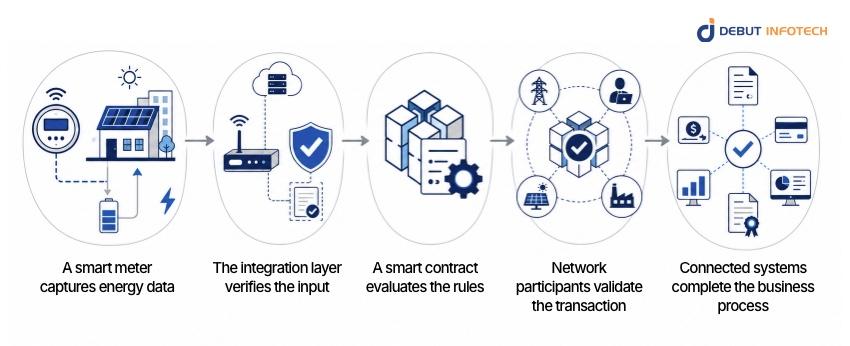
A blockchain-based energy system connects smart meters, distributed assets, market rules, and existing business platforms through a shared transaction network. The blockchain has no effect on the physical flow of electricity. Rather, it logs the verified events, like energy generation, consumption, transfer of ownership, and settlement instructions, allowing authorized participants to work based on the approved data.
A typical transaction follows five stages:
A meter or connected sensor measures the electricity generated, stored, or consumed by a solar installation, battery, household, or commercial asset. Accurate blockchain integration with smart meters is critical because incorrect source data can still produce an incorrect blockchain record.
IoT gateways, APIs, or data oracles authenticate the device, check the reading, and convert it into a format the network can process. This layer may also confirm participant identities, market permissions, and asset ownership.
The smart contract applies predefined conditions covering energy volume, pricing, participant eligibility, grid charges, or certificate ownership. Once the required conditions are met, it can approve a trade, calculate settlement, or initiate another authorized action.
Approved nodes confirm the transaction according to the network’s governance and consensus rules. The validated event is then added to the ledger, creating a shared record for utilities, traders, producers, and market operators.
The recorded event may trigger billing, payment, reporting, certificate issuance, or an update within a blockchain-based energy trading platform.
Energy platforms should not store every meter reading or personal record on-chain. Transaction proofs, asset identifiers, and ownership changes may be recorded on the ledger, while sensitive information and high-volume operational data remain in protected off-chain databases.
Permissioned networks are common in most enterprise blockchain-powered smart grids since access to data and participation can be controlled. Broad participation can be enabled via public networks, however privacy, compliance, governance, performance and transaction cost concerns may arise. The choice of model is determined by regulatory requirements, relationships with participants, data sensitivity and the actual need for decentralization in the project.
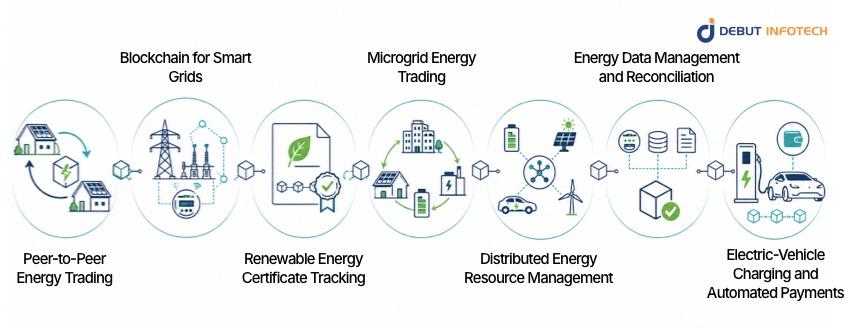
The most useful blockchain use cases in the energy sector involve coordination, settlement, ownership and data-sharing issues between multiple independent participants. The technology is not a substitute for the electricity networks, control-room systems or physical infrastructure. Instead, it can offer a common transaction layer that will link verified energy data to market regulations and payments, certificates and asset records.
Peer-to-peer (P2P) energy trading allows households, businesses, and other consumers to sell surplus electricity generated from solar panels or battery storage directly to nearby consumers instead of relying solely on traditional utility buyback programs. Smart meters measure electricity generation and consumption, while blockchain-based platforms use smart contracts to automatically match buyers and sellers, calculate prices, and execute settlements with a transparent audit trail.
The concept is already gaining traction in regulated energy markets. In 2026, the Delhi Electricity Regulatory Commission (DERC) approved a blockchain-enabled P2P energy trading pilot covering around 2,000 consumers across North and South Delhi. The initiative allows rooftop solar owners to negotiate electricity prices directly with buyers through a blockchain-powered platform while settlements are reflected in participants’ monthly electricity bills.
Despite its potential, blockchain does not replace the physical electricity grid or existing market regulations. Network charges, taxes, balancing responsibilities, and consumer protection rules still apply. Blockchain delivers the greatest value where multiple independent participants need a shared, tamper-resistant record of transactions without relying on a single intermediary. In markets with an efficient centralized settlement system, its additional benefits may be more limited.
A smart grid integrates electricity systems with digital meters, sensors, communication systems, storage systems and automated control systems. Blockchain for smart grids can support the coordination of transactions and permissions across these connected assets.
For example, a blockchain network may record which organizations can access meter data, confirm the identity of a battery participating in a flexibility program, or document transactions between a grid operator and an energy aggregator. Smart contracts may also apply predefined settlement rules after an asset delivers an approved service.
However, a smart grid blockchain should not be treated as the grid’s real-time operational control system. Grid balancing, protection, and equipment response often require specialized systems capable of processing data with extremely low latency. Blockchain is generally better suited to transaction validation, asset registration, audit records, and settlement than immediate physical control.
Organizations use renewable energy certificates and similar instruments to represent the environmental attributes associated with renewable electricity generation. These records may pass between generators, traders, suppliers, and corporate buyers before they are retired.
Blockchain for renewable energy can provide a shared history of certificate issuance, ownership transfers, and retirement. This may help authorized participants identify duplicated records, confirm current ownership, and trace how an environmental claim moved through the market. Smart contracts can also prevent a recorded certificate from being transferred again after retirement.
Blockchain does not prove that renewable electricity was generated. That evidence must come from approved meters, registries, auditors, or market authorities. If incorrect generation data enters the system, the ledger may preserve the incorrect record. A credible platform therefore requires trusted data sources, clear certificate standards, and governance procedures for correcting disputed information.
A microgrid is a localized energy system that can include solar panels, batteries, generators, buildings, and controllable loads. It can be linked to the main grid or used independently under certain circumstances.
Microgrid energy trading allows participants in a given geographic area (such as a university, industrial facility, residential neighborhood, or rural area) to trade locally produced electricity. Smart meters measure each participant’s production and consumption, while smart contracts apply the agreed pricing, eligibility, and settlement rules.
Blockchain can provide a common transaction record when several property owners, businesses, or asset operators participate in the same local market. It may also support battery charging decisions, local energy credits, and settlement between shared infrastructure users.
The commercial model must still account for grid access, system losses, backup supply, maintenance costs, and regulatory permissions. Blockchain supports the transaction process; it does not remove the need to manage the physical and financial responsibilities of the microgrid.
Distributed energy resources comprise rooftop solar systems, batteries, electric vehicles, small generators, and electricity loads that are flexible through the network. As the number of these assets increases, utilities and aggregators need reliable methods to identify them, verify their capabilities, and record their participation in energy programs.
Blockchain may serve as an asset registry that links each resource to an approved owner, a technical profile, and a participation status. Smart contracts can then apply program rules when an asset provides energy, stores electricity, or changes consumption in response to a market signal.
Within decentralized energy systems, this shared record can help utilities, aggregators, asset owners, and settlement providers coordinate without maintaining conflicting asset lists. Blockchain may also support payments for flexibility or demand-response services after validated systems confirm delivery.
The platform must protect commercially sensitive and personal data. Detailed operational information will often remain off-chain, while the ledger stores transaction proofs, permissions, and approved asset identifiers.
Energy transactions typically flow across multiple systems run by utilities, traders, energy aggregators, retailers, meter vendors, and market authorities. These discrepancies may lead to reconciliation issues, settlement delays, and disagreements.
Blockchain can support energy data management by giving authorized organizations access to the same approved transaction history. Instead of sending separate copies of a record between participants, each party can verify the event against the shared ledger. Smart contracts may also flag missing information, reject unauthorized submissions, or apply an agreed settlement process.
This model is most relevant when no single organization should control the complete record, and all participants need an auditable history. It is less compelling when one market operator already maintains a reliable central settlement system.
A blockchain platform should also be compatible with current billing, metering, customer management, and reporting processes. If there is no accurate integration and common data standards, the ledger can become another separately operated platform, which is not going to solve the reconciliation issue.
Electric vehicle (EV) charging is a process that includes drivers, charging-station operators, electricity suppliers, roaming providers, fleet managers, and payment processors. These organizations may need to confirm charger identity, customer permissions, energy consumption, tariffs, and settlement obligations.
A blockchain-based energy trading platform can record charging events and apply smart-contract rules to divide payments between approved participants. It may also support automated settlement when a driver uses a charger operated by a provider outside their normal network. For fleet operators, a shared record could improve the traceability of charging costs across vehicles and locations.
Future vehicle-to-grid models may allow electric vehicles to supply stored electricity or flexibility services back to the network. These transactions could be recorded on a blockchain, and the compensation could be distributed once the service is verified.
For adoption to take place, it requires interoperability in the vehicle, chargers, payment systems, and energy-market platforms. If a roaming and settlement network already exists and works well, blockchain needs to offer a tangible benefit and not just an additional layer of tech.
The benefits of blockchain in the energy sector depend on how well the technology addresses a specific coordination or trust problem. Its value comes from combining shared records, controlled data access, and programmable rules, not from replacing every existing energy platform.
Blockchain gives authorized utilities, generators, traders, and market operators access to the same approved transaction history. Because participants can verify when a record was created, transferred, or settled, the system can reduce uncertainty caused by conflicting databases. This transparency is especially useful in blockchain in energy markets, where several organizations may need to confirm the status of the same transaction.
Smart contracts can apply predefined pricing, eligibility, and settlement conditions after validated data enters the network. This automation may reduce manual processing in blockchain energy trading, microgrid transactions, flexibility programs, and certificate transfers. The operational advantage is not to eliminate all the intermediaries but to have fewer repetitive checks when the rules have been previously agreed upon by participants.
Records are frequently compared with one another in different systems by utilities, retailers, aggregators, and traders before settlement is finalized. A shared ledger provides one approved reference point, which can reduce mismatches and make disputed transactions easier to investigate. The resulting efficiency depends on accurate integrations, common data standards, and clear procedures for correcting errors.
Blockchain can record the ownership and transfer history of energy assets, local energy credits, and renewable energy certificates. Participants can figure out who created a record, who owns that record, and if the record has been retired. This supports stronger auditability, although trusted meters and authorized registries are still required to verify the original event.
Smaller generators, prosumers, batteries, and flexible loads may participate more easily when market permissions and settlement rules are programmable. This capability can support peer-to-peer energy trading and other decentralized energy markets by connecting verified activity with automated transaction processes.
A shared registry can help organizations identify, authorize, and track distributed energy resources across multiple programs. Utilities and aggregators can verify asset participation without maintaining conflicting records, while smart contracts can calculate payments after service delivery is confirmed.
These benefits are achievable only when blockchain solves a genuine multi-party problem. The operational benefits may be outweighed by poor data quality, inappropriate governance, or needless decentralization.
Energy blockchain projects involve more than selecting a distributed ledger and writing smart contracts. They need to function in electricity markets where regulations exist, interact with physical infrastructure, safeguard sensitive data and coordinate organizations with varying commercial interests. When there is no clear governance model, or proven business need, the challenges may exceed the benefits expected of the project.
Electricity trading, billing, grid access, issuance of electricity certificates and protection of consumers are subject to jurisdiction-specific rules. A proposed blockchain energy trading platform could technically work, but legally be limited because users are unable to trade directly or settlement must be made through licensed trading retailers and market operators. Before the market rules are encoded into smart contracts, the project teams need to verify the roles of the participants, grid charges, taxation, reporting obligations, and how data will be stored.
Blockchain preserves submitted records, but it cannot determine whether a physical event occurred accurately. Smart meters, sensors, APIs, and data oracles remain responsible for reporting generation, consumption, and asset performance. Weak blockchain integration with smart meters may allow faulty devices, manipulated readings, or incorrect asset identities to create misleading records. Authentication of the devices, validation controls, anomaly detection and formal correction procedures are therefore imperative.
Energy readings can provide an insight into the household’s routines, production schedules, asset usage, and commercially sensitive trading activity. This data can pose privacy and compliance issues if it’s recorded directly on-chain. A proper architecture typically stores the operational and personal details in more secure off-chain systems and leaves the proof of transactions, permissions, or references on the ledger.
Energy systems may generate large volumes of device data and require rapid operational responses. A smart grid blockchain may support asset registration, transaction validation, and settlement, but it is generally unsuitable for immediate grid protection or real-time equipment control. Architects must separate latency-sensitive operations from processes that benefit from shared verification.
Smart-contract errors can automate incorrect prices, payments, permissions, or certificate transfers across multiple transactions. Other components that add to the attack surface include nodes, private keys, wallets, APIs, and administrative accounts. Contract audits, penetration testing, role-based access controls, key-management procedures, monitoring and an incident-response plan are all essential components in securing development.
The participants need to agree on who is allowed to participate in the network, validate transactions, update contracts, approve software changes, and fix mistakes. Immutability does not remove disputes. If the governance and amendment process are not clearly defined, conflicts between utilities, traders, technology providers and regulators may cause delays to operations.
Connecting blockchain with metering, billing, identity, payment, and reporting systems can significantly increase blockchain energy platform development cost. Ongoing node operation, security updates, compliance reviews, and network governance also require resources. Even a well-designed platform creates little value without adoption from the organizations needed to complete the transaction process.
These risks do not rule out blockchain technology in energy. They show why implementation should begin with regulatory validation, a limited pilot, measurable success criteria, and evidence that blockchain performs better than a conventional centralized platform.
An energy company should use blockchain when multiple independent participants need to verify transactions, share records, or automate agreed rules without allowing one organization to control the entire system. The decision should be based on a measurable business problem rather than an assumption that decentralization is always beneficial.
A practical suitability assessment should examine the following conditions:
These characteristics may justify blockchain technology in energy for peer-to-peer energy trading, microgrid settlement, flexibility program, certificate management, and coordination across decentralized energy systems.
But, when there is already one trusted organization doing it efficiently, blockchain is not the right solution. A centralized database may be more effective if the project consists of a limited number of participants, needs rapid processing, or offers information that cannot be distributed across a network. It can also be cost-effective when the costs of blockchain governance, security, integration and infrastructure outweigh the benefits.
Prior to the development process, the company should evaluate and benchmark both architectures based on the participant trust, data ownership, transaction volume, privacy, performance, regulatory compliance, integration effort and expected return. Blockchain should be used only if there is an operational benefit over a simpler, centralized platform.
The blockchain energy platform development cost depends on the platform’s scope, architecture, integrations, security requirements, and regulatory obligations. A limited proof of concept for one transaction workflow requires far fewer resources than a production network connecting utilities, smart meters, traders, payment providers, and market authorities. For this reason, a credible estimate should follow technical discovery rather than a generic price range.
Cost increases with the number of workflows the platform must support. A system that keeps track of renewable energy certificates is simpler than a system that involves peer-to-peer energy trading, asset registration, automated settlement, billing and regulatory reporting. Approvals, user roles, dashboards, dispute handling and administration controls all have an impact on development effort.
The selected network model influences infrastructure and engineering requirements. Permissioned blockchains often require participant identity management, access controls, node governance, and rules for admitting or removing members. Public networks may introduce transaction fees, privacy limitations, and different performance considerations. Custom consensus or token mechanisms add further complexity and should be included only when the business model genuinely requires them.
Integration is often a major cost driver. Blockchain integration with smart meters may require device authentication, data validation, secure APIs, and middleware that converts readings into usable transaction events. Integration with billing, customer management, payment, trading, and reporting platforms may need extra development, especially if the legacy systems don’t offer standard interfaces.
Prices, permissions, ownership, and settlement are governed by smart contracts, which also must be designed, tested, and independently reviewed. Security activities could involve contract audits, penetration testing, private key management, monitoring, backup, and incident-response controls. Documentation and compliance efforts can also be heightened by privacy, energy-market, consumer-protection, and data-retention requirements.
Expected user numbers, transaction volume, settlement speed, node count, and data-retention rules affect platform design. High-volume meter readings are usually stored off-chain, while proofs or references remain on-chain. Building this hybrid architecture adds databases, integration services, and access controls.
Organizations should also budget for cloud infrastructure, node operation, software upgrades, governance, user support, and compliance reviews after launch. The most reliable estimate therefore covers the complete platform lifecycle, not only initial development, and connects each cost component to a defined business requirement.
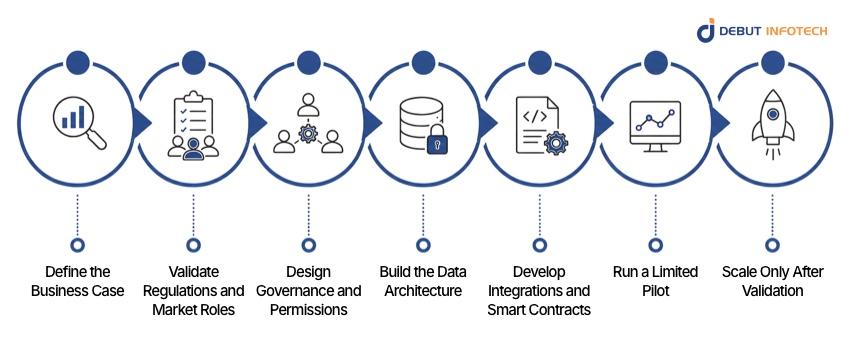
Implementing blockchain technology in energy requires coordinated business, regulatory, data, and technical planning. The objective is not simply to launch a distributed ledger. It is to improve a specific multi-party process while preserving the reliability, privacy, and performance of existing energy systems.
Start by identifying the operational problem, affected participants, and expected outcome. Problems that can be solved with this include repetitive transaction reconciliation, disjointed asset records, slow certificate transfers, and restricted settlement visibility. Set measurable objectives like a reduced number of data mismatches, quicker settlement periods, or higher ownership traceability. The project should continue only when blockchain offers a clear advantage over a centralized platform.
Outline the roles of the utilities, generators, consumers, aggregators, traders, meter providers and regulators. Ensure that the proposed workflow is in line with licensing, grid-access, billing, taxation, privacy, consumer-protection and reporting regulations. This validation must occur before developers convert commercial rules into smart contracts.
Decide who can join the network, submit data, validate transactions, update contracts, and resolve disputes. Permissioned networks are often more suitable for regulated energy projects because participant identity and data access can be controlled. Governance agreements should also define software upgrades, operating costs, incident handling, and participant removal.
Distinguish information that needs shared verification from information that is to be kept private. Ownership records, transaction proof and permissions can be kept on-chain; personal information and high volume meter readings are kept in protected off-chain databases. To ensure reliable blockchain integration with smart meters, it is essential to have authenticated devices, standardized data formats, validation mechanisms, and protocols for handling erroneous readings.
Connect the blockchain network with metering, billing, identity, payment, trading, and reporting systems. Smart contracts should implement approved pricing, eligibility, ownership, and settlement rules. Testing must cover normal transactions, exceptions, contract updates, incorrect data, and disputes. Independent security reviews should assess smart contracts, APIs, private keys, nodes, and administrative access.
Test one use case on a controlled group of participants with realistic data of transactions. Assess the technical performance, data quality, user adoption, regulatory compliance and operational value. A pilot can be centered on peer-to-peer energy trading, certificate tracking, or microgrid energy trading, and not necessarily initiate more broad business changes.
Expand the platform only when the pilot meets its success criteria and participants accept the governance model. A trusted blockchain development company can support feasibility assessment, architecture design, integration, security testing, and the transition from pilot to production.
The future of blockchain in the energy sector will rely on the ability of projects to achieve tangible benefits in settlement, traceability and coordination. Adoption is expected to continue to be targeted at a narrow range of multi-party workflows, and not on a wholesale replacement of current grid infrastructure.
Key developments may include:
Blockchain is therefore unlikely to control the physical grid. Its more realistic future is as a shared transaction, permission, and audit layer within carefully governed decentralized energy systems.
Any effective energy blockchain platform starts with a well defined coordination, settlement or traceability issue. Prior to development, consider blockchain as opposed to a centralized architecture and ensure measurable outcomes are identified such as reduced reconciliation errors, quicker settlement, or improved clarity on asset ownership. The roles of participants, regulatory considerations, data quality, privacy, governance, integrations, and future operating costs should also be considered in the business case.
Start with a focused pilot that tests a valuable workflow with realistic data and well-defined measures of success. Scale only when the platform demonstrates operational value and participants accept its governance model.
A trusted blockchain application development company can assess suitability, design secure blockchain technology in energy, integrate existing systems, and move a validated concept toward production without adding unnecessary technical complexity.
Blockchain in the energy sector is a shared digital ledger that allows authorized participants to record and verify energy transactions using the same approved data. It can support trading, certificate tracking, asset registration, and settlement, but it does not control electricity flows or independently verify physical meter readings.
Blockchain is used when utilities, generators, consumers, traders, and market operators need a common transaction record without giving one participant complete control. The use of blockchain technology in the energy industry can improve traceability, automate agreed rules, and reduce reconciliation across separate systems.
Common blockchain applications in energy include peer-to-peer energy trading, microgrid energy trading, renewable energy certificates, electric-vehicle charging settlement, distributed asset registration, and shared energy data management. Each use case still depends on reliable source data, suitable regulations, and integration with existing energy platforms.
Yes, blockchain for renewable energy can improve the traceability of generation records, certificate ownership, transfers, and retirement. It may also support settlement between renewable generators and buyers. However, approved meters, registries, and auditors must verify the original generation data before it is recorded.
Blockchain for smart grids is suitable for asset registration, permissions, transaction verification, and settlement between multiple participants. A smart grid blockchain is generally not appropriate for real-time grid protection or equipment control, which require specialized systems with very low latency.

Our Latest Insights
USA
2501 Chatham, Rd Suite R Springfield, IL 62704
+1-708-515-4004
info@debutinfotech.com
UK
7 Pound Close, Yarnton, Oxfordshire, OX51QG
+44-770-304-0079
info@debutinfotech.com
Canada
154 Eden Oak Trail, Kitchener, ON N2A 0H9
+1-708-515-4004
info@debutinfotech.com
INDIA
Sector 101-A, Plot No: I-42, IT City Rd, JLPL Industrial Area, Mohali, PB 140306
9888402396
info@debutinfotech.com