ON THIS PAGE
Progress0%




Our Global Presence :



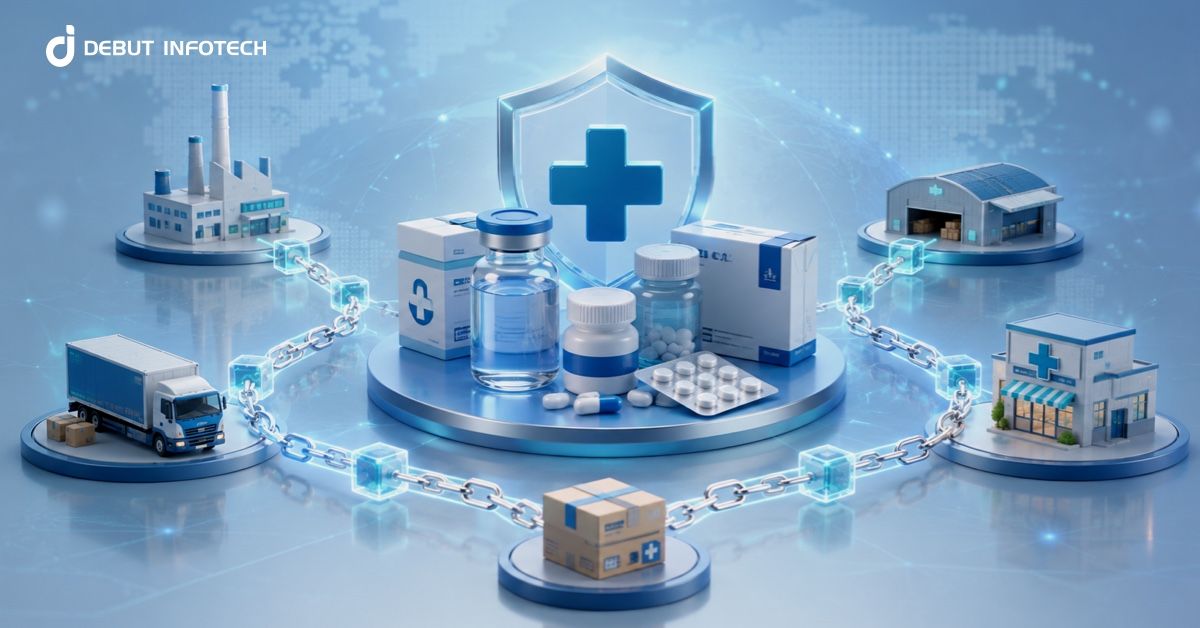


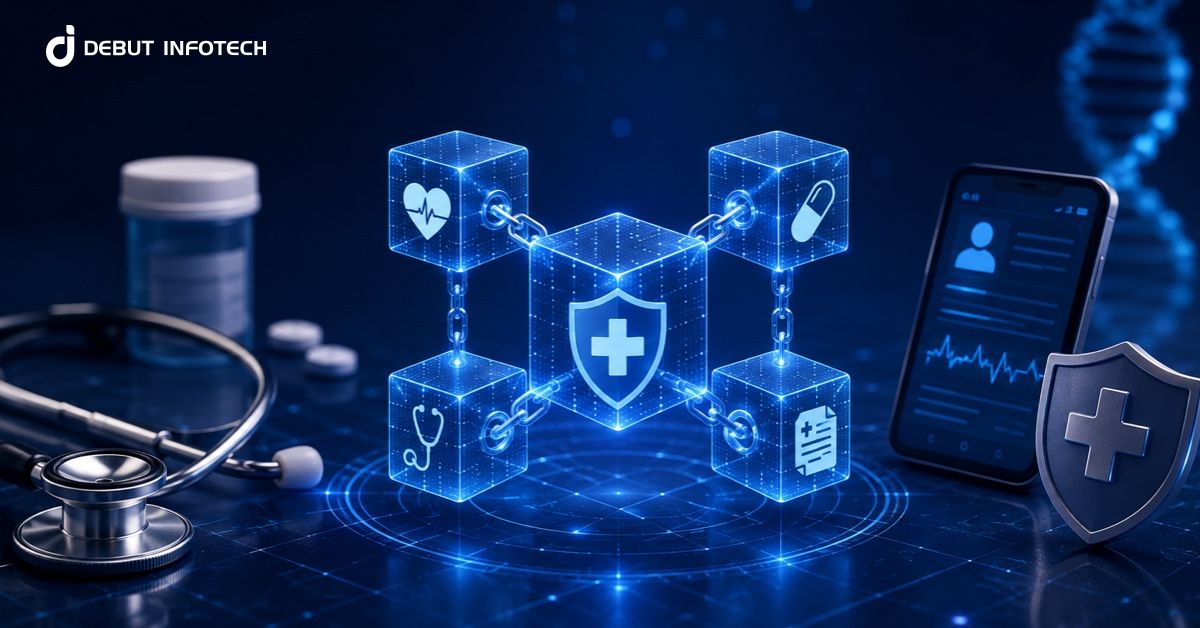
Blockchain creates a shared, tamper-resistant audit trail that improves traceability across manufacturers, distributors, logistics providers, hospitals, and pharmacies while supporting faster compliance reviews and recalls.
Package-level verification strengthens pharmaceutical traceability by combining serialization, QR/barcode scanning, and chain-of-custody records to help detect counterfeit, expired, or unauthorized products.
IoT and blockchain work best together for cold-chain logistics, enabling trusted monitoring of temperature-sensitive vaccines, biologics, and diagnostics while providing verifiable shipment histories.
Smart contracts automate supply chain workflows such as supplier validation, delivery confirmation, invoice approvals, recall notifications, and compliance checks, reducing manual intervention and operational delays.
Successful implementations require integration with ERP, WMS, EHR, and IoT systems, making interoperability, data governance, and role-based access control critical design considerations.
Medical supply chain platforms vary significantly in cost and scope, with blockchain traceability MVPs starting around $45,000–$90,000 and enterprise-grade ecosystems ranging from $180,000–$400,000+ depending on integrations and stakeholder complexity.
Adoption challenges extend beyond technology, as stakeholder participation, data standardization, privacy controls, scalability, governance frameworks, and reliable IoT data determine long-term business value and project success.
The use of blockchain in medical supply chain operations can enhance tracking, verification, and documentation of medical products throughout the entire supply chain. It establishes one shared, tamper-proof record from manufacturer to distributor, logistics partner, hospital, pharmacy, or care provider to help teams prevent a lack of accuracy or timeliness in a supply chain where both are essential.
Medical supply chains are particularly vulnerable as several stakeholders are involved in handling drugs, vaccines, diagnostic kits, medical devices, and other essentials of the hospitals until they reach the end users. Each transfer is a new opportunity for records to be incomplete, stock to be misreported, temperature to be uncontrolled, or counterfeit product to get in the system.
An example of this is cold chain vaccine distribution. Blockchain can keep track of batch information, shipment updates, IoT temperature readings, changes of custody and delivery confirmation on one single trusted ledger. This will make it easier for the authorised teams to verify the integrity of the products and to act accordingly in case of a recall or compliance problem.
This article discusses how blockchain can enable transparency, product verification, smart contracts, IoT logistics, important software capabilities, cost considerations, implementation hurdles, and pertinent case studies.
Medical supply chains are founded on trust, but this trust is hard to sustain when each organization operates from a different system. One drug, vaccine, diagnostic test or medical device can travel from the manufacturer to wholesalers, distributors and logistics partners, pharmacies, hospitals, clinics, regulators and finally, patients. Teams must be provided with evidence of the product’s authenticity, safe storage and handling, and correct documentation at each handoff.
The challenge is this evidence is often in disjointed pieces. Product information can be stored in an ERP system, inventory data in a warehouse management system, shipment information in a logistics portal, purchase data in procurement system, temperature data in an IoT system, and compliance data in a separate file. Each system can have its own purpose, but when combined they rarely give a single assured perspective of the product journey.
This is an actual gap that poses operational and patient safety challenges. The World Health Organization reports that at least 1 in 10 medicines in low- and middle-income countries are substandard or falsified, while an estimated US$30.5 billion is spent on such products every year. For healthcare providers, non-traceability can result in loss of money, delayed treatment, regulatory risk and a lack of confidence in suppliers.
Digital trust is even more critical when it comes to cold-chain products. Vaccines, Biologics, Insulin and diagnostic materials require strict temperature control. When a shipment is received with missing temperature data, the quality team may have to wait before releasing the product while trying to manually verify that the product was not exposed to conditions outside the approved limits.
Medical devices also need to be traceable. Hospitals and distributors should check the authenticity, warranty status, service and recall exposure. With those records spread apart, audits take longer and recalls are more difficult to handle.
This is why it’s no longer about efficiency in healthcare supply chain management, it’s about transparency. It now becomes a compliance, risk management and patient-safety priority. Blockchain can be helpful in this respect because it allows multiple supply-chain participants to have a common, tamper-proof history of product movement, handling and verification without requiring all parties to be part of a single system.
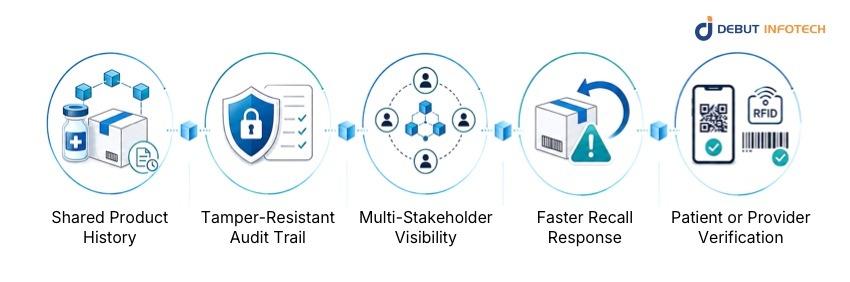
Blockchain has the potential to enhance transparency in the medical supply chain by providing a traceable and shared history of product movement, allowing trusted stakeholders to access it. From the most operational list of blockchain applications in the healthcare industry, supply chain traceability is right up there because it supports manufacturers, distributors, logistics providers, hospitals, pharmacies and regulators to operate from verified records, rather than disconnected systems.
With blockchain, approved parties can record important supply-chain events on a permissioned digital ledger. These records can be time-stamped, cryptographically secured and linked to a product, batch, lot, package or shipment.
Each product can be linked to a digital trail, which tracks it from the production to the delivery. This product history can contain manufacturing date, batch/lot number, serial number, expiry date, quality certificate, shipment handoffs, warehouse transfer, pharmacy/hospital receipt and recall status.
For instance, a medical device manufacturer can document the medical device serial number, production data, warranty details, and quality certificate. A distributor can then enter the shipment information and a hospital can verify receipt. This establishes a more clear chain of custody and allows procurement teams to determine if the product record is a corresponding item received.
Blockchain does not guarantee that all data entered into the system is correct. When bad information is entered at the point of entry, blockchain doesn’t do the correction automatically. But, it can make it more difficult to detect unauthorized change.
Suspicious edits, missing events and inconsistent records can be flagged, since each record is linked and protected with cryptographic methods. This provides a more robust audit trail for compliance, procurement and quality assurance teams than a disconnected spreadsheet, email or manual documentation.
Medical supply chains rely upon coordination in multiple organizations. With each party holding their own copy of the record, teams have to allocate time to reconciling data between ERP, warehouse, logistics, procurement and compliance systems.
Blockchain can help mitigate that friction, by providing a common version of the verified records to stakeholders. Production events can be recorded by the manufacturer, transfers verified by the distributor, movement of the shipment can be confirmed by the logistics provider, the receipt can be confirmed by the hospital, and the approved compliance data can be reviewed by the regulator if needed.
During a recall, each team should be aware of the affected batches, where they were shipped, and to which customers or facilities they were shipped. Blockchain-based traceability can accelerate this process by enabling stakeholders to trace the product journey throughout the supply chain.
Recall teams can find affected products, locations and handoff points faster and more accurately rather than having to search multiple systems.
Blockchain can also be used to verify at the point of use. QR codes, barcodes, RFID or NFC tags can enable a pharmacist, the hospital staff or the patient to verify product information with trusted records.
This does not imply that blockchain is the sole means of proving authenticity. It can assist with verifying authenticity along with serialization, secure scanning, trusted source data and the proper onboarding of trusted supply-chain participants.
Package-level verification enables teams working across the healthcare supply chain to verify the identity, status and movement of each saleable drug package rather than the larger batch or shipment. Each unit can contain a serialized digital identity, which can be tracked from production to distribution, dispensing or clinical use.
This matters because pharmaceutical traceability depends on trust at every handoff. Under the FDA’s Drug Supply Chain Security Act, certain prescription drugs are expected to move toward interoperable, electronic tracing at the package level. The purpose is to make it harder for counterfeit, stolen, contaminated, or otherwise unsafe products to enter the legitimate drug supply chain.
Serialization assigns each package a distinct identifier, typically associated with a product code, serial number, lot number, expiration date, manufacturer and trading partner information. By linking this identity with a blockchain-based traceability system, stakeholders can ensure the package is a genuine package, active, and flowing through the appropriate channels.
Verification happens through scans at key supply chain checkpoints. QR codes, 2D barcodes, RFID tags, or NFC-enabled labels can be used by manufacturers, wholesalers, 3PL providers, distributors, pharmacies and hospitals to verify the identity and condition of a product.
For instance, a person who gets insulin shipments can scan packages when they arrive. When one serial number is not in line with the shipment record, the system can identify it before the product is delivered to the pharmacies or hospitals.
Blockchain supports a shared chain-of-custody record by logging transfer events across the network. Each event can show who handled the product, when it was received, where it moved, and whether storage or transport conditions were met. This creates a clearer audit trail across organizations that may use different internal systems.
A blockchain-based traceability system could be useful in identifying problems like missing scans, duplications in serial numbers, invalid suppliers, temperature deviations, expired products, and unauthorized route changes.
During a recall, teams can trace affected packages more precisely, locate them faster, and separate high-risk units from safe inventory. For many healthcare organizations, this makes pharmaceutical traceability one of the most practical starting points for blockchain in healthcare.
IoT and blockchain in pharma supply chain logistics are strongest when they are both used together. IoT sensors monitor real-world conditions during storage, handling and transportation while blockchain ensures the integrity of selected supply chain records.
This is crucial because the logistics of pharmaceuticals depends on more than just the speed at which they are delivered. A range of vaccines, biologics, diagnostic material, specialty drugs and some medical devices could be impacted by temperature fluctuations, humidity, shock, light exposure, compromised seals, handoff delays, or inadequate handling at handoff points.
In a real cold-chain workflow, the sensors can be included in a shipment from the manufacturer’s warehouse to a 3PL’s cold room, and then into a refrigerated truck that arrives at a hospital pharmacy or distributor. The devices can track temperature, humidity, geolocation, shock and vibration, light exposure, container opening and route deviation.
For instance, when a vaccine shipment needs to be kept in an approved temperature range, the sensors can be used to monitor whether the product was kept in that temperature range during the shipment. If the cooling unit breaks down at the last-mile of the delivery, the system can flag the problem before the delivery is received into the inventory.
Blockchain does not replace IoT sensors. It strengthens trust in the data trail created by those sensors.
A practical system should not store massive raw sensor files directly on-chain. Instead, sensor telemetry can be stored securely off-chain, while blockchain can store hashes, event proofs, and custody updates, compliance checkpoints, calibration references, and critical exceptions.
This enables stakeholders to confirm that the initial record has not been secretly altered, whilst preventing network congestion. By itself, however, blockchain cannot prove that the sensor reading was accurate. Role-based access, reliable connectivity, secure device identity, good data governance and calibrated devices remain critical to the system.
If the IoT sensors detect that a vaccine, biologic or diagnostic is removed from its authorized condition, the system can alert the appropriate stakeholders. A smart contract or workflow engine can alert the manufacturer, logistics provider, distributor and receiving facility.
For example, if a biologic shipment is out of the approved temperature range for 45 minutes, the IoT platform can send an alert, but the blockchain will document the exception, the time of the deviation, the shipment ID, the person holding custody, and prove that the sensor data file has not been tampered with. The receiving hospital may then quarantine the shipment and ask for a quality check prior to acceptance or rejection.
Confirmed event data can help eliminate disputes between manufacturers, third-party logistics, distributors and health-care facilities. If there are any questions about who was involved in handling the shipment, when a delay was experienced or if the product had been exposed to an unacceptable condition, each party can refer to the same chain-of-custody record.
These records can also be used to assist with GDP compliant audits, internal quality reviews, CAPA investigations, delivery verification, and product release. The history of temperature, proof of delivery, custody logs, exception reports and handling checkpoints are more easily accessible and difficult to alter.
For healthcare logistics leaders, the value is not simply collecting more data. The value is creating a reliable decision trail. IoT gives visibility into what happened, while blockchain adds confidence to the record that governs, audits and resolves supply chain events.
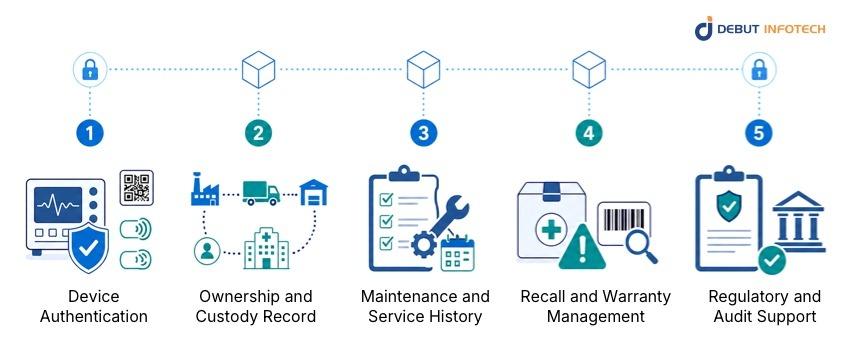
Medical device tracking is more than just knowing where a product is. Healthcare teams should also be aware if a device is authentic, approved, handled correctly, and if it has complete documentation.
This is where blockchain can come in handy. Together with device serialization, UDI, QR codes, RFID, NFC, ERP systems, and warehouse management platforms, blockchain can provide a shared record of each device, batch or component as it travels through the supply chain. The FDA’s UDI system is intended to be used to identify medical devices from manufacturing through distribution to patient use, and blockchain can be used to complement the UDI system by capturing custody events, verification activities, and lifecycle updates in a tamper-resistant ledger.
Any surgical implant, cardiac device, orthopedic product, hospital consumable or laboratory testing kit can be given a unique digital identity. When a hospital procurement officer scans the QR code, RFID tag or NFC chip, the system can check the product with trusted manufacturer and distributor information.
This facilitates teams to identify fake products, relabelled products, out-of-date products, fake replacement parts, or products that are outside of the approved distribution chain.
Blockchain can keep a record of each handoff from manufacturer to distributor, logistics provider, hospital and service teams. For instance, when a hospital receives a cardiac implant, they can confirm the source of the implant, the distributor who supplied it, the date it arrived and if it came via the approved supply chain.
This provides procurement and compliance teams with enhanced visibility around product accountability, chain of custody and provenance.
Blockchain can store maintenance events, calibration records, software updates and replacement-part history for high-value medical equipment, like diagnostic machines, laboratory instruments, imaging systems, and surgical equipment.
If a device fails, the manufacturer and hospital can determine if it was genuine, who installed it and whether it was installed by an approved technician.
In a recall, the manufacturer is able to identify the affected serial numbers, lot, batch or components and trace them back to the facility it was received. This can enable hospitals to respond more quickly to events involving patient safety and minimise confusion.
The same record can also help with warranty decisions with the ability to view purchase history, custody movement, service activity and approved repairs.
Blockchain is not a substitute for a regulatory reporting system, UDI databases or quality management systems. Rather, it can help to build them up by maintaining a tangible record of manufacturing, distribution, storage, maintenance, and recall.
In the case of healthcare logistics leaders, procurement heads, and medical device manufacturers, it translates to a reduction in blind spots, improved accountability, and enhanced audit preparedness throughout the medical device lifecycle.
Smart contracts enable medical supply chain teams to automate decisions based on rules in purchasing, logistics, quality control, inventory, and payment processes. A simple way to explain a smart contract is that it is a programmed contract that performs an action if certain conditions are met.
For healthcare organizations, this is useful because supply chain decisions often depend on many connected checks: Is the supplier approved? Is the product serialized? Did the shipment follow the right route? Was the required temperature maintained? Has the receiving team confirmed delivery? Smart contracts can connect these events and reduce the manual follow-ups that often slow down distributors, hospital procurement teams, and manufacturers.
This is significant in regulated supply chains where traceability and quality of the product is paramount. For instance, the FDA’s Drug Supply Chain Security Act centers on interoperable electronic package level tracking of specific prescription medicines, and GS1 healthcare standards enable product traceability for prescription medicines and medical devices. WHO/EMA guidance also gives special focus to quality assurance, integrity of medicines and good distribution practices throughout the supply chain.
An example of this is a shipment of a vaccine from a manufacturer to a hospital pharmacy, where the temperature is critical to the vaccine’s effectiveness. The manufacturer makes a note of the batch number, expiry date and shipment number. The logistics provider’s IoT sensor monitors temperature during transit. The hospital scans the product as soon as it arrives and the smart contract will verify whether it conforms to the purchase order, approved supplier, and whether the temperature was within limits. If all conditions are fulfilled, it can confirm, update inventory and approve the invoice.
| Workflow | Trigger | Automated Action | Operational Value |
| Supplier onboarding | Supplier submits credentials | Grants or denies access based on approval rules | Helps prevent unauthorized suppliers |
| Product receipt | Warehouse or hospital scans product | Confirms receipt and updates records | Reduces delivery disputes |
| Cold-chain monitoring | Sensor records unsafe temperature | Flags shipment for quarantine or review | Protects product quality |
| Invoice approval | Delivery and quality checks are complete | Approves invoice or payment workflow | Reduces settlement delays |
| Recall management | Manufacturer flags affected batch | Notifies distributors, hospitals, or pharmacies | Improves recall coordination |
| Expiry management | Product nears expiry date | Sends alert or blocks onward distribution | Reduces risk of unsafe use |
However, smart contracts are not a complete solution on their own. They rely on precise information from ERP systems, warehouse management systems, bar code scanners, IoT devices and quality management platforms. If all conditions are fulfilled, it can confirm, update inventory and approve the invoice.
The best use case is not to replace people. It is enabling teams to react quicker, with more transparent rules, audit trails and no blind spots in the medical supply chain.
When integrating blockchain into a medical supply chain, it’s important to have something that addresses a functional need, rather than just the ledger. The goal of the healthcare logistics team, pharmaceutical distributors, the hospital procurement unit, and device manufacturers is to build a trusted digital system that verifies the products, suppliers, documents and compliance events, every step of the way.
A robust medical supply chain platform for blockchain should incorporate traceability, automation, integration and secure access control. Here is a practical feature checklist for a buyer that can be used to plan a solution.
| Feature | What It Does | Why It Matters |
| Product serialization module | Creates unique digital identities for drugs, medical devices, or packaging units | Supports package-level verification and helps teams trace products from manufacturer to end user |
| QR, barcode, and RFID scanning | Captures product movement at warehouses, distribution points, hospitals, and pharmacies | Improves visibility across handoffs and reduces blind spots in the supply chain |
| Supplier onboarding | Verifies manufacturers, distributors, logistics partners, and other authorized participants | Helps prevent unapproved vendors from entering the network |
| Smart contract workflows | Automates events such as approvals, payments, recalls, compliance checks, and delivery confirmations | Reduces repetitive manual tasks and improves process consistency |
| IoT integration | Connects temperature, humidity, GPS, and shock sensors to supply-chain records | Supports cold-chain monitoring for vaccines, biologics, lab samples, and temperature-sensitive medicines |
| Blockchain ledger | Records validated supply-chain events across approved network participants | Creates a shared, tamper-resistant audit trail for traceability and accountability |
| Off-chain document storage | Stores certificates, invoices, shipping documents, quality reports, and regulatory files securely outside the blockchain | Keeps large files accessible without overloading the blockchain network |
| ERP, WMS, and EHR integration | Connects blockchain records with enterprise resource planning, warehouse, and healthcare systems | Prevents data silos and allows teams to work from familiar platforms |
| Compliance dashboard | Displays audit logs, exceptions, supplier status, shipment data, and reporting records | Helps teams prepare for inspections, internal reviews, and regulatory reporting |
| Recall management module | Identifies affected batches, lots, serial numbers, or package IDs | Speeds up response when defective, expired, or compromised products must be removed |
| Analytics dashboard | Tracks inventory movement, supplier performance, delivery delays, temperature breaches, and exceptions | Helps operations teams make faster, evidence-based decisions |
| Role-based access control | Defines who can view, add, approve, or update specific data | Protects sensitive business, patient-related, and compliance information |
For instance, a shipment of vaccines can be scanned and recorded at each stage of its journey from the manufacturer to a distributor and onto a hospital. When an IoT sensor captures a temperature spike while in transit, the system can alert the shipment, inform relevant teams and retain the event history to be reviewed during audit.
These features are designed to complement each other to form a single seamless traceability layer. The blockchain ledger tracks the verified events, IoT devices provide real-time condition information, smart contracts enable the actions to be carried out in the workflow and integrations link the system with the current healthcare operations.
Companies developing such platforms typically collaborate with a healthcare app development agency to design the platform’s architecture, select the appropriate blockchain framework, develop the platform’s integrations, and create compliant user workflows.
Medical supply chain software development cost depends on the size of the network, the type of blockchain architecture, and how deeply the platform connects with existing healthcare systems. A basic blockchain traceability MVP may cost $45,000 to $90,000, while a more advanced enterprise medical supply chain platform can reach $180,000 to $400,000+.
| System Type | Estimated Cost | Timeline | Best For |
| Blockchain traceability MVP | $45,000–$90,000 | 3–5 months | Single product line, limited stakeholders, QR/barcode scanning |
| Mid-level pharma supply chain platform | $90,000–$180,000 | 5–8 months | Distributors, logistics firms, regional pharma networks |
| Enterprise medical supply chain system | $180,000–$400,000+ | 8–14 months | Multi-party hospital, pharma, distributor, or device ecosystems |
| Blockchain + IoT cold-chain platform | $120,000–$300,000+ | 6–12 months | Vaccines, biologics, diagnostics, and temperature-sensitive drugs |
| Medical device tracking platform | $80,000–$220,000 | 4–9 months | Device manufacturers, hospitals, and equipment distributors |
Some of the key cost factors are the number of stakeholders and users, rules for product serialization, blockchain platform selection, and use of a public or private permissioned network. Manufacturers, distributors, hospitals and regulators typically need to have more robust identity management, access control, audit records and compliance workflows for a private blockchain.
Additional costs arise if the platform integrates with ERP, WMS, EHR, and procurement systems, or if it has built-in options like smart contracts, geolocation, real-time alerts, and IoT sensors for monitoring cold chains. For instance, a vaccine shipment tracked through multiple storage points will need to have more validation logic than a product authentication tool that scans and verifies.
While blockchain has the potential to enhance transparency and traceability in the medical supply chain, it cannot be simply dropped in, as it requires careful customization to address the specific challenges of each stage. The success of its implementation relies on the design, governance, integration and adoption of the network by the organizations involved.
Below are the main challenges healthcare and pharmaceutical supply chain teams should consider before adopting blockchain.
The real value of blockchain is in the extent to which all major stakeholders embrace it. The sharing of verified supply chain events will require an agreement between manufacturers, distributors, logistics providers, pharmacies, hospitals, and regulators.
With few stakeholders involved, there is limited visibility. A hospital, for instance, might be able to establish that a shipment was received, but if there is no manufacturer and distributor information it may lack confidence in the origin of the shipment, handling, and chain of custody.
Many medical supply chains use diverse ERP systems, product codes, barcode types, warehouse systems and reporting workflows. If the product information is recorded differently by each organization, then the blockchain may contain conflicting or incomplete product data.
Stakeholders should have a common data model, common identifiers and common formats for batch numbers, expiry dates, shipment information, recalls and temperature history before implementation.
Blockchain should seamlessly integrate with current healthcare and logistics infrastructure. This contains ERP, WMS, procurement platforms, EHR systems, quality management software and regulatory reporting software.
If not properly integrated via APIs or middleware, teams can end up re-entering information in multiple systems. This leads to more workload, higher expenses, and potential for human error.
Commercial, healthcare, pricing, supplier and contractual data should not be written directly on-chain as it is sensitive information. This is particularly significant in the pharmaceuticals and medical device supply chain, where access control and compliance are of critical importance.
A more effective solution is permissioned blockchain networks, role-based access, encryption and off-chain storage. The blockchain can then store the cryptographic hashes, timestamps or verification proofs, without revealing the sensitive information.
Blockchain can be used to secure the records once they have been entered in the chain, but it does not necessarily ensure that the data entered was correct in the first place. Blockchain can keep a record of an incorrect IoT sensor, barcode read, RFID tag, or manual input.
That’s why you need to have validated IoT devices, secure scanning process, audit trails, exception alerts, and robust data verification controls to go with blockchain.
Every scan, shipment update, handoff, temperature read and recall event can add up to many transactions within the medical supply chain.
If the architecture is poorly designed, this can affect performance and increase operating costs. To prevent this, it’s important for organizations to decide which events will need to be recorded on-chain, which information will remain off-chain and how the system will manage periods of high traffic.
Governance is also crucial to blockchain adoption. It is important that stakeholders understand who can write data, validate transactions, approve users, correct errors, resolve disputes and make changes to the network.
If these are not established, the system could become hard to manage, particularly if there are many companies, regulators, and healthcare institutions involved.
Overall, the challenges of blockchain in medical supply chain adoption are not only technical. They are also operational, organisational and regulatory. Blockchain is most useful when it’s supported by proper governance, accurate data inputs, IoT, APIs, cybersecurity measures, and extensive stakeholder engagement
Developing blockchain for the medical supply chain is not just about writing smart contracts or developing a distributed ledger. It needs to be built securely, integrated with health care systems, have strong stakeholder access controls, be compliance-ready, and be simple enough for procurement teams, distributors, clinicians, and manufacturers to trust.
Debut Infotech’s work on WellPop, a healthcare web and mobile platform, reflects this kind of healthcare technology experience. Its experience in building HIPAA-compliant architectures, secure cloud systems, EHR integrations, and multi-user healthcare workflows provides the kind of security and interoperability framework required for private permissioned blockchain networks.
Key capabilities from the WellPop project include:
Debut Infotech also worked on MULTIM3D, a video streaming solution for the healthcare industry that provided both medical and pharmaceutical content for the professional user via a secure, on-demand web experience. This further reflects experience in building digital platforms for medical and pharmaceutical audiences.
For a blockchain-based supply chain solution, this experience matters. A practical platform may need distributor dashboards, hospital procurement access, product verification tools, audit-ready records, and secure workflows for multiple stakeholders across the healthcare ecosystem.
Creating a blockchain-based medical supply chain involves more than just selecting a platform. Healthcare organizations must grasp what to monitor, who needs access and how data will flow between systems and identify areas where automation can fill in the manual gaps.
Debut Infotech supports this process through blockchain consulting, feasibility analysis, and custom blockchain application development. Our team is able to recommend the most appropriate architecture for various applications including drug management, medical device authentication, cold chain management, supplier verification, and hospital visibility.
These can involve a range of activities, such as developing product serialization processes that link batch numbers, shipping information, temperature monitoring, and delivery confirmations on a shared ledger, for pharmaceutical distributors and healthcare logistics teams. Smart contracts can then be used to automate verification steps, flag exceptions or trigger approvals if pre-defined conditions are met.
Debut Infotech can also support IoT integration for real-time tracking, as well as ERP, WMS, and EHR integration so blockchain records do not sit in isolation. Dashboards, analytics layers, and mobile scanning apps can help procurement teams, warehouse staff, and compliance officers access the information they need quickly.
Beyond development, Debut’s blockchain development services cover blockchain integration, Blockchain-as-a-Service, AI-powered blockchain development, enterprise blockchain engineering, and post-launch optimization. This makes it easier for healthcare businesses to move from pilot projects to scalable, compliance-ready platforms.
Blockchain improves medical supply chain transparency by creating a shared, tamper-resistant record of product movement across manufacturers, distributors, logistics providers, hospitals, pharmacies, and regulators. Each product scan, shipment update, quality certificate, and handoff can be recorded as a verified event, making it easier to confirm authenticity, track inventory, detect exceptions, and respond quickly during recalls.
Blockchain helps secure the pharmaceutical supply chain by linking drugs and packages to verified digital records that are difficult to alter without detection. When combined with serialization, QR/barcode scanning, role-based access, and supplier verification, blockchain can reduce counterfeit risks, improve chain-of-custody visibility, and strengthen audit readiness.
Smart contracts automate predefined supply-chain actions such as supplier approval, shipment acceptance, payment release, recall alerts, expiry warnings, and compliance checks. For example, a smart contract can confirm that a shipment was received, verify that temperature conditions were maintained, and trigger payment or exception review based on agreed rules.
Blockchain can improve medical device tracking by creating a verified digital identity for each device, component, or batch. Hospitals, distributors, and manufacturers can use this record to confirm authenticity, track ownership, store service history, manage warranties, and identify affected products during recalls.
The main challenges include stakeholder onboarding, data standardization, integration with ERP/WMS/EHR systems, privacy protection, IoT data reliability, scalability, governance, and implementation cost. Blockchain is most effective when paired with strong data controls, clear governance, secure APIs, and phased rollout across supply-chain participants.

Our Latest Insights
USA
2501 Chatham, Rd Suite R Springfield, IL 62704
+1-708-515-4004
info@debutinfotech.com
UK
7 Pound Close, Yarnton, Oxfordshire, OX51QG
+44-770-304-0079
info@debutinfotech.com
Canada
154 Eden Oak Trail, Kitchener, ON N2A 0H9
+1-708-515-4004
info@debutinfotech.com
INDIA
Sector 101-A, Plot No: I-42, IT City Rd, JLPL Industrial Area, Mohali, PB 140306
9888402396
info@debutinfotech.com