ON THIS PAGE
Progress0%

Our Global Presence :




ChatGPT-like chatbot development can cost $30,000 to $470,000+, depending on complexity, data, integrations, security, and scale.
Architecture choices such as LLM APIs, RAG, fine-tuning, multimodal AI, and agentic workflows affect development costs.
Enterprise integrations add development effort through data mapping, authentication, workflow logic, and testing.
Development timelines can range from 4-8+ weeks for focused LLM chatbot to 4-8+ months for an enterprise AI assistant.
Chatbot ROI can be measured through labor savings, productivity gains, support-cost reduction, and revenue impact, with AI investments expected to deliver 21% ROI in 2026.
Ongoing costs include LLM usage, infrastructure, monitoring, maintenance, and support.
AI chatbots are taking on a broader role across customer service, knowledge access, sales support, and workflow automation. A Gartner survey conducted in April-May 2026 found that AI spending among customer service leaders increased 38%, while overall service and support budgets grew only 2%. Gartner also projects worldwide spending on AI models and platforms to reach $64 billion in 2026. OpenAI reported in August 2026 that its products now serve more than two million businesses.
That investment is also making AI chatbot development cost a more important planning question. The cost to build a chatbot like ChatGPT depends on far more than the conversational interface. Model strategy, business data, integrations, security, expected usage, and deployment scale can materially change the investment.
This guide covers the architecture choices, development effort, operating expenses, timelines, maintenance, and ROI involved in building a ChatGPT-like solution.
For 2026 planning, the cost to develop a ChatGPT-like chatbot can range from roughly $30,000 for a focused LLM-based solution to $470,000+ for an enterprise AI assistant.
Projects move toward the higher end of this range when they require RAG, proprietary business data, multimodal capabilities, AI agents, enterprise integrations, stronger governance, or production-scale infrastructure.
Once the required capabilities are defined, the cost to build an AI chatbot like ChatGPT can be assessed across three dimensions: solution complexity, development phase, and business use case.
The ChatGPT-like chatbot development cost increases as the solution moves from a focused LLM application to an AI assistant with proprietary knowledge, workflow automation, advanced integrations, and enterprise controls.
| Complexity | Scope | Estimated Development Cost |
| Focused LLM Chatbot | LLM API, basic conversational interface, authentication, limited integrations | $30,000-$50,000 |
| Business AI Chatbot | Business data, RAG, authentication, 1-3 integrations | $70,000-$125,000 |
| Advanced AI Assistant | Multimodal AI, agents, workflows, evaluation, multiple integrations | $125,000-$235,000 |
| Enterprise AI Assistant | Complex data access, governance, SSO/RBAC, scalability, monitoring | $235,000-$470,000+ |
These ranges should be used as planning benchmarks rather than fixed prices. Two solutions using the same foundation model can require very different budgets when their data access, integrations, automation, and production requirements differ.
A useful way to understand AI chatbot development cost is to look at where engineering effort is typically concentrated across the development lifecycle.
| Project Phase | Indicative Budget Share | Effort Level |
| Discovery and Architecture | 8-10% | Moderate |
| UX and Conversation Design | 6-8% | Low-Moderate |
| AI and Data Engineering | 23-27% | High |
| Backend and Integrations | 20-24% | High |
| Frontend Development | 10-12% | Moderate |
| Testing and AI Evaluation | 14-18% | Moderate-High |
| Security and Deployment | 9-11% | Moderate-High |
AI and data engineering, backend integrations, and evaluation often account for a significant share of the budget because they determine how reliably the chatbot works with business knowledge, systems, and real-world requests.
The cost to develop a ChatGPT-like chatbot also varies according to the business problem being solved. A customer support chatbot, internal knowledge assistant, and agentic workflow system can use similar foundation models while requiring very different data access, controls, integrations, and evaluation.
| Business Use Case | Scope | Estimated Development Cost |
| Customer Support Chatbot | RAG, CRM integration, human handoff, analytics | $70,000-$140,000 |
| Internal Knowledge Assistant | Enterprise search, RAG, permissions, document access | $80,000-$160,000 |
| Sales AI Assistant | CRM data, recommendations, lead qualification, workflow automation | $80,000-$170,000 |
| Regulated Business Assistant | Sensitive data, stronger controls, auditability, extensive evaluation | $150,000-$300,000+ |
| Agentic Workflow Assistant | Tool calling, multiple systems, approvals, multi-step automation | $150,000-$300,000+ |
These ranges are directional. Integration depth, data sensitivity, accuracy requirements, workflow complexity, and expected scale can move the final budget above or below them.
Need a More Accurate AI Chatbot Cost Estimate?Share your required features, integrations, data sources, and deployment requirements. Our AI team can help define the scope and estimate your development investment.
Several technical and delivery decisions can materially change the engineering effort behind a ChatGPT-like chatbot. The largest differences usually appear in model strategy, data readiness, system access, evaluation, security, and production requirements.
These cost drivers rarely occur in isolation. As requirements compound, the project can move quickly from a focused AI application to enterprise-level engineering scope.
AI architecture has a direct impact on development effort. A basic solution may use a hosted LLM API, while more advanced systems can add RAG, fine-tuning, multimodal processing, or agentic workflows.
These estimates describe architecture-specific engineering and can overlap within a complete chatbot build. They should not be added together to calculate total project cost.
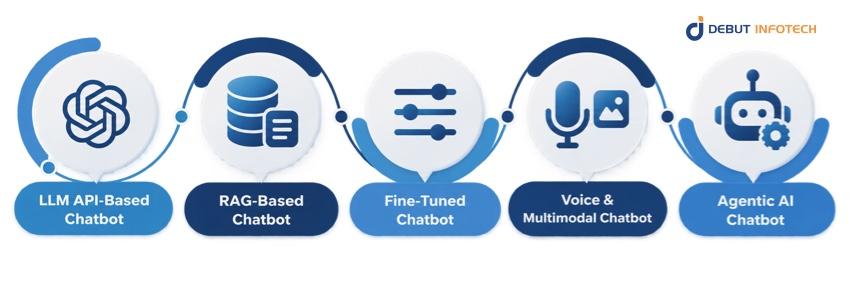
An LLM API-based chatbot is usually faster to implement because it relies on an existing model rather than hosting one internally. Integration costs can range from $7,000-$15,000 for a basic setup to $35,000-$75,000+ for enterprise integration.
These figures cover the AI integration layer, not the full chatbot product or ongoing API usage.
A RAG-based AI chatbot connects the model with approved business knowledge to improve relevance and grounding. RAG-related development can range from $25,000-$50,000 for a focused implementation to $100,000-$200,000+ for enterprise deployments.
The additional effort typically involves data ingestion, indexing, retrieval logic, permissions, and evaluation.
Fine-tuning adapts an existing model for more consistent domain behavior, terminology, or task performance. Fine-tuning is harder to benchmark with a single development range because costs vary significantly with dataset preparation, model choice, training cycles, and evaluation requirements.
For frequently changing business knowledge, RAG is usually more suitable. Fine-tuning is more relevant when the objective is specialized behavior, terminology, formatting, or task performance.
Voice and multimodal AI add support for speech, images, documents, and other input formats. These capabilities can require speech processing, file pipelines, additional model integrations, and broader testing.
They are usually estimated as added architecture scope rather than a standalone chatbot price.
An agentic AI chatbot can use tools, interact with business systems, and complete multi-step tasks. Costs rise with the number of tools, workflows, approvals, integrations, and recovery paths the agent must manage.
Agentic architectures generally require more orchestration and testing than response-only chatbots.
Not Sure Which AI Architecture Fits Your Use Case?Evaluate LLM APIs, RAG, multimodal AI, and agentic workflows against your business data, integrations, security requirements, and expected scale.
The ChatGPT-like app development cost depends on whether the mobile product is primarily a front end for an existing AI backend or requires additional mobile-specific features, platform support, and application logic.
The final cost to develop an app like ChatGPT also depends on whether the product targets iOS, Android, or both, and whether development uses native or cross-platform technology. Businesses working with a mobile app development company should also account for app store deployment, device testing, mobile analytics, and performance optimization when defining the final budget.
There is no single AI chatbot monthly cost because recurring expenses vary by model, traffic, token consumption, infrastructure, retrieval requirements, and support needs. A reliable AI chatbot operating cost estimate should therefore account for the services the system continues to consume after deployment.
Monthly AI Chatbot Cost = Model Usage + Infrastructure and Data + Monitoring + Maintenance and Support + Third-Party Services
Model and LLM Usage
The LLM API cost depends primarily on the selected model, actual input and output token usage, caching, conversation volume, and any additional tools or modalities used. Voice, image, and document-processing services can add further usage-based charges for multimodal AI applications.
Infrastructure & Data
Recurring infrastructure can include application hosting, databases, caching, vector storage, file storage, networking, and retrieval infrastructure required to keep the chatbot available. RAG-based chatbots may also require embeddings, document indexing, retrieval services, and knowledge-base synchronization. Persistent conversation history and growing data volumes can also increase storage and management requirements.
Monitoring & Operations
Production AI systems may require logging, latency and error monitoring, usage analytics, observability, and ongoing AI evaluation. These services help teams identify performance issues and control model and infrastructure usage.
Maintenance & Support
The AI chatbot maintenance cost can include prompt updates, retrieval tuning, model migrations, integration maintenance, security updates, performance optimization, and production support.
Monthly operating expenses should be estimated against expected users, conversation volume, token consumption, infrastructure needs, and support requirements rather than a single market-average figure.
For long-term budgeting:
3-Year Total Cost of Ownership = Initial Development Cost + 36 Months of (LLM Usage + Infrastructure + Monitoring + Maintenance + Support)
Feature selection can materially change the engineering effort behind a ChatGPT-like chatbot. The right AI chatbot features should support secure access, contextual conversations, business workflows, and production monitoring without adding unnecessary complexity.
| Feature | What It Adds | Typical Development Impact |
| Authentication and Role-Based Access | Secure identity, user permissions, and controlled access to business data | Moderate |
| Conversation History & Memory | Maintains conversation history and context across sessions | Moderate |
| Fallbacks & Guardrails | Controls unsupported, unsafe, or unreliable responses | Moderate |
| Multilingual Support | Enables multilingual support across different user groups and markets | Moderate |
| Voice Interaction | Adds speech recognition, text-to-speech, streaming, and latency handling | High |
| RAG & Business Knowledge | Grounds responses in proprietary documents, databases, and approved business knowledge | High |
| Analytics & AI Monitoring | Tracks usage, response quality, latency, feedback, and AI performance | Moderate |
| Enterprise Integrations | Connects the chatbot with CRM, ERP, DMS, ticketing, and workflow systems | High |
| Human Handoff | Routes conversations to employees when escalation or manual review is required | Moderate |
| AI Agents & Tool Calling | Enables AI agents to execute actions and multi-step workflows across connected systems | Very High |
| Fine-Tuned or Specialized Model Configuration | Supports domain-specific behavior, terminology, and task performance | High-Very High |
| Multimodal AI Support | Adds image, document, voice, or other non-text inputs to the conversational experience | High |
Development impact is directional and reflects the additional engineering each capability may introduce. Some features share the same underlying architecture, so their cost impact should not be calculated independently or added together.
The time to build a chatbot like ChatGPT can range from several weeks for a focused LLM solution to several months for an enterprise AI assistant. Architecture, data preparation, integrations, security controls, and AI evaluation shape the final delivery timeline.
| Chatbot Type | Typical Timeline |
| Focused LLM Chatbot | 4-8+ weeks |
| Business AI Chatbot | 8-14+ weeks |
| RAG-Based AI Chatbot | 10-16+ weeks |
| Multimodal or Voice AI Chatbot | 12-20+ weeks |
| Agentic AI Chatbot | 14-24+ weeks |
| Enterprise AI Assistant | 4-8+ months |
Timelines extend when teams must clean or prepare business data, coordinate multiple integrations, validate permissions, complete compliance reviews, or run broader AI evaluation cycles.
A clearly defined MVP can shorten the initial development timeline by prioritizing high-value workflows and deferring secondary integrations or advanced capabilities.
Post-launch maintenance reflects the engineering required to keep an AI chatbot accurate, secure, compatible, and reliable as models, business data, integrations, and requirements change. The AI chatbot maintenance cost should therefore be planned separately from the initial development budget.
| Chatbot Scope | Indicative Annual Maintenance Cost |
| Focused LLM Chatbot | 10-15% of initial development cost |
| RAG-Based Business Chatbot | 15-25% |
| Enterprise AI Assistant | 20-30%+ |
These percentages are planning benchmarks rather than fixed rates. Actual AI chatbot maintenance cost can vary with usage patterns, model changes, integration complexity, support coverage, and reliability requirements.
Beyond routine maintenance, several long-term AI chatbot operating costs are easy to underestimate.
Including these expenses in long-term budgeting provides a more realistic view of AI chatbot total cost of ownership and helps businesses plan for ongoing operational requirements after deployment.
A SaaS chatbot usually has a lower upfront cost, while custom AI chatbot development requires more initial investment but offers greater control over data, integrations, workflows, and long-term scalability.
| Approach | Cost Profile | Best Fit |
| SaaS AI Chatbot | Lower setup cost with recurring subscription and usage fees | Standard support or low-complexity use cases |
| Custom AI Chatbot | Higher initial AI chatbot development cost, with more control over architecture and integrations | Businesses with proprietary workflows, data, or enterprise requirements |
| Hybrid Approach | Combines SaaS or hosted models with custom RAG, integrations, and application logic | Businesses seeking faster delivery without sacrificing core customization |
SaaS is generally more cost-effective when workflows and integrations are standardized. Custom or hybrid development becomes easier to justify when proprietary data, deeper integrations, workflow ownership, security, or governance requirements determine the product’s value. The decision should therefore be based on total cost of ownership rather than initial development cost alone.
Reducing AI chatbot development costs requires controlling scope, engineering complexity, and production usage without compromising reliability.
Start With a Focused MVP
Prioritize the highest-value workflows, integrations, and AI chatbot features first. This helps validate business impact before expanding the solution.
Use Existing Foundation Models
Using established models avoids the cost and infrastructure burden of training a foundation model from scratch.
Evaluate RAG Before Fine-Tuning
For knowledge-heavy applications, RAG can reduce retraining requirements while keeping business information current.
Use Model Routing
Route routine requests to lower-cost models while reserving more capable models for complex tasks that justify higher inference costs.
Optimize Token and Context Usage
Caching, selective retrieval, concise prompts, and controlled context can reduce unnecessary token consumption and AI chatbot operating cost.
Limit Unnecessary Agent Actions
Use AI agents only where multi-step automation creates clear value. Excessive tool calls, retries, and agent loops can increase both engineering and inference costs.
Monitor Production Usage
Track token consumption, model usage, and high-cost workflows to identify opportunities for further optimization.
The most effective approach is to match AI agent architecture and model usage with the value each use case is expected to deliver.
AI chatbot ROI should account for measurable cost savings, productivity gains, revenue contribution, and recurring operating expenses, not only the initial AI chatbot development cost.
As a broader benchmark, the 2026 SAP Value of AI Report, conducted with Oxford Economics, found that businesses globally expect an average 21% ROI from AI investments in 2026.
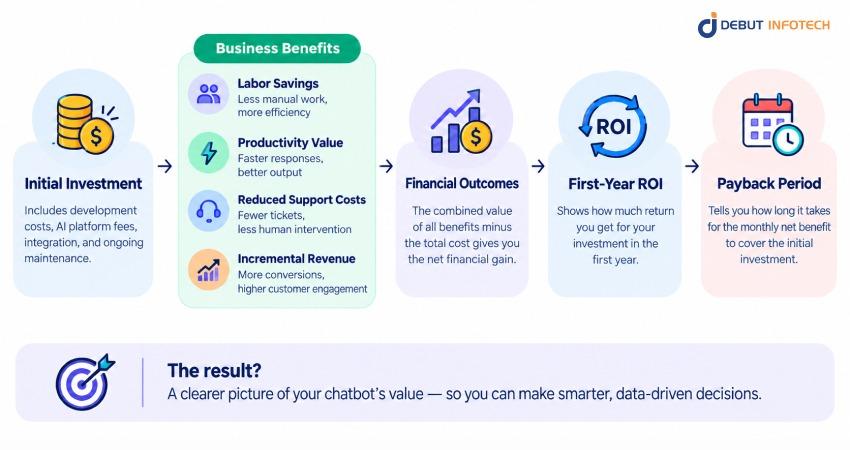
A practical way to calculate financial benefit is:
Annual Financial Benefit = Labor Savings + Productivity Value + Reduced Support Costs + Incremental Revenue
For the first year:
First-Year AI Chatbot ROI = (First-Year Financial Benefit – First-Year Total Cost) ÷ First-Year Total Cost ✕ 100
Where:
First-Year Total Cost = Initial Development Cost + First-Year Operating Cost
The AI chatbot payback period can be estimated as:
Payback Period (Months) = Initial Investment ÷ Monthly Net Benefit
Where:
Monthly Net Benefit = Monthly Financial Benefit − Monthly Operating Cost
This simplified calculation works best when monthly benefits and operating costs remain reasonably stable.
For enterprise planning, ROI is more credible when each benefit is tied to a measurable baseline such as support cost per ticket, handling time, employee hours saved, conversion rate, or revenue influenced.
A production-ready ChatGPT-like chatbot typically combines AI models, orchestration, retrieval, application development, integrations, infrastructure, and observability across several technical layers.
The AI chatbot technology stack should match the required architecture and operating environment rather than introduce tools that add complexity without measurable technical value.
Debut Infotech combines AI engineering, enterprise integration, and production governance to deliver custom AI chatbot development for complex business environments. With 15+ years of software engineering experience, 150+ engineers, and 500+ delivered solutions, we support projects from AI architecture and data engineering through deployment and ongoing optimization.
Our AI development services cover LLM integration, RAG, multimodal AI, AI agents, model orchestration, and conversational AI chatbot development. We align the architecture with business data, workflows, expected usage, and automation requirements.
Our AI chatbot development services connect conversational AI with CRM, ERP, knowledge bases, internal APIs, identity systems, and workflow platforms. This enables enterprise AI chatbot solutions to retrieve business data, update systems, trigger workflows, and support operational tasks across existing applications.
We incorporate access controls, audit logging, monitoring, data protection, and AI governance requirements into the architecture from the outset. These controls are especially important for custom AI chatbots operating with sensitive data, regulated workflows, or enterprise-wide access.
For a U.S.-based immigration services organization, we developed an AI-powered legal automation platform combining conversational AI, multilingual assistance, appointment scheduling, document workflows, and human handoff.
The solution reduced consultation handling time by 40%, while 80%+ of initial queries were resolved automatically.
For organizations evaluating an enterprise AI chatbot development company, this combination of AI engineering, enterprise integration, governance, and applied project experience provides a practical foundation for complex chatbot initiatives.
Build Your AI Chatbot With an Enterprise Engineering TeamFrom LLM integration and RAG to enterprise systems, AI agents, security, and deployment, we can help scope and engineer your chatbot solution.
A reliable ChatGPT-like chatbot budget starts with five inputs: the target use case, business data, required integrations, governance requirements, and expected production usage.
Defining these variables early provides a stronger basis for estimating AI chatbot development cost, forecasting ongoing expenses, controlling scope, and evaluating the expected return on investment.
Planning a custom AI chatbot for your business? Schedule a free consultation to define the scope, assess the required architecture, and estimate development and operating costs.
The cost to develop a ChatGPT-like chatbot can range from roughly $30,000 for a focused LLM-based solution to $470,000+ for an enterprise AI assistant. The final AI chatbot development cost is shaped by architecture, proprietary data, integrations, security controls, evaluation requirements, and production scale.
The custom AI chatbot development cost varies with the level of business-specific functionality required. RAG, enterprise integrations, workflow automation, multimodal AI, AI Agents, role-based access, and governance can increase the investment compared with a focused LLM chatbot.
Yes. Businesses can build a ChatGPT-like chatbot using an LLM API from providers such as OpenAI, Anthropic, or Google. This approach can reduce model-development effort while still supporting custom business data, workflows, integrations, user roles, and application logic.
The LLM API cost is typically usage-based and varies by model, actual input and output token usage, caching, conversation volume and any additional tools or modalities used. Businesses should account for both ongoing API consumption and the separate LLM API integration cost when estimating the total project budget.
For knowledge-intensive applications, RAG is often more cost-effective than fine-tuning because it connects an existing LLM with current business data without retraining the model. However, the RAG chatbot development cost still includes data preparation, retrieval infrastructure, permissions, indexing, and AI evaluation.
Core AI chatbot features can include authentication, conversation history, guardrails, RAG, multilingual support, voice interaction, enterprise integrations, analytics, human handoff, and AI agents. The final feature set should reflect the business workflows, users, data access, and level of automation required.
The time to build a chatbot like ChatGPT can range from about 4-8 weeks for a focused LLM chatbot to several months for an enterprise AI assistant. A RAG-based business chatbot may require around 10-16 weeks, while agentic, multimodal, or heavily integrated solutions can take longer.
As a planning benchmark, annual AI chatbot maintenance cost can represent roughly 10-30%+ of the initial development investment. Model changes, RAG maintenance, integrations, monitoring, security updates, evaluation, and ongoing engineering support can influence the long-term AI chatbot operating cost.
Building a ChatGPT-like chatbot usually means creating an application around an existing foundation model. Training an LLM involves training the underlying foundation model itself, which requires substantially more data, computing infrastructure, expertise, and investment.
Yes. An enterprise AI chatbot can integrate with CRM, ERP, helpdesk platforms, databases, knowledge systems, identity providers, and internal APIs. These integrations can support data retrieval, record updates, workflow triggers, authentication, human handoff, and other operational tasks.
Our Latest Insights
USA

2501 Chatham, Rd Suite R Springfield, IL 62704
+1-708-515-4004
info@debutinfotech.com
UK

7 Pound Close, Yarnton, Oxfordshire, OX51QG
+44-770-304-0079
info@debutinfotech.com
Canada

154 Eden Oak Trail, Kitchener, ON N2A 0H9
+1-708-515-4004
info@debutinfotech.com
INDIA

Sector 101-A, Plot No: I-42, IT City Rd, JLPL Industrial Area, Mohali, PB 140306
9888402396
info@debutinfotech.com

9001:2015
Quality Certified

ISO 27001
Security Certified

A+ Rating
Accredited Business

Certik
Security & Audit


Copyright © 2026, Debut Infotech. All rights reserved. | Privacy Policy