ON THIS PAGE
Progress0%






Our Global Presence :




Cryptocurrency exchange architecture determines platform survival by directly influencing scalability, security, compliance, and operational resilience under high trading volumes.
A layered architecture approach improves reliability by separating critical components such as the matching engine, API gateway, wallet infrastructure, databases, and monitoring systems.
Scalability requires horizontal scaling and microservices architecture using technologies like Kubernetes, database sharding, and multi-region deployments to handle sudden market spikes.
Security depends on defense-in-depth strategies including HSM-based key management, multi-signature custody, DDoS protection, encryption, and continuous security testing.
Compliance must be embedded into the system design through KYC/AML workflows, Travel Rule integrations, and jurisdiction-specific frameworks such as MiCA and FinCEN requirements.
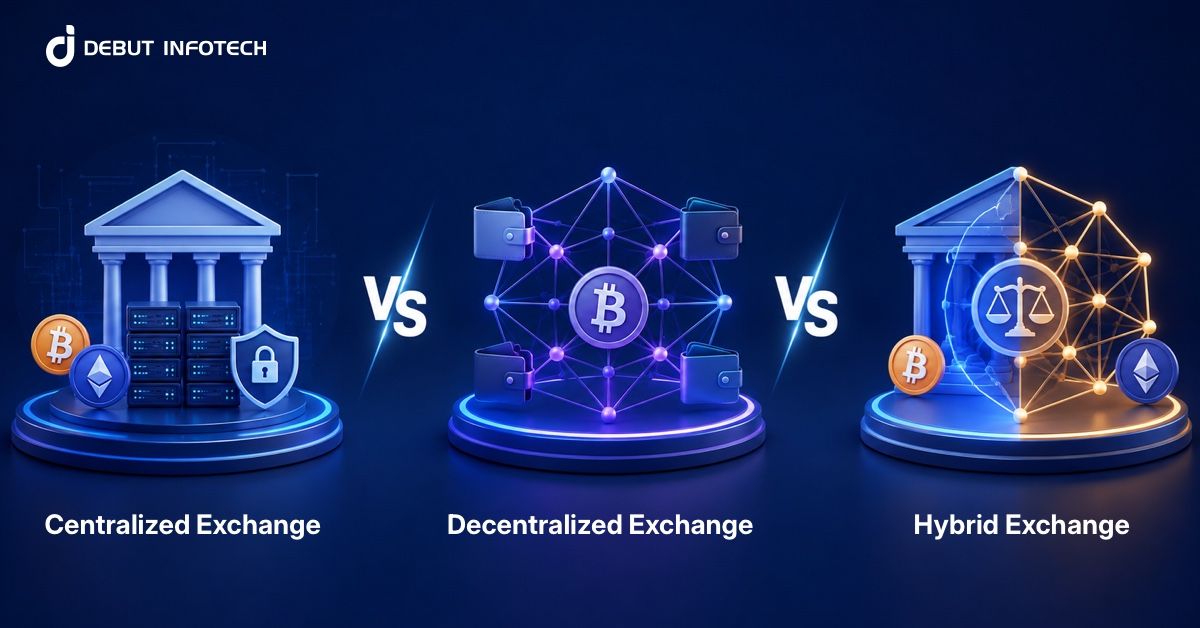
CEX, DEX, and hybrid models involve different architectural trade-offs in custody, latency, scalability, and regulatory obligations, making platform goals a key decision factor.
Development costs vary significantly based on architecture complexity, with MVP exchanges starting around $150K while institutional-grade platforms require custom infrastructure and multi-jurisdiction compliance capabilities.
A matching engine clearing tens of thousands of orders per second. Wallet infrastructure is holding nine figures in digital assets. A network that simply cannot go down without making national news. These are not features on a roadmap — they are the load-bearing walls of any trading venue, and they are decided long before launch, in the architecture. This is a decision document for the people who own that outcome: founders, CTOs, and product leaders weighing what to build, what to buy, and where a shortcut today becomes an incident report tomorrow.
Cryptocurrency exchange architecture is the full-stack technical framework — spanning the matching engine, wallet infrastructure, API gateway, security layers, and compliance systems — that determines whether an exchange can handle volume, withstand attacks, and remain trusted. Get it right, and the platform scales quietly through every bull run. Get it wrong, and no amount of marketing, liquidity, or token incentives will save it. The sections below walk the architecture layer by layer, then translate each choice into the cost, risk, and scalability trade-offs that decide which design is right for your exchange.
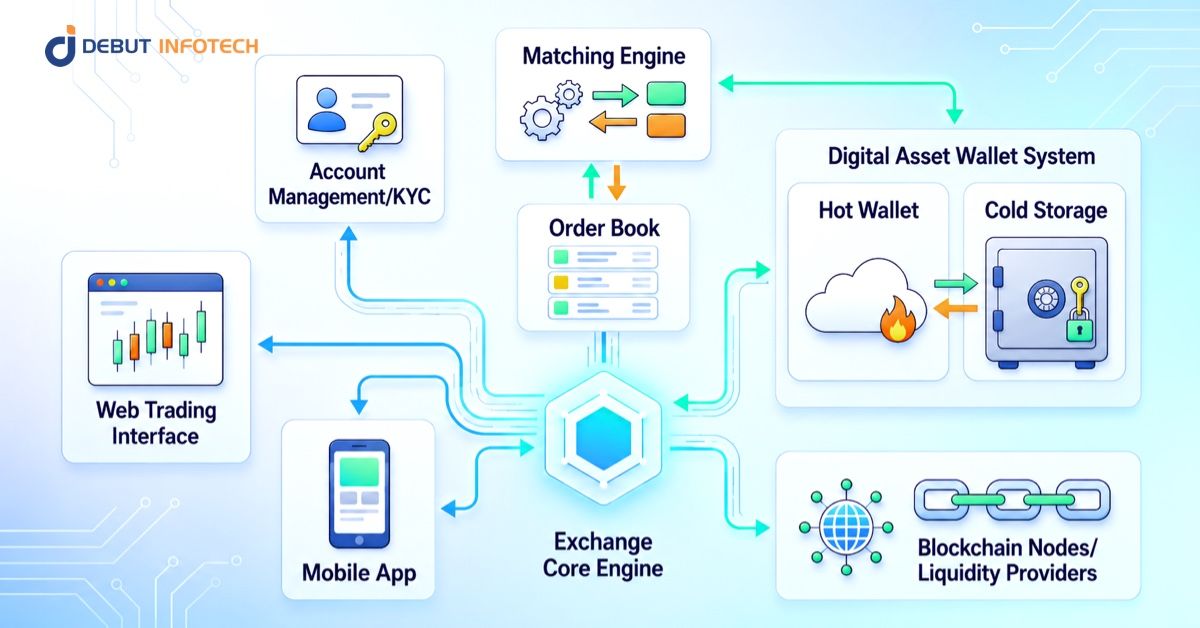
Cryptocurrency exchange architecture is the system design that defines how a trading platform processes orders, stores digital assets, manages users, and ensures security and regulatory compliance. It includes core components such as the matching engine, wallet infrastructure, API gateway, and database layer.
It is the complete set of software components, data stores, and network infrastructure — and the way they are deployed and connected — that enables a platform to accept orders, match trades, custody assets, and remain compliant under real-world load. In engineering terms, it is the contract between performance, security, and cost: every meaningful decision trades one against the others.
It helps to separate two views that get blurred in marketing copy. Logical architecture describes what components exist and how they relate — the matching engine, the order book, the wallet service, the compliance pipeline. Physical architecture describes how components are actually deployed — which cloud regions, how many availability zones, what runs on bare metal versus in containers, and where the keys are physically located. A clean, logical design can still fail catastrophically if the physical deployment puts all critical services in a single data center.
The central tension never goes away: performance, security, and cost. An in-memory matching engine is blisteringly fast but loses state on a crash unless you engineer durability around it. Cold storage is the safest place for customer funds, but it adds latency to withdrawals. Multi-region redundancy buys resilience but multiplies your infrastructure bill. There is no universally correct answer — only the right answer for your volume, jurisdiction, and risk appetite.
This matters because most exchange failures are architectural, not market, failures. Mt. Gox — once handling the majority of global Bitcoin volume — collapsed in 2014 after losing roughly 850,000 BTC, the product of years of unaudited wallet handling and absent controls, rather than a bad market. FTX imploded in November 2022 with an ~$8 billion shortfall in customer funds that regulators traced to commingled customer deposits and a complete breakdown of the separation between the exchange and its affiliated trading firm — again, an architecture-and-controls failure, not a price crash. The lesson for anyone designing a centralized exchange architecture is blunt: the system either makes those failure modes structurally impossible, or it does not.
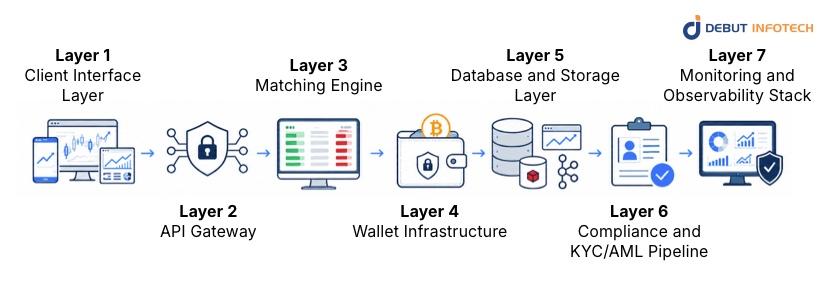
A production exchange is best understood as a stack of seven layers, each with a clear job, a set of technology choices, and consequences if you choose badly. From the client interface, requests flow through a crypto exchange API gateway into the matching engine, while state is managed through a scalable crypto exchange database design and secured by wallet infrastructure and compliance layers. This layered model sits at the core of any cryptocurrency exchange system design.
At a high level, the architecture flows as follows:
| Layer | Primary Role | Key Technologies / Components | Critical Architecture Decision | Key Performance or Security Consideration |
| 1. Client Interface Layer | Delivers the web, mobile, and advanced trading experience | React, Next.js, React Native, Swift, Kotlin, WebSockets, REST, CDN, DDoS protection | Use WebSockets for live order books, trades, and balance updates; use REST for historical or less time-sensitive data | Target sub-100 ms interaction response and protect the edge with CDN and DDoS controls |
| 2. API Gateway | Controls and routes all client and third-party requests | Kong, AWS API Gateway, Nginx, OAuth 2.0, JWT, API keys, rate limiting, load balancing | Keep backend services and the matching engine isolated from direct public access | Enforce authentication, request validation, traffic throttling, endpoint limits, and abuse protection |
| 3. Matching Engine | Maintains the order book and matches buy and sell orders | C++, Rust, Redis, in-memory order books, replayable event logs, FIFO, pro-rata matching | Balance ultra-low latency with durable and recoverable order-book state | Common targets include 100,000+ orders per second and single-digit-millisecond matching latency |
| 4. Wallet Infrastructure | Secures deposits, withdrawals, private keys, and exchange-held assets | Hot wallets, cold wallets, HSM, multisig, MPC, whitelisting, time-locks, anomaly detection | Keep most assets offline while maintaining enough hot-wallet liquidity for withdrawals | Protect keys, prevent single-person control, monitor unusual withdrawals, and limit online asset exposure |
| 5. Database and Storage Layer | Stores balances, orders, users, market data, and immutable system events | PostgreSQL, CockroachDB, Redis, TimescaleDB, InfluxDB, Kafka, read replicas, sharding | Match each data type to the correct database and use event sourcing for replay and reconciliation | Avoid single-database bottlenecks and maintain a reliable event record for recovery, reporting, and audit |
| 6. Compliance and KYC/AML Layer | Handles identity verification, transaction screening, sanctions checks, and regulatory reporting | OCR, liveness checks, Jumio, Onfido, Chainalysis, Elliptic, Notabene, IVMS101, Kafka | Run compliance as an asynchronous, event-driven service rather than blocking every user action | Maintain regulatory coverage without creating latency or disrupting the trading experience |
| 7. Monitoring and Observability Layer | Tracks performance, security incidents, uptime, logs, and on-chain activity | Datadog, New Relic, Prometheus, Grafana, Splunk, Elastic Security, Forta, Tenderly | Centralize metrics, logs, traces, security events, and real-time alerts | Typical targets include 99.99% uptime, sub-10 ms matching latency, and sub-2-second page loads |
This is everything the user touches: the web app, the mobile apps, and the advanced trading terminal. Typical stacks use React or Next.js for web and React Native — or native Swift and Kotlin — for mobile, with a dedicated terminal for high-frequency and institutional users.
The defining architectural decision here is how data reaches the screen. Real-time data — live order book depth, trade prints, balance updates — should stream over WebSocket connections, which keep a persistent channel open and push updates the instant they happen. Historical and less time-sensitive data — candles, account statements, settings — is fine over REST. Mixing these up is a common and expensive mistake: polling a REST endpoint for order book updates hammers your servers and still feels laggy.
Performance at this layer is a perception problem as much as an engineering one. Static assets and market data should be served via a CDN to push content closer to users, and DDoS protection should be at the edge (Cloudflare or equivalent) so volumetric attacks never reach your origin. A reasonable target is a UI response time of sub-100 ms for interactive actions; beyond that, traders feel friction and assume the platform is slow or unsafe.
Every request and every third-party integration from those clients passes through the crypto exchange API gateway before it reaches anything that matters. The gateway is the single front door and handles the unglamorous work that keeps the rest of the system alive: authentication, request routing, and rate limiting. This layer is often referred to as the crypto exchange API gateway, and it is critical for enforcing access control and protecting backend services.
Common choices are Kong, AWS API Gateway, or a hardened custom Nginx layer. Whatever the tool, the gateway enforces a rate limiter per user and per endpoint, validates OAuth 2.0 flows and JWT sessions, and manages API key issuance and scopes for programmatic traders. It is also where you implement a load balancer strategy to spread traffic across service instances.
The architectural reason a gateway exists is isolation. The matching engine — your most performance-sensitive and most attack-attractive component — should never be directly exposed to the public internet. The gateway absorbs malformed requests, throttles abuse, and gives you a single chokepoint to shed load or block bad actors without touching core trading logic. An exchange without a real gateway is an exchange with its crown jewels facing the street.
The matching engine is the component that is the exchange: it maintains the order book and pairs buyers with sellers. It is the most performance-critical part of any crypto exchange’s matching engine architecture, and at scale it must sustain very high throughput — designs commonly target 100,000+ orders per second while maintaining single-digit-millisecond matching engine latency.
Speed comes from keeping the active order book in memory, frequently backed by Redis caching or a bespoke in-memory structure, so matches happen at memory speed rather than disk speed. The catch is durability: memory is volatile, so a serious engine pairs the in-memory book with a persistent, replayable log so the exact order book state can be rebuilt after a crash without losing or double-counting orders.
Matching logic itself is a design choice. FIFO (price-time priority) rewards whoever posted first at a given price and is the default for most spot markets. Pro-rata matching allocates fills proportionally across orders at the same price and is suited to certain derivatives and high-liquidity instruments. Many venues run both, applied on a market-by-market basis.
On the build axis, options run from custom C++ or Rust engines for the lowest possible latency (the route serious and high-frequency venues take), to open-source components, to licensed third-party engines that get you to market faster. The right pick depends on your target TPS throughput and the degree to which ultra-low latency is central to your value proposition.
This is where an exchange holds other people’s money, so it is where the most damaging failures happen. The foundational decision is the hot/cold wallet architecture: keep the large majority of assets in offline cold storage, disconnected from the internet, and only a small operational float in hot wallets to service live withdrawals. A widely used industry baseline keeps roughly 95% of funds cold and around 5% hot, sized to expected withdrawal volume.
Private keys are the real asset, and they should live in HSM key management (Hardware Security Modules) — tamper-resistant devices built to generate and use keys without ever exposing them. On top of that, custody is hardened with multi-signature (multi-sig) custody: an M-of-N scheme where, say, three of five authorized keyholders must sign before funds move, so no single compromised key or insider can drain a wallet. For institutional-grade setups, MPC (Multi-Party Computation) wallets split a single key into shares that are never reassembled in a single location, delivering a keyless-feeling level of custody with strong operational flexibility.
Around the keys sits a control layer: withdrawal address whitelisting, time-locks that delay large or unusual withdrawals, and anomaly detection that flags behavior outside a user’s pattern. These are the controls whose absence turned routine incidents into terminal ones at failed exchanges.
Different data has different physics, and good crypto exchange database design matches each to the right store rather than forcing everything into a single store. Transactional, must-be-consistent data — balances, orders, user records — belongs in a strongly consistent relational store such as PostgreSQL or a distributed SQL engine like CockroachDB. High-volume time-series data, price history, candles, and metrics are well-suited to a purpose-built TimescaleDB or InfluxDB. Ephemeral, hot-path data lives in Redis.
At scale, a single primary database becomes the bottleneck, which is where a PostgreSQL sharding strategy comes in: order history and user data are partitioned horizontally — by user ID, trading pair, or time window — so no single node carries the entire load. Read replicas let analytics and reporting run without touching the primary that trading depends on.
The pattern that ties this together is event sourcing with Apache Kafka: rather than storing only the current state, the system records every state change, every order, fill, deposit, and withdrawal, as an immutable event in a Kafka event stream. That log becomes the source of truth. It lets you rebuild any view of the system, feed real-time analytics and compliance, and reconcile balances with cryptographic confidence, which is precisely the discipline whose absence defined the FTX collapse.
Regulated exchanges run a full KYC/AML pipeline, and their architecture determines both user experience and regulatory exposure. The identity flow typically runs: document upload → OCR extraction → liveness check → sanctions and watchlist screening, with tiered limits unlocking as a user clears each stage.
The tooling is mature. Identity verification commonly uses Jumio or Onfido; on-chain risk and source-of-funds screening uses Chainalysis or Elliptic to score wallet exposure before crediting deposits or releasing withdrawals. For cross-VASP transfers, Travel Rule compliance is implemented through standards such as IVMS101 and integrations like Notabene, so that originator and beneficiary data travel with qualifying transactions (see Chainalysis’s overview of the Travel Rule and its thresholds).
The architectural insight that separates good systems from frustrating ones: compliance should be a non-blocking, asynchronous service, not a checkout gate. Screening that runs inline on every action adds latency and breaks the trading experience; screening that runs as an event-driven service — subscribing to the same Kafka stream from Layer 5 — keeps the platform fast while still catching what it must.
You cannot operate what you cannot see. Application performance is tracked with Datadog, New Relic, or a Prometheus + Grafana stack for metrics and dashboards. Security events flow into a SIEM (Splunk or Elastic Security) with real-time alert thresholds so anomalies page a human in seconds, not hours. On-chain activity — smart contract events, suspicious flows — is watched with tools like Forta and Tenderly.
Observability is also where you make reliability measurable. Mature venues commit to explicit SLA targets — on the order of 99.99% uptime (“four nines”), sub-10ms matching engine latency, and sub-2-second page loads — and instrument the stack so they can prove it. Those numbers are not vanity; they are the contract with institutional clients and, increasingly, with regulators.
Crypto markets do not scale linearly; they spike. Volume can multiply overnight in response to a single news event, which is why crypto exchange scalability has to be built in from day one rather than bolted on during a crisis.
The first principle is to favor horizontal scaling over vertical scaling. Vertical scaling — buying a bigger server — hits a hard ceiling and creates a single point of failure. Crypto exchange horizontal scaling adds more machines and distributes the load across them, with no comparable ceiling and improved resilience as a side effect. Exchanges that try to scale vertically eventually run out of road at the worst possible moment.
Horizontal scaling depends on a microservices architecture. Splitting the platform into independent services, matching engine, wallet service, user service, and notification service, lets each scale independently. The notification service can spin up dozens of instances during a spike while the matching engine scales on a completely different profile, and a fault in one service does not take down the others. Those services are typically packaged in containers and orchestrated with Kubernetes, which handles auto-scaling, self-healing, and rolling deployments automatically.
Data scales the same way. The database sharding strategy from Layer 5 — sharding by user ID, trading pair, or timestamp — keeps storage pace with traffic. And because latency is partly a function of physical distance, geographic distribution across multiple regions reduces round-trip time for a global user base while doubling as disaster resilience.
None of this is trustworthy until it is tested. Serious launches include a load testing methodology that simulates realistic peak conditions — hundreds of thousands of concurrent users and the order rates that come with them — before going live, so the breaking points are found in a test environment rather than discovered by customers.
If scalability is about handling growth, resilience is about surviving failure, and the two are different engineering disciplines. The entire conversation around crypto exchanges’ network architecture resilience starts from one assumption: every component will fail eventually, so the system must be designed to degrade gracefully rather than collapse. Designing for crypto exchanges’ resilience — a network architecture engineered around failure rather than around the happy path — is what separates platforms that ride out incidents from platforms that become cautionary tales.
The circuit breaker pattern is foundational. When a downstream service starts failing or slowing, a circuit breaker trips and automatically isolates it, preventing the failure from cascading through services waiting on it. The platform sheds the broken function and keeps the rest running, instead of locking up entirely.
Physical redundancy is the next layer. A multi-AZ (Availability Zone) deployment spreads infrastructure across data centers that fail independently, so no single facility is a point of failure, directly addressing the most common single-data-center weakness. Within that, teams choose between active-active failover (multiple regions serving traffic simultaneously, instant failover, higher cost) and active-passive (a standby region that takes over on failure, cheaper, slightly slower cutover). For exchanges, active-active is the institutional-grade choice for the trading path; active-passive is often acceptable for supporting systems.
Resilience also has to be quantified. Regulated crypto exchange disaster recovery planning is expressed in two numbers: RTO (Recovery Time Objective — how fast you must be back up) and RPO (Recovery Point Objective — how much data you can afford to lose). Common targets for regulated venues are RTO under 4 hours and RPO under 1 hour, backed by encrypted snapshots written to geographically separate storage at a tight cadence (every 15 minutes is a reasonable bar). The fault tolerance of the whole system is only as good as the last time you actually tested a failover.
Finally, the network edge needs its own defenses. DDoS mitigation is layered — BGP anycast routing to absorb and distribute attack traffic, dedicated scrubbing centers, and rate limiting at the edge — so volumetric attacks are neutralized before they reach the origin. For latency-sensitive institutional flow, colocation near major liquidity venues shaves the milliseconds that matter to professional traders. Public frameworks such as the NIST Cybersecurity Framework 2.0 provide teams with a structured approach to govern, identify, protect, detect, respond to, and recover from these failure modes.
The choice between exchange models is not a branding decision; it is an architectural one with concrete consequences for latency, custody, and compliance. The table below compares the three across the dimensions that actually drive design.
| Dimension | CEX | DEX | Hybrid |
|---|---|---|---|
| Order matching | Centralised engine | On-chain AMM / CLOB | Centralized engine + on-chain settlement |
| Custody | Exchange-held | User-held (smart contract) | User-held |
| Latency | <10ms | ~400ms–12s (block time) | <10ms matching + on-chain settlement |
| Scalability | Database | Blockchain TPS limit | Database + L2 for settlement |
| Compliance | Full KYC/AML | Wallet screening only | Configurable |
A centralized exchange (CEX) runs the architecture described throughout most of this guide: a centralized matching engine, exchange-held custody, and full KYC/AML. It delivers the lowest latency and the smoothest experience, at the cost of concentrating funds and trust in one operator.
A decentralized exchange (DEX) moves matching and settlement on-chain, so users retain custody of their funds in their own wallets. Here, the DEX smart contract architecture is the product: a factory contract that deploys trading pairs, a router that finds the best path across pools, and pair (or pool) contracts that hold liquidity and execute swaps. The trade-offs are inherent to the chain — settlement is bounded by block time, and gas optimization becomes its own architectural workstream, because inefficient contracts make trading prohibitively expensive at scale.
A hybrid exchange tries to keep the best of both: a centralized matching engine for CEX-grade speed, with settlement and custody handled on-chain so users retain control. The hard part is the design of settlement finality — reconciling instant off-chain matching with slower on-chain settlement without creating windows where the state is ambiguous. Done well, it is a genuinely differentiated model; done badly, it inherits the weaknesses of both. (For venues adding leveraged products, a crypto derivatives exchange layers margin, funding, and liquidation engines on top of whichever base model you choose.)
Security is not a feature you add; it is a property of the whole stack, and the right model is defense in depth — overlapping controls so that breaching one layer still leaves an attacker facing the next.
Start with a clear threat model. A crypto exchange faces external hackers (headline risk), insider threats (often the more dangerous), smart contract exploits (for any on-chain component), and social engineering (the human layer that bypasses technical controls). Each demands different defenses, and a program that obsesses over one while ignoring the others is not actually secure.
Those defenses map to layers. At the network layer: a WAF and DDoS mitigation. At the application layer: strict input validation and the rate limiting enforced by the API gateway. At the data layer: encryption at rest and in transit, so intercepted or exfiltrated data is useless. At the operational layer: least-privilege access controls and a formal key-management key ceremony — multi-person, air-gapped, and documented — so that moving or generating critical keys can never be done quietly by one individual.
Verification has to be continuous, not annual. The baseline is penetration testing at least quarterly, plus a continuous bug bounty that pays external researchers to find what internal teams miss. Any smart contract handling funds requires a formal smart contract audit from a recognized firm — Trail of Bits, CertIK, or OpenZeppelin — each with different strengths across manual review, formal verification, and ongoing monitoring. Finally, insurance architecture coverage for hot-wallet holdings through providers like Coincover or Lloyd ‘s-backed policies is the financial backstop for the residual risk that no technical control fully eliminates.
Compliance treated as an afterthought becomes technical debt and regulatory risk simultaneously. Retrofitting KYC, screening, and reporting into a system that was not designed for them is slow, brittle, and exactly how exchanges end up with the gaps that regulators punish. The alternative is to architect compliance as a first-class part of the platform from the start.
A tiered KYC model is the usual backbone: Tier 1 (email and phone, low limits) for fast onboarding, Tier 2 (full ID verification, higher limits) for active traders, and Tier 3 (institutional KYB — know-your-business) for corporate clients. Each tier is an architectural state that unlocks specific capabilities and limits.
On top of identity sits AML transaction monitoring that combines rule-based flags (thresholds, structuring patterns, high-risk jurisdictions) with machine-learning anomaly detection for behavior that no static rule anticipated. Sanctions screening runs real-time checks against OFAC, EU, and UN lists for both deposits and withdrawals. And regulatory reporting — automated SAR (Suspicious Activity Report) generation and transaction-reporting pipelines — has to be built in, because manual reporting does not survive scale.
Jurisdiction shapes architecture directly. EU-facing exchanges must reckon with MiCA: ESMA has confirmed that the transitional period ends on 1 July 2026, after which any entity serving EU clients without a MiCA license is in breach of EU law — making MiCA-aligned compliance architecture effectively mandatory for the European market. Beyond the EU, design decisions diverge by regime: the US (FinCEN MSB registration), the UAE (VARA), and Singapore (MAS DPT licensing) each impose different obligations. The cross-border baseline for transferring information is the FATF Risk-Based Approach guidance for VASPs, which underpins Travel Rule requirements worldwide.
Choosing the right system design often requires working with a cryptocurrency exchange development company that understands infrastructure, scalability, and regulatory constraints. There is no single best architecture — only the one that fits your constraints. Five decision variables drive almost every choice: expected TPS (how much throughput you actually need), user geography (which regions, and therefore which latency and data-residency requirements), regulatory jurisdiction (which licenses and compliance obligations apply), custody model (exchange-held, user-held, or hybrid), and budget.
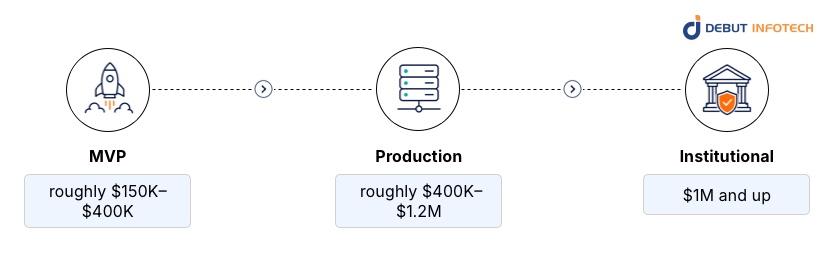
Budget, in practice, sorts most projects into three tiers:
The most useful framing is a build vs buy vs white-label decision made per layer, not for the whole platform at once. You might white-label the matching engine to launch quickly, build a custom wallet and compliance layer where your differentiation and risk live, and buy best-in-class observability off the shelf. Treating the decision layer by layer — rather than as one all-or-nothing choice — is how teams balance speed, cost, and control.
Architecture is easiest to judge against real delivery. Three Debut Infotech projects illustrate the patterns above under genuine production constraints.
NDAX — Canadian regulated exchange. A unified, enterprise-grade crypto suite pairing the NDAX Exchange with a self-custodial, multi-chain wallet. Architecture highlights: a high-throughput trading engine on a microservices architecture, merged CEX and DEX execution within one platform, AI-driven trading automation, bank-grade encryption with proactive threat monitoring, and a compliance pipeline built around FINTRAC — including registration as a Money Service Business (MSB). Outcome metrics: over $12 billion in trading volume facilitated, an 85% increase in transaction speed, a 90% reduction in manual intervention, and a 100% improvement in security posture — the platform went on to become Canada’s second-largest crypto exchange, serving tens of thousands of active users without scaling headcount.
A multi-region deployment built on the horizontal-scaling architecture from Section 3, with a feature scope spanning spot, margin, futures, and a full API trading terminal. The OKX architecture decisions were driven specifically by the platform’s user-volume requirements:
A smart-contract security architecture that has undergone a formal CertIK audit. CertIK approval required. The reason certification matters is for institutional counterparties, a recognized audit is increasingly the price of entry, not a nice-to-have.
Cryptocurrency exchange architecture is the full-stack technical framework — matching engine, wallet infrastructure, API gateway, database and storage, security layers, and compliance systems — that lets a trading platform accept orders, match trades, custody assets, and stay compliant under load. It spans both the logical design (what components exist) and the physical deployment (how and where they run).
The core components are the client interface layer (web, mobile, trading terminal), the API gateway (auth, routing, rate limiting), the matching engine (the order book), wallet infrastructure (hot/cold storage, HSM, multi-sig/MPC), the database and storage layer (PostgreSQL, time-series stores, Redis, Kafka event sourcing), the KYC/AML compliance pipeline, and the monitoring and observability stack.
A matching engine maintains the order book and pairs buy and sell orders according to defined rules — most commonly FIFO (price-time priority), sometimes pro-rata. For speed, it holds the active book in memory, and for safety, it writes every change to a persistent, replayable log so the state can be rebuilt after a failure. Well-designed engines target 100,000+ orders per second at single-digit-millisecond latency.
A CEX uses a centralized matching engine and holds custody of user funds, delivering very low latency and full KYC/AML at the cost of trust concentration. A DEX runs matching and settlement on-chain via smart contracts, so users keep custody — gaining censorship resistance but inheriting blockchain latency and gas costs. Hybrids combine a centralized engine with on-chain settlement.
Through redundancy and graceful degradation: multi-AZ and multi-region deployment, so no single data center is a point of failure, circuit breakers to isolate failing services before they cascade, active-active or active-passive failover, layered DDoS mitigation at the network edge, and disaster-recovery targets (commonly RTO <4 hours, RPO <1 hour) backed by frequent encrypted, geographically separated backups.
Defense in depth across network (WAF, DDoS), application (input validation, rate limiting), data (encryption at rest and in transit), and operational layers (least-privilege access, documented key ceremonies). Add a cold-dominant wallet architecture with HSM and multi-sig/MPC custody, quarterly penetration testing, plus a bug bounty, formal smart contract audits, and insurance on hot-wallet holdings.
Costs typically fall into three tiers: an MVP on a white label or licensed engine runs roughly $150K–$400K; a production-grade build with a custom matching engine, multi-region deployment, and full compliance stack runs roughly $400K–$1.2M; and an institutional-grade platform with colocation, custom HSM, formal audits, and full licensing starts around $1M. The biggest cost drivers are the custody model, target throughput, and the number of regulatory jurisdictions.

Our Latest Insights
USA

2501 Chatham, Rd Suite R Springfield, IL 62704
+1-708-515-4004
info@debutinfotech.com
UK

7 Pound Close, Yarnton, Oxfordshire, OX51QG
+44-770-304-0079
info@debutinfotech.com
Canada

154 Eden Oak Trail, Kitchener, ON N2A 0H9
+1-708-515-4004
info@debutinfotech.com
INDIA

Sector 101-A, Plot No: I-42, IT City Rd, JLPL Industrial Area, Mohali, PB 140306
9888402396
info@debutinfotech.com

9001:2015
Quality Certified

ISO 27001
Security Certified

A+ Rating
Accredited Business

Certik
Security & Audit


Copyright © 2026, Debut Infotech. All rights reserved. | Privacy Policy