ON THIS PAGE
Progress0%






Our Global Presence :





Blockchain developer costs vary widely by experience and specialization: Typical rates range from about $25–$300+ per hour, with senior architects, protocol engineers, and security auditors commanding premium rates.
Hiring location can materially change the budget: The U.S. and Western Europe generally cost more than India, Eastern Europe, Latin America, and Southeast Asia, but communication, time-zone overlap, and rework also affect total cost.
Project risk should determine the developer seniority you hire: Junior developers can handle defined, lower-risk tasks, while DeFi, financial applications, smart contracts, bridges, and protocol architecture often require senior or specialist expertise.
The hiring model affects both cost and control: Freelancers suit focused assignments, dedicated teams support ongoing development, outsourcing fits complex end-to-end builds, and in-house teams provide stronger long-term ownership of core blockchain capabilities.
Security, infrastructure, and maintenance belong in the total budget: Recruitment, cloud and node infrastructure, RPC services, testing, security audits, remediation, monitoring, and post-launch maintenance can substantially increase costs beyond developer rates.
Lowest hourly rates do not necessarily mean lower project costs: Technical screening, paid trial tasks, milestone-based delivery, clear governance, and independent security reviews can reduce rework, turnover, coordination overhead, and costly hiring mistakes.
Technology requirements should drive hiring decisions: Skills in Solidity, Rust, smart-contract security, token standards, blockchain infrastructure, testing, DevOps, and platforms such as Ethereum, Solana, or Hyperledger should align with the project's architecture and business requirements.
The cost to hire blockchain developers can range from roughly $25 to $300+ per hour, depending on experience, location, specialization, and project complexity. Full-time salaries can range from around $50,000 for junior talent in lower-cost markets to $250,000+ for senior architects and security specialists in high-cost markets. These are planning ranges rather than fixed market prices. Actual costs vary by hiring model, technology stack, and the developer’s track record.
A junior developer working on a defined dApp feature often cost far less than a senior protocol architect or security auditor handling a high-risk financial application.
Your budget also needs to account for recruitment, infrastructure, security audits, maintenance, and other costs beyond the developer’s hourly rate. Market demand, technology specialization, and the level of security your project requires can also influence rates, making it important to evaluate total project costs rather than hourly pricing alone.
This guide breaks down blockchain developer rates by experience, country, and specialization. It also compares hiring models, explains the factors that affect costs, and covers what to look for when hiring, which technical skills matter, and how to control expenses without compromising quality or security.
Blockchain development remains a specialized software engineering market. The supply of experienced developers is also uneven. That matters when estimating hiring costs because developers with proven experience in smart contracts, protocol engineering, security, and multi-chain development command a premium.
Here are four useful indicators for the current market:
1. U.S. software developers had a median annual wage of $133,080 in May 2024, according to the U.S. Bureau of Labor Statistics. Blockchain developers are a specialized subset of software developers, so this provides a useful baseline for understanding high-income markets.
2. Software developer employment is projected to grow 16% from 2024 to 2034 in the U.S. The BLS also projects about 267,700 additional software developer jobs over that period. Strong demand for software engineering talent puts upward pressure on compensation for specialized developers.
3. 39,148 new developers explored crypto in 2024, according to Electric Capital. At the same time, the total developer population declined 7%. This distinction matters because experienced crypto developers are becoming more valuable even when overall developer participation fluctuates.
4. Established crypto developers with at least two years of experience grew 27% year over year and produced 70% of crypto code commits in 2024. This helps explain why a developer with several years of actual blockchain experience can cost considerably more than a conventional software developer with similar general coding experience.
Location also has a major effect on the final cost to hire blockchain developers. A company hiring in the United States may pay substantially more than one hiring in India, Eastern Europe, or Latin America for comparable engineering capacity.
However, the cheapest hourly rate does not automatically produce the lowest project cost. Communication, management, security, and rework can quickly erase the difference.
Experience should be treated as a cost and risk variable. A junior developer can be a sensible choice for clearly defined, low-risk work. Projects involving financial assets, smart-contract upgrades, bridges, wallets, consensus mechanisms, or sensitive infrastructure usually justify more experienced engineers.
The following ranges are practical budgeting estimates based on current freelance and software-engineering market benchmarks.
| Experience level | Typical hourly rate | Approx. Annual salary |
| Junior, 0–2 years | 30–60/hr | 60,000–100,000 |
| Mid-level, 2–5 years | 60–100/hr | 100,000–160,000 |
| Senior, 5–8+ years | 100–175/hr | 160,000–250,000 |
| Architect / Lead / Auditor | 150–300+/hr | 220,000–400,000+ |
Annual figures are broad full-time market-planning ranges, not direct conversions of freelance rates. Contractor rates generally include costs that employees and employers account for separately.
Junior talent can work well for tasks such as frontend implementation, API integration, documentation, basic testing, wallet UI work, bug fixing, and well-defined backend features. It can also make sense when a senior developer provides architecture and code review.
A junior developer becomes a poor fit when the work involves designing a protocol, handling significant user funds, writing unaudited production smart contracts, developing cryptographic systems, designing consensus logic, or making security-critical architectural decisions.
Mid-level developers are suitable for projects that require independent implementation but have established architecture and technical direction. They can handle smart-contract features, dApp integrations, backend services, testing, and blockchain APIs with limited supervision. They are a stronger choice than juniors when the project has moderate complexity or several interconnected components.
However, highly security-sensitive blockchain protocols, complex token economics, and major architectural decisions may still require senior oversight or specialist review.
Senior developers are appropriate when the project involves complex architecture, substantial user funds, multiple blockchain integrations, or demanding performance requirements.
They can make technical decisions, review other developers’ work, identify security risks, and guide implementation without constant supervision. Their higher rates can reduce rework and technical debt.
For DeFi platforms, wallets, exchanges, enterprise blockchain systems, and production smart contracts, senior expertise can provide stronger risk control throughout development.
Architects, technical leads, and security auditors are best suited to high-risk or technically demanding blockchain projects. An architect can define protocol and infrastructure design, while a lead coordinates technical execution across developers and systems.
Auditors focus on finding vulnerabilities before deployment. Their rates are higher because their decisions can affect the entire project. They are particularly valuable for DeFi protocols, bridges, custom networks, complex smart contracts, and enterprise blockchain infrastructure.
Geographic hiring can produce substantial cost differences. The ranges below represent typical planning estimates for professional blockchain development rather than guaranteed salary or freelance rates. The table below shows blockchain developer cost by country:
| Region | Typical hourly rate | Approx. annual salary |
| United States | $100–$200/hr | $150,000–$280,000+ |
| Canada | C$95–C$205/hr | C$110,000–C$210,000 |
| UK / Western Europe | £65–£135/hr / €75–€150/hr | £90,000–£190,000 / €105,000–€210,000+ |
| Eastern Europe | €35–€80/hr | €60,000–€115,000 |
| India | ₹2,100–₹5,000/hr | ₹30 lakh–₹65 lakh |
| Latin America | $35–$90/hr | $50,000–$120,000 |
| Southeast Asia | $25–$70/hr | $35,000–$90,000 |
These ranges reflect market differences and should be adjusted for seniority and specialization. For comparison, Canada’s official Job Bank reports a national blockchain developer median wage of C$31.25 and high of C$77.33.
India and other lower-cost markets can offer substantial savings. HSBC’s technology labor analysis found that Indian software wages were about 13% of equivalent U.S. wages, while Latin American wages were generally 50–70% below U.S. equivalents in its 2023 comparison. These figures are broader software-market benchmarks rather than blockchain-specific rates, so they should not be applied mechanically to senior blockchain specialists.
Offshore hiring can reduce labor costs by 40–60% or more in some situations, particularly when companies hire from India, Southeast Asia, Eastern Europe, or Latin America.
The actual saving depends on the local market, developer seniority, specialization, and engagement model. However, lower offshore blockchain developers cost also introduce tradeoffs that should be assessed before choosing an offshore team.
The Tradeoffs In Hiring Offshore Blockchain Developers
Timezone gaps can make collaboration slower, especially when developers and stakeholders need frequent discussions.
A six-to twelve-hour difference may mean waiting until the following day for answers, approvals, or fixes. This matters more during testing, deployment, and incidents.
Teams can reduce the impact through overlapping work hours, clear documentation, and defined escalation procedures.
Communication quality can affect the total blockchain development pricing as much as the developer’s hourly rate. Misunderstood requirements may lead to incorrect implementations, repeated development, or delayed releases.
Written specifications, regular status updates, shared documentation, and clear acceptance criteria help reduce these problems.
Strong English communication also becomes important when technical decisions require precise explanations.
Offshore teams require stronger governance around code, infrastructure, credentials, and production access.
Define who owns the repository, cloud accounts, deployment keys, documentation, and intellectual property before development starts. Use role-based permissions and maintain an audit trail for sensitive actions. These controls reduce operational risk without preventing external developers from working efficiently.
A lower-cost developer is not necessarily a lower-cost hire.
Inexperienced developers may require extensive supervision, produce more defects, or need senior engineers to correct their work. Technical screening, paid test assignments, code reviews, and milestone-based delivery can help control quality.
For security-critical blockchain work, independent review should remain part of the process.
Cross-border development can create additional legal considerations involving intellectual property, confidentiality, data handling, payment terms, liability, and dispute resolution.
Contracts should clearly establish ownership of source code and deliverables. They should also define access to confidential information, termination procedures, and responsibilities for security incidents.
Legal requirements vary by jurisdiction, so professional advice may be appropriate.
Offshore development works best when governance is deliberate. Keep repositories, deployment permissions, secrets, architecture decisions, and production access under controlled ownership. Use offshore developers for execution where appropriate, but retain strong technical oversight for security-critical components.
Blockchain developers do not represent one homogeneous skill category. A Solidity developer building a token contract and a protocol architect designing a new consensus layer can have completely different market values.
| Specialization | Typical hourly rate | Typical use |
| Core protocol / blockchain architect | 150–300+ | Protocol design, consensus, node architecture, scaling |
| Smart contract developer | 60–150+ | DeFi, tokens, NFTs, DAOs, on-chain business logic |
| Security auditor | 100–300+ | Smart-contract reviews, vulnerability analysis, exploit prevention |
| dApp / frontend developer | 40–100+ | Web3 interfaces, wallets, APIs, blockchain integrations |
| Solana / Rust developer | 80–200+ | Solana programs, Rust-based blockchain systems |
| Hyperledger / enterprise developer | 60–150+ | Permissioned networks, enterprise integrations, private blockchain |
Specialized security and protocol work commands a premium because the cost of mistakes can be far higher than the developer’s fee.
For example, Chainalysis reported $2.2 billion in cryptocurrency stolen from platforms during 2024, across 303 hacking incidents. CertiK later reported more than $3.35 billion in Web3 security losses across 630 incidents in 2025.
The hiring model influences the cost of hiring a blockchain developer. It affects the hourly rate. It determines how much control you have, how quickly you can start, how much internal management is required, and whether the team can support the project beyond the initial build.
| Hiring model | Relative cost | Control | Speed to hire | Best-fit use case |
| In-house | High | Very high | Slow | Long-term core product and IP |
| Freelancer | Low–medium | Medium | Fast | Small or narrowly scoped projects |
| Dedicated team | Medium–high | High | Medium | Ongoing product development |
| Outsourcing / agency | Medium–high | Medium | Fast–medium | End-to-end builds and complex projects |
In-house hiring provides the greatest control over product development, technical decisions, security practices, and intellectual property. Developers become familiar with the company’s systems and business objectives over time.
Pros:
Cons:
In-house teams are best suited to companies where blockchain is a core part of the product or competitive advantage. The higher fixed cost becomes easier to justify when development will continue for years.
Freelancers provide flexible access to specialized blockchain skills without the long-term cost of employing a full-time developer. They can be particularly useful for defined assignments such as smart-contract development, wallet integration, frontend work, technical fixes, or proof-of-concept development.
Pros:
Cons:
Freelancers work best when requirements are clear and the project does not require a large multidisciplinary team.
A dedicated team provides a stable group of developers who work continuously on your product while remaining external to the organization. This approach offers more continuity than freelancers without requiring the company to recruit every engineering role internally.
Pros:
Cons:
Dedicated blockchain developers are particularly useful for blockchain products that need ongoing development, testing, DevOps, maintenance, and technical support.
Outsourcing transfers much of the development responsibility to an external provider. An experienced blockchain agency can handle architecture, smart contracts, frontend development, backend systems, QA, DevOps, and security coordination under one engagement.
Pros:
Cons:
Blockchain development outsourcing is a strong option when a company has a defined product but lacks the internal blockchain expertise to build it. It is also useful when speed matters and assembling an internal team would delay development.

Blockchain developer costs are mainly affected by experience, location, technical specialization, project complexity, security requirements, engagement model, and development urgency. Each factor can change the number of hours required, the type of expertise needed, or the developer’s market rate.
Here are crucial factors affecting the cost to hire blockchain developers:
Experience is one of the strongest factors affecting blockchain developer costs.
A developer who has only completed tutorials or small test projects will generally cost less than someone who has deployed production smart contracts or built blockchain infrastructure at scale.
Experienced developers can identify architectural problems earlier, make better technical tradeoffs, and require less supervision. Their track record also matters.
A developer who has worked on DeFi protocols, wallets, exchanges, or enterprise blockchain systems brings domain knowledge that can shorten development time.
For high-risk projects, paying more for proven expertise can reduce rework, delays, and security problems later.
Location has a direct effect on blockchain developer rates because compensation varies considerably between technology markets.
Developers in the United States and Western Europe generally command higher rates than developers in India, Eastern Europe, Latin America, and Southeast Asia.
However, location should not be evaluated on price alone. Consider timezone overlap, communication, local employment costs, and availability of specialized talent.
A lower-cost market can deliver substantial savings when the team has the required expertise and strong processes are in place.
Conversely, poor communication or limited availability can create delays that offset the initial savings. Location works best as a budget variable, not a quality shortcut.
The blockchain technology stack can significantly change the cost of development.
A developer who works with common EVM technologies may be easier and cheaper to hire than a specialist in protocol engineering, zero-knowledge systems, Solana development, or advanced cryptography. The same applies to enterprise technologies such as Hyperledger, where developers need knowledge of permissioned networks and enterprise integrations.
Specialized skills have smaller talent pools, which can increase rates. Your requirements should therefore determine the skill set you pay for.
Hiring an expensive specialist for routine frontend work wastes budget, while assigning complex protocol engineering to a generalist can create technical and security problems.
Project complexity directly affects the number of developers, development hours, testing requirements, and technical specialties needed.
A basic token contract may require a relatively small team, while a DeFi protocol, blockchain network, or cross-chain application can involve several engineering disciplines. Complexity can increase through factors such as:
The more interconnected the system becomes, the more important architecture, testing, security review, and experienced technical leadership become.
Security requirements can increase blockchain development costs substantially because blockchain vulnerabilities can result in irreversible financial losses.
Projects handling user funds usually require more extensive testing, code review, threat modeling, monitoring, and independent auditing than ordinary applications. Requirements may include:
Security should influence the developer profile you hire from the beginning. A low-cost development team without strong security experience may create additional expenses later through remediation, audits, redeployment, or emergency fixes.
The engagement model affects both the developer’s rate and the amount of management the client must provide.
Freelancers can be cost-effective for short, clearly defined assignments, while dedicated teams make more sense for continuous development.
Agencies may cost more than individual developers but provide architecture, QA, DevOps, and project management under one engagement.
Fixed-price contracts can improve budget predictability when requirements are stable, while hourly arrangements offer more flexibility when scope is still changing.
Choosing the wrong model can increase costs through idle capacity, excessive management, change requests, or unnecessary long-term commitments. Match the engagement structure to project scope and duration.
Project urgency can increase blockchain development costs because compressed timelines often require additional developers, longer working hours, or parallel development.
A team may need to prioritize speed over the normal sequence of architecture, implementation, testing, and review. This can also increase coordination overhead.
Urgent launches are particularly risky when smart contracts or financial infrastructure are involved because reducing testing time can create security problems.
If the launch date is fixed, identify the critical features early and allocate experienced developers to them. Adding capacity can help, but rushing security reviews or deployment procedures simply to meet a deadline can create larger costs after launch.
The hourly rate represents only part of the total blockchain developer hiring cost. Recruitment, onboarding, infrastructure, security audits, and ongoing maintenance can significantly increase the budget required to build and operate a blockchain product.
The advertised developer rate does not include the cost of finding and preparing the person for the project. Recruitment can involve:
These costs are particularly relevant when hiring in-house because companies also absorb employment-related expenses and management time.
Specialized blockchain roles can take longer to fill because the qualified candidate pool is smaller.
A company can reduce unnecessary recruitment costs by defining the role clearly, screening for relevant blockchain experience, and verifying technical ability before making a long-term commitment.
Blockchain development requires infrastructure beyond the developer’s workstation. Depending on the project, the budget may include:
Some expenses increase as transaction volume and user activity grow. Infrastructure requirements can also change when a project moves from testnet to production. These costs should be included in the project budget from the beginning.
Otherwise, a development estimate may look affordable while the actual operating cost becomes considerably higher after launch.
Security audits are a separate cost from development because an independent security review serves a different purpose.
Developers focus on building the system, while auditors examine the implementation for vulnerabilities, design weaknesses, and attack paths.
Audit costs vary according to contract size, code complexity, protocol architecture, and the scope of the review. A project may also need remediation work after the initial audit, followed by a second review.
Budgeting for this process early gives developers enough time to address findings before deployment. For applications handling significant user funds, treating security auditing as an optional expense can expose the project to disproportionate financial risk.
Blockchain development does not end when the application goes live. Production systems require ongoing technical work to remain secure, compatible, and reliable. Maintenance may include:
Maintenance costs depend on the application’s complexity and usage. A simple dApp may require limited ongoing support, while a DeFi protocol or enterprise blockchain platform can need continuous monitoring and engineering. Include maintenance in the original budget rather than treating it as an unexpected post-launch expense.
A bad blockchain hire can cost much more than the difference between two hourly rates.
Suppose one developer charges $50 per hour and another charges $100. If the cheaper developer introduces a vulnerability that requires weeks of remediation, an external audit, contract redeployment, customer support, and legal work, the initial saving disappears quickly.
The security stakes are unusually high. Immunefi recorded $1.64 billion in crypto losses during Q1 2025, while CertiK recorded $2.47 billion in losses during H1 2025 across hacks, scams, and exploits.
A strong hiring process therefore needs to evaluate more than coding ability. Look for evidence of deployed work, security awareness, testing discipline, code review experience, and transparency about previous incidents.
The differentiator is not simply finding someone who claims to write secure code. It is verifying that they have done so in production.
The right hiring model depends on your project’s stage, complexity, duration, and internal capabilities. Freelancers suit short, focused assignments, while dedicated teams support ongoing development.
Agencies are useful for complex end-to-end builds, and in-house teams make sense when blockchain is central to the company’s long-term product strategy. A hybrid approach can also combine internal ownership with external expertise.
| Project situation | Recommended model | Why |
| Early proof of concept | Freelancer | Low commitment and fast access to specialized skills |
| Simple MVP | Freelancer / small agency | Suitable for defined requirements |
| DeFi or financial product | Dedicated team / specialist agency | Requires multiple technical disciplines |
| Enterprise blockchain | Dedicated team / outsourcing | Architecture, integration, security, and support are needed |
| Core proprietary protocol | In-house + specialist consultants | Retains strategic knowledge internally |
| Long-term product | In-house / dedicated team | Provides continuity and product knowledge |
| Short-term technical gap | Freelancer | Avoids permanent hiring |
| Security-critical smart contracts | Specialist developer + independent auditor | Separates development from security validation |
If blockchain is central to your competitive advantage, retaining architectural knowledge internally becomes more valuable. If blockchain is one component of a broader product, outsourcing can make more financial sense.
A hybrid model is also practical. Keep product ownership and strategic architecture inside the company while using external specialists for development, audits, protocol engineering, or temporary capacity.
Professional blockchain consulting services can help companies assess their internal capabilities and determine whether in-house development, outsourcing, or a hybrid model makes more financial sense.
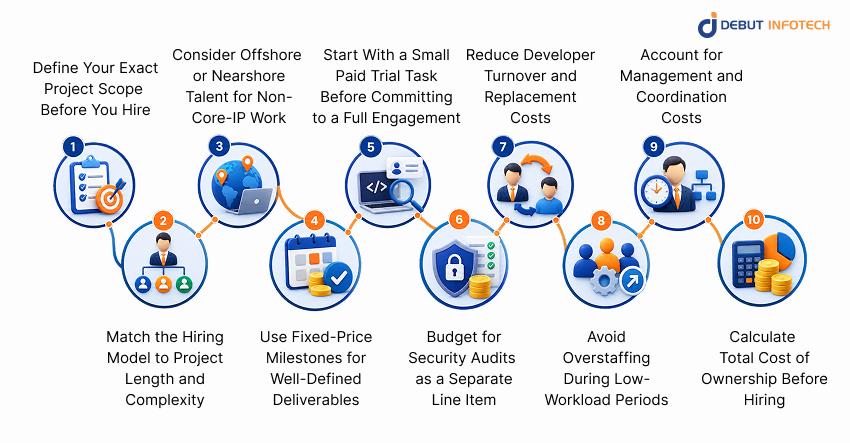
You can reduce blockchain hiring costs by defining the scope clearly, choosing the right engagement model, considering offshore or nearshore talent, using milestone-based contracts, testing developers before committing, and budgeting for security. You can also control turnover, overstaffing, management overhead, and total ownership costs while maintaining the expertise and quality your project requires.
A clearly defined scope gives you a realistic basis for comparing developers, rates, and hiring models. Vague requirements often lead to changing estimates, additional development hours, and unexpected technical work.
Before contacting candidates, document the core requirements, target blockchain, required integrations, expected users, major features, and security expectations.
Include the expected deliverables and acceptance criteria where possible. Your scope should cover:
A precise scope helps developers estimate effort more accurately and reduces budget surprises during development.
Your hiring model should reflect how much work needs to be done and how long development will continue.
Hiring a full-time developer for a two-month assignment can create unnecessary overhead, while relying on one freelancer for a complex product can create capacity and expertise gaps.
Consider the project duration, technical complexity, required specialties, and expected maintenance needs before deciding. Freelancers generally work well for narrow, short-term assignments.
When you decide to hire dedicated blockchain developers or agencies, you’d realise that they are better suited to ongoing products requiring several skills.
In-house hiring becomes more practical when blockchain development is a permanent business capability. The right model prevents you from paying for capacity you do not need.
Offshore and nearshore developers can reduce labor costs while giving you access to a broader talent pool.
Depending on the market and seniority, companies can sometimes achieve 40–60% lower development costs compared with hiring equivalent talent in high-cost markets. This approach works particularly well for non-core work such as:
For core protocol architecture, proprietary algorithms, private infrastructure, or security-critical components, tighter oversight may be appropriate.
Evaluate timezone overlap, communication, technical screening, intellectual-property protections, and governance alongside the blockchain developer hourly rate.
Savings are useful only when quality remains consistent.
Fixed-price milestones can make budgeting easier when project requirements are stable and deliverables can be clearly defined.
Instead of paying for an open-ended block of development hours, divide the project into measurable stages with agreed acceptance criteria.
For example:
Each milestone should specify what will be delivered, when it is due, and how completion will be evaluated.
Avoid using fixed pricing when requirements are still changing rapidly. In that situation, hourly or time-and-materials billing may provide greater flexibility and reduce disputes over scope changes.
A small paid trial can help you evaluate a developer’s technical ability before committing a substantial budget.
Give candidates a realistic but limited task related to the actual project. Assess more than whether the code works. Look at:
A paid task also gives the developer a fair opportunity to demonstrate their skills without requiring unpaid work.
The exercise should be short enough to evaluate efficiently but realistic enough to reveal how the candidate approaches production-style problems. This can prevent expensive hiring mistakes later.
Security auditing should have its own budget rather than being absorbed into the development estimate.
Developers can build and test the code, but an independent audit provides another layer of review. This is particularly important for applications involving financial transactions, user assets, DeFi mechanisms, bridges, wallets, or complex smart contracts. Your security budget may need to cover:
Reducing audit spending simply to lower development costs can create a false economy. A vulnerability discovered after deployment may require emergency fixes, redeployment, compensation, or other expensive remediation.
Developer turnover can create costs that never appear on the original hiring quote. When an experienced developer leaves, you may need to repeat recruitment, onboarding, knowledge transfer, and technical handover.
Development can also slow while the replacement learns the codebase. Longer contracts, clear responsibilities, competitive compensation, and proper documentation can help reduce these costs.
For blockchain projects, retaining technical knowledge is especially valuable because architectural decisions and smart-contract logic can be difficult for a replacement to understand quickly.
Hiring more developers than the project currently requires can increase costs without improving delivery.
Some blockchain projects need additional specialists during architecture, smart-contract development, testing, or launch but require fewer developers afterward.
Scale the team according to workload instead of maintaining maximum capacity throughout the project
A dedicated team or staff-augmentation model can make this easier because you can adjust development capacity as requirements change. This approach can prevent companies from carrying unnecessary salary or contractor costs during slower development phases.
Developer rates do not capture the internal time required to manage external or distributed teams.
Project managers, technical leads, product owners, and senior engineers may spend substantial time reviewing work, clarifying requirements, resolving blockers, and coordinating releases. These costs increase when several independent freelancers are involved.
A smaller, well-structured team can sometimes deliver more efficiently than a larger group of low-cost developers. Clear ownership, documentation, communication processes, and defined reporting structures help reduce coordination overhead and keep management costs under control.
Compare developers using their expected total cost rather than their advertised hourly rate. Your calculation should consider:
A developer charging $70 per hour may ultimately cost less than one charging $40 if they require less supervision, produce fewer defects, and complete the work faster.
Looking at total cost of ownership gives you a more realistic comparison and prevents a low hourly rate from creating a higher overall project bill.
Look for proven production experience, relevant blockchain expertise, strong technical judgment, clear communication, and evidence of successful project outcomes.
Deployed work, GitHub activity, technical test tasks, references, and experience handling vulnerabilities can reveal more than a resume alone.
Domain knowledge also matters because DeFi, enterprise, gaming, payments, and other blockchain projects involve different technical risks.
Prioritize verifiable production experience over polished portfolio descriptions. Ask candidates to explain projects they have actually contributed to and, where possible, provide evidence such as:
They may not be able to share proprietary source code, but they should be able to explain their responsibilities, architecture decisions, and technical challenges. Look for consistency between what a candidate claims and what can be independently verified.
A developer who can discuss production constraints and past decisions in detail generally provides stronger evidence of practical ability than someone relying primarily on screenshots or generic project descriptions.
A scoped technical task can reveal how a developer thinks, communicates, and handles practical problems. The assignment should resemble the type of work they will perform on your project without requiring a large unpaid deliverable. Evaluate:
The goal is not simply to test whether they know a programming language. It is to understand their development process. A strong candidate should be able to explain why they made specific decisions and identify limitations or potential risks in their solution.
Ask candidates about previous bugs, vulnerabilities, failed deployments, or production incidents. You are not looking for someone who claims never to have made a mistake. Instead, assess how responsibly they handled problems. Ask:
A developer who can discuss mistakes openly may provide more useful insight than someone who presents an unrealistically perfect history.
Blockchain projects often involve irreversible transactions and financial risk, so accountability and incident-management experience can be as valuable as technical knowledge.
Technical ability alone does not guarantee an effective remote working relationship. Developers need to communicate decisions, blockers, risks, and progress clearly, especially when teams operate across different time zones. Evaluate whether candidates can:
This becomes particularly important when hiring offshore developers. Strong asynchronous communication reduces unnecessary meetings and prevents small misunderstandings from becoming development delays.
During interviews or trial tasks, pay attention to how candidates explain their reasoning. Clear communication is part of effective technical delivery, not a separate soft skill.
Look for developers whose previous experience matches the type of blockchain product you are building. Different domains involve different technical risks and business requirements.
A DeFi developer may understand liquidity mechanisms and smart-contract attack surfaces, while an enterprise blockchain developer may have stronger experience with permissioned networks and existing business systems.
Relevant experience may include:
Domain alignment can shorten the learning curve and reduce the amount of project-specific supervision required. It also helps developers identify risks that may not be obvious to general software engineers.
References provide another way to assess whether a developer consistently delivers what they promise. Ask previous clients about communication, reliability, technical quality, deadline management, and how the developer handled problems.
Where references are unavailable, look for other verifiable evidence such as public repositories, deployed applications, documented case studies, or client testimonials that can be independently confirmed.
Be cautious with vague claims such as “built a successful DeFi platform” without details about the developer’s actual role. The goal is to establish what the candidate personally contributed and whether their previous work produced measurable or verifiable outcomes.
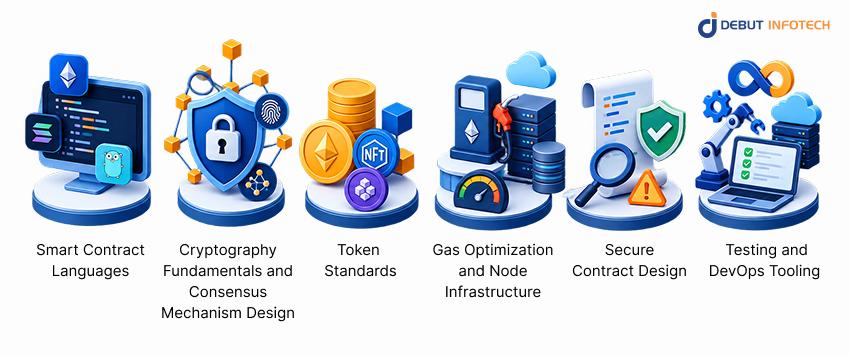
A capable blockchain developer should have relevant programming expertise, blockchain and cryptography fundamentals, knowledge of token standards, gas optimization skills, secure smart-contract development experience, and familiarity with testing and DevOps tools.
The exact requirements depend on the target network and project type, but production experience with the relevant technology stack is more important than simply listing multiple programming languages.
A blockchain developer should have strong command of the languages required by your target network. Common options include:
Language knowledge alone is not enough. Assess whether the developer understands the execution environment, development framework, testing process, and security model of the chosen chain
A strong candidate should also be able to explain why a particular language and architecture are appropriate for the project rather than simply listing several programming languages on their resume.
Blockchain developers should understand the cryptographic and consensus principles behind the networks they build on. Relevant knowledge includes:
The developer does not necessarily need to be a cryptographer. However, they should understand the security assumptions behind the system and how transactions are validated.
For protocol-level projects, stronger knowledge of consensus design becomes important. This helps developers identify architectural weaknesses instead of treating cryptographic components as black-box features.
Developers working on token-based applications should understand the standards supported by the target blockchain and how those standards affect implementation. For EVM-based projects, common standards include:
The developer should understand more than how to implement these standards. They should know how token transfers, approvals, ownership, metadata, and access controls work.
Experience with real token deployments is also useful because implementation decisions can affect compatibility with wallets, exchanges, marketplaces, and other decentralized applications.
A capable blockchain developer should understand how application design affects transaction costs and network performance.
Gas optimization knowledge may include storage usage, calldata, transaction structure, contract interactions, and efficient smart contract architecture. Developers working on infrastructure should also understand:
These skills become particularly important as transaction volume grows. Poorly optimized contracts can increase user costs, while weak node infrastructure can create reliability problems.
Look for developers who can balance optimization with code readability and security rather than reducing gas consumption at the expense of maintainability.
Security should be a core technical requirement for developers writing production smart contracts. Candidates should understand common protections and attack surfaces, including:
A strong developer should also understand how these protections apply to the specific protocol rather than adding security patterns mechanically. Ask candidates to explain previous vulnerabilities they have identified or prevented.
For financial applications, experience with threat modeling, secure development practices, and independent audit preparation can provide additional confidence.
Blockchain developers should be comfortable testing contracts and applications before they reach production. Relevant tools and practices include:
Testing should cover normal transaction flows as well as failure conditions, access-control restrictions, unexpected inputs, and interactions with external contracts.
DevOps knowledge also matters because blockchain applications require controlled deployment processes.
A developer who can build, test, deploy, monitor, and troubleshoot the application is generally more valuable than one who focuses only on writing contract code.
Finding skilled blockchain developers at a suitable rate is easier when you work with a team that already has the expertise, infrastructure, and delivery experience your project requires. Debut Infotech provides blockchain development services for businesses that need help with smart contracts, dApps, DeFi platforms, enterprise blockchain solutions, and custom blockchain products.
Debut Infotech can provide:
Instead of recruiting and managing individual developers, you can work with a team matched to your project’s scope, technology stack, and budget. We can support both focused development requirements and larger end-to-end blockchain projects.
Whether you’re validating an idea, building an MVP, or expanding an existing platform, our team can help you select the right development approach and turn your requirements into a production-ready blockchain solution.
The cost to hire blockchain developers depends on more than an hourly rate. Experience, location, specialization, project complexity, security requirements, and hiring model all influence the final budget.
Companies can control costs by defining scope, choosing the right engagement model, considering offshore talent, and verifying technical expertise before hiring.
However, cost savings should not come at the expense of security or quality. A well-planned hiring strategy balances development costs with long-term project reliability.
Hiring a blockchain developer can cost around 5,000–15,000 per month for a full-time developer, depending on experience and location. Junior developers may cost 40,000–70,000 annually, while senior specialists can command 100,000–180,000+ per year. Freelancers typically charge 40–150+ per hour.
Blockchain developers generally charge 40–150+ per hour. Junior developers often fall around 40–60/hour, mid-level developers around 60–100/hour, and senior developers around 100–150+ per hour. Developers specializing in smart contracts, DeFi, zero-knowledge technology, or enterprise blockchain can charge 150–200+ per hour.
The average blockchain developer hourly rate is roughly $60–$100 per hour. Junior developers typically charge $40–$60/hour, mid-level professionals charge $60–$100/hour, and senior developers commonly charge $100–$150+ per hour. Rates can climb beyond $200/hour for highly specialized blockchain architecture, security, or smart contract expertise.
Start by setting your budget, technical requirements, and project timeline. Decide whether you need a freelancer, in-house developer, dedicated team, or development company. Review 3–5 portfolios, check relevant blockchain experience, and assess skills in Solidity, Rust, Web3, or your chosen network. Before hiring, discuss rates, milestones, security, and delivery dates.
Blockchain development can cost roughly 20,000–50,000 for a basic application, 50,000–100,000 for a mid-complexity product, and 100,000–250,000+ for advanced platforms. A crypto exchange, DeFi protocol, enterprise blockchain, or large Web3 ecosystem can exceed $250,000. Features, integrations, security audits, and development time drive the final cost.

Our Latest Insights
USA
2501 Chatham, Rd Suite R Springfield, IL 62704
+1-708-515-4004
info@debutinfotech.com
UK
7 Pound Close, Yarnton, Oxfordshire, OX51QG
+44-770-304-0079
info@debutinfotech.com
Canada
154 Eden Oak Trail, Kitchener, ON N2A 0H9
+1-708-515-4004
info@debutinfotech.com
INDIA
Sector 101-A, Plot No: I-42, IT City Rd, JLPL Industrial Area, Mohali, PB 140306
9888402396
info@debutinfotech.com