ON THIS PAGE
Progress0%






Our Global Presence :






AI adoption is moving from experimentation to operational deployment, with businesses increasingly prioritizing measurable ROI, workflow integration, governance, and scalable infrastructure.
Agentic AI, multimodal AI, RAG, smaller language models, edge AI, and AI-native search are reshaping enterprise applications by making AI more autonomous, contextual, efficient, and accessible.
AI infrastructure is becoming a strategic business consideration, as compute costs, custom silicon, data-center capacity, cloud versus on-premises decisions, and inference economics directly affect scalability.
The biggest barrier is no longer AI availability but successful scaling, with poor data quality, legacy integrations, weak governance, unclear KPIs, and insufficient post-launch ownership limiting enterprise impact.
AI ROI should be measured through business outcomes rather than usage alone, using metrics such as processing time, cost per transaction, error rates, revenue impact, productivity, and customer experience.
The workforce is shifting toward AI-enabled roles and hybrid human-AI workflows, increasing demand for AI engineering, governance, data, security, and domain-specific expertise while preserving the importance of human judgment.
The AI landscape has changed significantly since 2023 and 2024. Those years were largely about experimentation. Businesses tested generative AI tools, built proofs of concept, and explored where the technology could fit. In 2026, the focus has shifted toward embedding AI into core operations, from customer service and software development to analytics, healthcare, finance, and supply chains.
Adoption has moved faster than measurable business impact. Most organizations now use AI somewhere in the business, and generative AI has reached similarly wide use. Yet scaling remains a problem. Many organizations are still running pilots instead of deploying AI broadly across their operations.
This gap between adoption and impact is one of the defining themes of AI Trends 2026. Companies are no longer debating whether AI belongs in the enterprise. They’re deciding which processes should use it, how much autonomy it should have, how it should be governed, and how its contribution should be measured.
This article examines the future of artificial intelligence in 2026, technologies, investments, industries, risks, workforce changes, and strategies shaping that transition. It also indicates where AI consulting services can help businesses translate these trends into action.
The AI industry is entering 2026 with spending at an unprecedented scale, and the numbers reveal several clear AI industry trends shaping enterprise strategy.
Gartner forecasts that worldwide AI spending will reach $2.59 trillion in 2026, representing a 47% increase from 2025. AI infrastructure accounts for a major share of this spending as organizations expand the computing capacity needed to train and operate increasingly demanding AI systems.
Enterprise technology budgets are moving in the same direction. McKinsey’s 2026 Global Tech Agenda found that half of surveyed organizations identify AI as a top technology investment area, and half expect their technology budgets to increase by more than 4% in 2026 compared with the previous year.
Adoption is also approaching a high level for AI trends 2026. Stanford reports that 88% of organizations used AI in at least one business function, while 70% used generative AI in at least one function. However, the rate of AI agent deployment remains much lower across individual functions. Broad access to AI has arrived faster than deep operational integration.
Spending is consequently shifting from experimentation toward operational deployment. Businesses are paying for model inference, AI-enabled software, data infrastructure, security, integration, monitoring, and ongoing maintenance. These AI trends 2026 create a more durable spending base, but also add pressure on companies to prove these investments improve revenue, productivity, cost efficiency, or customer experience.
| AI industry indicator | 2026 figure/signal | What it shows |
| Global AI spending | $2.59 trillion forecast | AI investment is moving into a new spending tier |
| Annual AI spending growth | 47% | AI remains one of the fastest-growing technology categories |
| Organizations using AI | 88% | Enterprise adoption is approaching saturation |
| Organizations using generative AI | 70% | GenAI has moved beyond early experimentation |
| Companies identifying AI as a top technology investment | 50% | AI is becoming a core budget priority |
High adoption does not automatically translate into high business value. The early AI race focused on access and experimentation. In contrast, the 2026 AI trends market is increasingly concerned with infrastructure, integration, governance, efficiency, and measurable returns.
Companies that connect AI tools to well-defined workflows will have a clearer path to proving whether the investment is working.
AI infrastructure is becoming a strategic consideration as model usage grows.
Compute availability, chip development, hosting decisions, and data-center capacity increasingly shape the cost and scalability of enterprise AI. Gartner expects AI infrastructure to account for a substantial share of total AI spending in 2026.
| Infrastructure trend | What is happening | Why it matters |
| Compute spend | AI infrastructure and inference demand continue to drive major spending | Determines the cost and scalability of AI workloads |
| Custom silicon | Specialized AI chips are competing with general-purpose GPUs | Can improve efficiency, speed, and cost for specific workloads |
| Compute as a moat | Reliable access to computing capacity is becoming a competitive advantage | Gives organizations greater ability to train, deploy, and scale AI |
| Cloud vs. On-premises | Falling inference costs are prompting businesses to reassess hosting strategies | Helps companies balance cost, control, security, and performance |
| Data-center capacity | AI demand is driving expansion of data-center infrastructure | Limited capacity can become a constraint on AI deployment |
Computing is becoming one of the highest operating costs for AI applications. Training still requires enormous computing resources, but inference is growing in importance as companies move AI into production.
An application serving millions of users can generate continuous model requests, particularly when agents perform multiple reasoning and tool-use steps per task.
Businesses should therefore evaluate compute based on the workload rather than simply choosing the most powerful hardware available. High-performance GPUs may make sense for model development, while smaller accelerators or optimized inference hardware may be more economical for routine production workloads.
Custom AI chips are gaining ground alongside general-purpose GPUs. Major cloud and technology companies are developing their own accelerators to improve performance for specific workloads and reduce dependence on external chip suppliers.
Competition increasingly comes down to cost per inference, energy efficiency, memory bandwidth, and latency. A chip does not have to outperform a leading GPU across every workload to be commercially useful. It only needs to deliver better economics for the tasks it is designed to handle.
This trend will give enterprises more infrastructure choices. Companies running AI at scale can increasingly compare GPUs, custom accelerators, cloud AI chips, and specialized hardware according to the requirements of individual applications.
Access to compute is becoming a strategic advantage because advanced AI systems depend on large, reliable processing capacity. Stanford’s 2026 AI Index reports that global AI compute capacity continues to expand at a steep rate.
For startups, affordable compute access determines how fast they can train, fine-tune, test, and deploy. For enterprises, the concern is predictable access to enough compute to support production workloads without infrastructure costs undermining the business case.
Compute planning should be part of AI architecture from the start. Organizations should estimate expected model calls, latency, and peak usage before selecting an infrastructure model.
Cloud remains the default choice for many organizations. It offers flexible access to expensive AI hardware without building in-house data-center capacity.
But enterprises are reassessing when cloud deployment makes sense. Falling inference costs, predictable workloads, data-residency requirements, privacy concerns, and long-term infrastructure spending are making private and hybrid environments more attractive for certain applications.
The practical approach is to evaluate workloads individually. Firms typically use private infrastructure for sensitive data, dedicated hardware for high-volume applications, and cloud for experimental projects. A hybrid architecture can combine these approaches without forcing every AI workload into the same environment.
Physical infrastructure is becoming a constraint on AI growth. Expanding capacity requires electricity, cooling systems, networking equipment, land, transformers, and access to advanced semiconductor supply chains.
Gartner expects global data-center systems spending to grow strongly in 2026 in response to AI-driven demand, and Stanford’s AI Index reports continued growth in AI data-center power capacity.
Enterprises planning large AI programs should factor in compute availability and energy requirements early, rather than treating infrastructure as an afterthought.
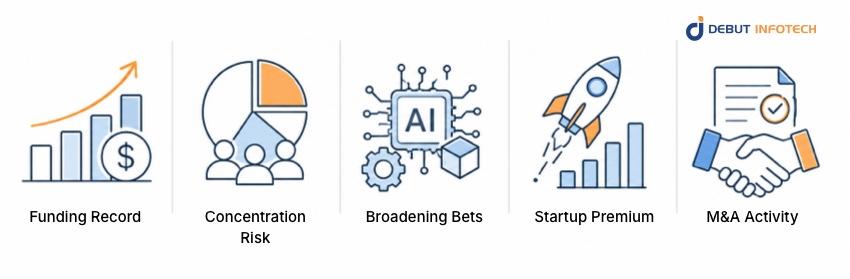
AI investment is reshaping the startup market in 2026, moving beyond model development into infrastructure, specialized applications, robotics, healthcare, and other sectors where AI can solve specific business problems.
Crunchbase reports that global startup funding reached $510 billion in the first half of 2026, already surpassing the full-year total recorded in 2025. AI companies captured a significant share. This reinforces the technology’s position as the dominant theme in venture investment.
The funding environment shows how capital-intensive advanced AI has become. Building frontier models requires enormous compute, specialized talent, data, and infrastructure. This means that the largest companies can raise far more capital than most early-stage startups.
A large share of AI funding is concentrated among a small number of frontier laboratories. OpenAI and Anthropic alone raised a combined $217 billion in H1 2026, 43% of all global startup funding in the period.
This creates a funding imbalance. Frontier labs need enormous capital to compete at the model level, while smaller AI startups can struggle to attract comparable funding even with commercially viable products.
Investors should distinguish between the capital requirements of foundation-model development and those of AI application companies. The two operate under very different economics.
Investment is also spreading into AI infrastructure and specialized applications such as data infrastructure, AI chips, robotics, healthcare, cybersecurity, and enterprise software.
This reflects a shift toward practical AI applications. Startups don’t need a frontier model to attract capital. Instead, they can build around existing models and compete through proprietary data, domain expertise, or workflow integration.
For businesses, this broadening means more options. Companies can choose from specialized AI providers instead of depending entirely on a small number of general-purpose model companies.
AI startups command higher valuations than many traditional tech startups because investors expect AI to create large markets and reshape existing software categories. Access to strong models can let young companies scale faster than earlier software businesses.
That premium isn’t guaranteed to translate into long-term success. AI startups still need sustainable revenue, defensible technology, strong retention, and manageable infrastructure costs.
Businesses evaluating an AI startup should look past valuation or funding history to product-market fit, model dependence, data advantages, security practices, and cost of serving customers.
Acquisition activity is among major AI investment trends. Larger technology companies can acquire specialized AI startups to gain talent, intellectual property, infrastructure, or a ready-made product rather than developing every capability internally.
CB Insights reported 266 AI M&A deals in Q1 2026, a 90% year-over-year increase, showing established companies actively using acquisitions to expand AI capabilities.
For businesses evaluating AI vendors, this consolidation creates both opportunity and risk. Acquisitions can give smaller AI companies access to larger distribution networks and resources. They can also change product roadmaps, pricing, or ownership of the technology.
Enterprises should therefore assess the stability of an AI vendor before making a major dependency. Financial backing, product roadmap, data policies, model availability, integration options, and exit strategies all matter when an AI system becomes part of a critical business process.
The fastest-growing AI technology trends in 2026 include agentic AI, multimodal models, small language models, edge AI, mature RAG architectures, AI-native search, synthetic data, and conversational AI. Together, these future enterprise AI technologies are making AI more autonomous, context-aware, efficient, accessible, and capable of handling increasingly complex enterprise workflows.
| AI technology | What is changing in 2026 | Business relevance |
| Agentic AI | AI systems are moving from generating responses to completing multi-step tasks | Automates workflows and reduces manual intervention |
| Multimodal AI | Models increasingly process text, images, audio, and video together | Supports richer customer, healthcare, retail, and enterprise applications |
| SLMs & Edge AI | Smaller, specialized models are becoming more capable and efficient | Enables lower-cost, faster, and local AI processing |
| RAG | Retrieval is becoming a governed knowledge layer rather than a simple add-on | Improves access to reliable enterprise information |
| AI-native search | Search is shifting toward generated answers and intelligent retrieval | Makes internal knowledge discovery faster |
| Synthetic data | AI-generated data is being used where real-world data is limited or sensitive | Supports training, testing, and privacy-sensitive applications |
| Voice AI | Real-time conversational systems are becoming more capable | Expands AI into customer service and operational workflows |
Agentic AI is one of the most important AI trends 2026.
Developing AI agents can interpret objectives, plan tasks, use tools, retrieve information, and complete multiple steps with limited human intervention. McKinsey reports that 62% of organizations are at least experimenting with AI agents, while 23% are already scaling an agentic system somewhere in the enterprise.
Enterprise applications are increasingly embedding task-specific agents. Examples include customer-service agents that investigate account issues, software-development agents that modify and test code, and research agents that collect and summarize information across sources.
Businesses should start with workflows where boundaries are clear and mistakes are containable, then expand agent responsibility as performance becomes reliable and measurable.
Multimodal AI lets models work with several forms of information such as text, images, audio, video, and structured data. This makes AI more useful in environments where information has traditionally been fragmented across different systems.
A healthcare application, for example, could combine clinical notes, medical images, lab results, and patient records. A manufacturing system could combine machine-vision footage, sensor readings, maintenance records, and production data.
The business opportunity comes from connecting these information sources. Organizations should focus on use cases where combining modalities improves a decision or reduces manual work rather than adding multimodal capabilities simply because they are available.
Smaller language models are gaining attention as businesses grow more conscious of inference costs, latency, privacy, and deployment flexibility. A smaller model trained or fine-tuned for a narrow task can outperform a larger general-purpose model on that specific workload.
This matters most for organizations that need AI close to the point where data is generated. Edge AI can process information locally on devices, vehicles, industrial equipment, and other systems without sending every request to the remote cloud environment.
Smaller models also make local deployment more practical. Organizations handling sensitive information can keep certain workloads within controlled environments while still benefiting from AI capabilities.
Retrieval-augmented generation has evolved past connecting a chatbot to a document pile. Modern RAG systems involve document processing, metadata, permissions, retrieval ranking, freshness controls, evaluation, and monitoring.
This makes RAG an enterprise knowledge architecture rather than an AI feature. A system may need to retrieve from CRM records, internal documentation, databases, support tickets, and other business systems while respecting user permissions.
Businesses should treat the underlying knowledge as a governed asset. Poorly maintained information can lead an AI system to produce confident but outdated or incorrect answers. Better retrieval cannot compensate for unreliable source data.
Enterprise search is moving away from keyword matching. AI-native search can retrieve information, interpret a user’s intent, summarize relevant material, and generate an answer from multiple sources.
This is especially valuable in organizations where information is spread across cloud storage, project-management platforms, CRM systems, ticketing tools, and internal databases.
The shift requires strong permission management. An AI search system should only retrieve information that the requesting employee is authorized to access. Search quality and access control therefore need to be designed together.
Synthetic data is becoming more useful in areas where real-world data is limited, expensive to collect, hard to label, or subject to strict privacy requirements. It can be generated to support model training, testing, simulation, and the creation of rare edge cases.
Healthcare, financial services, autonomous systems, and other regulated industries can benefit from synthetic datasets when access to real information is restricted. Developers can use synthetic environments to test how an AI system behaves under conditions that may be difficult to reproduce in the real world.
Synthetic data should still be validated against real-world conditions. Poorly generated synthetic information can reproduce biases or create unrealistic patterns. It works best when used alongside carefully selected real data rather than treated as a complete replacement.
Voice AI is moving toward real-time interaction. Advances in speech recognition, reasoning, and voice generation are making AI systems more capable of holding natural conversations while accessing business information.
Enterprise applications include customer support, appointment scheduling, sales qualification, internal help desks, field service, and automated phone workflows. The value increases when the voice system can take action rather than simply answer questions.
Reasoning models have become a major part of the AI landscape. Instead of focusing only on an immediate response, AI reasoning models allocate additional computation to solving complex problems. Stanford reports that AI performance continues to accelerate. Coding performance on SWE-bench Verified jumped from 60% to nearly 100% in a single year, and agent task success on the OSWorld benchmark rose from 12% to roughly 66%. This implies that frontier systems are rapidly reaching or exceeding human baselines across several challenging benchmarks.
The next competition is increasingly about cost-performance. A model that answers slightly better but costs several times more to run may not be the best enterprise choice.
Businesses are comparing accuracy, latency, reliability, context capacity, tool use, and inference cost as a combined metric. This supports a shift toward smaller, domain-tuned models rather than the strongest general-purpose option available.
Test-time compute is another important machine learning trend. Instead of increasing model size during training, developers let a model spend more computation on difficult problems during inference. This makes intelligence partly a function of how much computation is allocated to a task.
Open-weight models are also narrowing the gap with proprietary systems. Stanford reports that open-source AI development continues to expand, with millions of AI projects hosted across platforms such as GitHub and Hugging Face.
Traditional machine learning remains important despite the attention around foundation models. Forecasting, classification, recommendation systems, anomaly detection, predictive maintenance, fraud detection, and optimization still depend heavily on established ML techniques. MLOps remains the operational backbone for many production AI systems.
AI is becoming more deeply connected to business operations in 2026. The strongest enterprise trends focus on specialization, better context, governance, AI workflow automation, and real-time decision-making. Together, these are changing how companies design AI systems and where they place them within the organization.
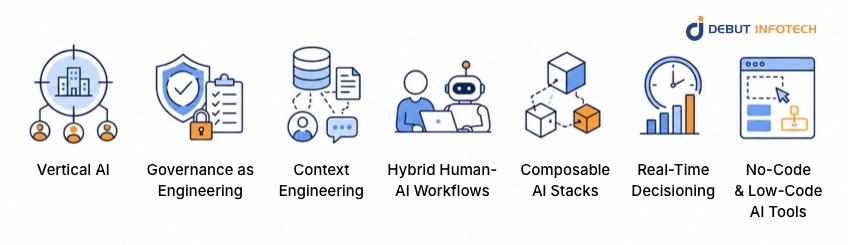
Here are the top enterprise AI trends 2026 that businesses should know:
Vertical AI is gaining traction because general-purpose models don’t always fit specialized workflows. Industry-specific AI can be trained, fine-tuned, or configured around the terminology, regulations, and data structures and processes of a particular sector.
Financial services, healthcare, legal, manufacturing, insurance, and real estate are examples where specialized AI can provide significant value. These systems can be designed around specific tasks such as claims processing, clinical documentation, contract review, fraud detection, or equipment maintenance.
Businesses evaluating vertical AI should focus on workflow performance rather than model size. A specialized system that consistently solves a narrow business problem can create more value than a larger general-purpose model that requires extensive customization.
AI governance is moving closer to the engineering process. Organizations need controls for data access, privacy, security, model evaluation, human oversight, audit trails, and acceptable use.
This matters most as businesses deploy agents capable of taking action. An agent that can modify records, communicate with customers, or trigger transactions needs much stronger controls than one that only drafts content.
Governance should be designed into the pipeline from the beginning. Businesses should define permissions, approval thresholds, monitoring requirements, evaluation criteria, and escalation procedures before the system reaches production.
Context engineering is becoming an important part of AI application development. The quality of an AI response depends not only on the model but also on the information supplied to it, the tools it can access, and the instructions governing its behavior.
Data architecture and AI architecture are increasingly connected. A capable model still underperforms if it receives outdated documents, incomplete records, irrelevant information, or poorly structured business data.
Organizations should treat context as a managed asset. Define which information an AI system needs, where that information comes from, how frequently it changes, and which users or agents are allowed to access it.
Fully autonomous AI is not appropriate for every business process. Many organizations get better results combining AI automation with human judgment.
AI can handle repetitive processing, information retrieval, classification, summarization, and routine recommendations. Humans stay responsible for exceptions, approvals, sensitive decisions, and situations beyond the system’s available information.
Businesses should define the human role explicitly. Specify when review is required, what to check, and what happens on an uncertain result, rather than a vague “human in the loop” requirement.
Enterprises are increasingly moving toward composable AI stacks that combine different models, tools, databases, APIs, and infrastructure components. This allows organizations to select technology based on the requirements of individual workloads.
One model might handle complex reasoning, another high-volume classification, another local or privacy-sensitive processing. Retrieval systems, workflow engines, vector databases, and business applications can then connect these models to operational data.
AI is moving from retrospective analysis toward real-time decision-making. Instead of examining information after an event, AI systems can analyze data as transactions, customer interactions, or operational events occur.
Examples include real-time fraud detection, dynamic pricing, personalized recommendations, customer-service routing, supply-chain optimization, and operational monitoring.
Real-time AI requires reliable data pipelines and low-latency infrastructure. Businesses should therefore evaluate the entire decision process rather than treating the model as an isolated component.
No-code and low-code AI platforms are making basic automation more accessible to business teams. Employees can create simple workflows for document classification, information extraction, customer communication, and internal knowledge management without building every component from scratch.
This can reduce the workload on engineering teams and allow business users to experiment with practical applications. It also shortens the path between identifying a repetitive task and testing an automated solution.
AI software trends are reshaping development through coding agents, multi-model stacks, open-weight models, automated code review, and agentic DevOps.
AI coding tools are moving beyond autocomplete. Modern coding agents can inspect repositories, understand requirements, modify multiple files, run tests, identify errors, and iterate on implementation.
This is changing how software teams divide work. Developers can delegate well-defined coding tasks to AI while spending more time on architecture, requirements, testing, review, and complex problem-solving.
Software teams are increasingly using multiple AI models instead of one provider, since different models have different strengths in reasoning, coding, speed, cost, and tool use.
A workflow might use one model for code generation, another for debugging, and a smaller model for routine transformations, with routing sending simple tasks to inexpensive systems and hard problems to stronger models.
This routing should be deliberate: ad hoc multi-model use increases complexity and cost tracking difficulty.
Open-weight models are becoming more attractive for software development because they give organizations more control over deployment and customization. Businesses can host models within their own environments, fine-tune them for specific tasks, and reduce reliance on external APIs where appropriate.
This particularly helps companies with strict data-residency or privacy requirements. It also provides another option when API pricing, availability, or vendor policies become a concern.
AI is becoming part of automated code review processes. Development tools can scan changes for potential vulnerabilities, bugs, duplicated logic, dependency risks, and quality problems.
The biggest benefit comes from integrating these checks directly into the pipeline, so developers get feedback during pull requests rather than after deployment.
AI code review should complement established security and testing practices. It should not replace static analysis, automated testing, penetration testing, or human review for high-risk applications.
AI agents are also moving into DevOps. They can monitor infrastructure, inspect logs, summarize incidents, and recommend remediation.
More advanced systems can perform approved operational actions, such as restarting a failed service or rolling back a deployment after predefined conditions are met.
Autonomous DevOps requires strict permission boundaries. High-impact changes should have approval controls, while lower-risk actions can be automated. Every action should also be logged so teams can understand what the agent did and why.
Technology and SaaS companies currently lead AI adoption, followed by financial services, while healthcare is accelerating rapidly. Retail is expanding AI across the customer journey, and manufacturing and logistics are increasing adoption as robotics, predictive systems, and automation become more practical for physical operations.
| Industry | Adoption trend | Key AI applications |
| Technology & SaaS | Leading adoption | Software development, customer support, analytics, product features |
| Financial services | High adoption and spending | Fraud detection, risk analysis, compliance, customer service |
| Healthcare | Rapid acceleration | Medical imaging, clinical decision support, documentation, drug discovery |
| Retail | Expanding across the customer journey | Recommendations, inventory, pricing, customer service |
| Manufacturing & logistics | Growing from a lower adoption base | Predictive maintenance, robotics, quality control, route optimization |
Technology and SaaS companies remain at the front of enterprise AI adoption. Since they already have cloud infrastructure, development teams, digital workflows, and large amounts of data, they have a strong foundation for deploying AI across functions.
AI is integrated into software development, customer support, sales, marketing, analytics, product management, and cybersecurity.SaaS companies are also adding AI directly to their products, allowing customers to automate tasks that previously required manual interaction with the software.
The competitive pressure is increasing as AI becomes a standard product capability. SaaS businesses need to determine whether AI should improve an existing feature, automate part of the customer’s workflow, or create an entirely new product capability.
Financial services are among the largest enterprise AI adopters because the industry generates large amounts of structured data and contains processes that depend on prediction, classification, risk assessment, and pattern recognition.
Banks, insurers, fintechs, and investment firms use AI for fraud detection, risk analysis, customer service, document processing, compliance, forecasting, and software development.
Financial institutions also face tighter requirements around privacy, explainability, and human oversight. AI influencing lending, fraud, investment, or account decisions requires stronger controls than low-risk productivity tools.
The sector’s high spending reflects the value of the underlying workflows. Small improvements in fraud detection, operational efficiency, customer retention, or risk management produce significant results at scale.
Healthcare is one of the sectors where AI adoption is accelerating quickly. Applications include medical imaging, clinical decision support, clinical documentation, drug discovery, patient engagement, remote monitoring, and administrative automation.
AI-enabled medical devices are also becoming more common. Stanford’s AI Index reports that the FDA authorized 258 AI-enabled medical devices in 2025 alone, continuing a multi-year growth trend. This reflects the increasing use of AI in clinical environments.
Healthcare should approach deployment differently from general business automation. Clinical AI needs proper validation, reliable data, clear accountability, and human oversight so it supports clinicians rather than becoming an unchecked clinical decision.
Retail is applying AI across more of the customer journey. Recommendation systems, customer-service automation, demand forecasting, inventory management, pricing, marketing personalization, visual search, and supply-chain planning are all expanding.
Retailers have an advantage because they already collect large volumes of customer and transaction data. AI can connect these data points to create more responsive recommendations, forecasts, and customer interactions.
The strongest retail applications will connect multiple parts of the business. A demand forecast, for example, becomes more valuable when it can influence inventory decisions, supplier orders, warehouse operations, and customer-facing availability.
Manufacturing and logistics have traditionally adopted digital technologies at a different pace from software companies.
AI is changing that pattern as computer vision, robotics, predictive maintenance, forecasting, and optimization become more accessible.
Manufacturing companies can use AI to identify defects, predict equipment failures, optimize production schedules, and improve quality control.
Logistics companies can apply it to route optimization, warehouse management, demand forecasting, and fleet operations.
The AI advancements transforming industries in 2026 go beyond incremental updates. They reshape how enterprises build, deploy, and govern AI systems.
AI efficiency has become a major area of innovation. Developers are working to reduce the computing resources required to train and run models while maintaining or improving performance.
This matters because inference costs can become significant when AI applications operate continuously. An enterprise system handling thousands of daily interactions may generate millions of model calls over time.
More efficient architectures make it practical to deploy AI in environments that could not support the cost of earlier systems. This includes mobile devices, edge hardware, enterprise applications, and high-volume operational workflows.
Large context windows allow AI systems to process much more information within a single interaction. This is useful for lengthy documents, software repositories, research material, contracts, and complex enterprise knowledge.
The business benefit is greater continuity. A system can work with a broader set of relevant information without requiring developers to divide every task into small isolated prompts.
Large context does not eliminate the need for retrieval and data management. Giving a model more information can still produce poor results if the information is irrelevant, outdated, duplicated, or poorly structured.
As companies deploy more autonomous agents, another category of AI system is emerging to supervise them. Guardian agents can monitor other agents, check their actions against policies, evaluate outputs, and identify situations that require human intervention.
This creates an additional layer of control for agentic systems. An organization could use one agent to complete a workflow and another system to verify whether the actions comply with defined rules.
Guardian agents will become more relevant as AI systems receive broader access to enterprise applications. The more authority an agent has, the greater the need for continuous oversight.
AI agents are beginning to move into commercial transactions. Instead of simply helping a user find a product or service, an agent could eventually compare options, select an appropriate choice, authenticate the user, and complete a transaction.
This creates opportunities for automated purchasing, travel booking, subscription management, procurement, and other transactional workflows.
It also introduces new requirements. Agentic commerce needs reliable identity verification, authorization, payment controls, transaction limits, audit trails, and clear rules for when an agent can act without human approval.
Confidential computing is gaining importance as organizations process more sensitive information through AI systems. It provides hardware-based protections designed to keep data protected while it is being processed.
This can support AI applications involving sensitive enterprise information, financial records, healthcare data, intellectual property, and other confidential workloads.
Confidential computing should be treated as one layer of a broader security strategy. It does not replace identity management, access controls, encryption, application security, or careful data governance.
World models represent another important direction for AI research. Instead of focusing primarily on language or isolated predictions, these systems attempt to model environments and how they change.
This is particularly relevant to robotics and autonomous systems. A machine operating in the physical world needs to understand not only what it sees but also how actions may affect its surroundings.
World models could eventually support more capable simulation, planning, robotics, autonomous vehicles, and industrial systems. Their practical value will depend on how accurately they can represent real environments and how reliably their predictions translate into physical actions.
The future of generative AI development is moving beyond standalone tools toward embedded, orchestrated, and personalized systems.
Enterprise spending will continue growing, but the focus is shifting toward measurable impact. AI will increasingly combine multiple tools, access business context, automate workflows, and tailor outputs to individual users.
The next stage of generative AI will be judged less by how impressive individual outputs look and more by whether these systems consistently improve business processes.
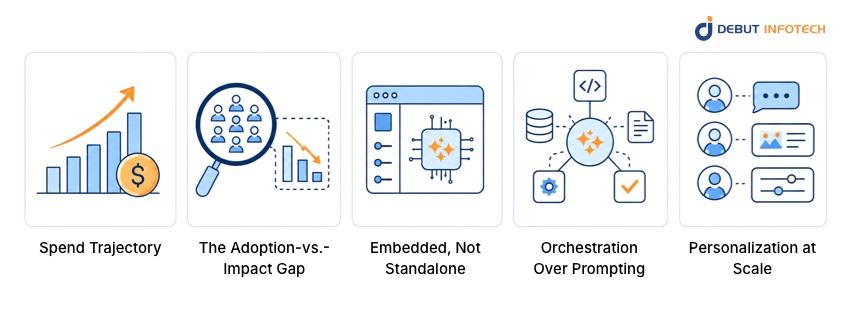
Here are the generative AI trends shaping the future:
Enterprise spending on generative AI is expected to keep growing as organizations integrate the technology into software, customer-facing services, analytics, and internal operations.
Gartner projects that worldwide spending on AI overall will reach $2.59 trillion in 2026, showing how quickly AI expenditure is moving from experimentation into large-scale infrastructure and services budgets.
This spending creates a stronger requirement for financial discipline. Companies will increasingly need to distinguish between AI spending that supports measurable business outcomes and spending that simply increases the number of AI tools employees can access.
Generative AI adoption is already widespread. Stanford’s AI Index reports that 70% of organizations use it in at least one business function. Yet the same research shows organizations continue to struggle to achieve significant financial impact.
This explains why high adoption figures can exist alongside disappointing ROI. Giving employees access to an AI assistant doesn’t automatically change a business’s economics. The technology needs to be connected to a workflow where time, cost, revenue, quality, or another measurable outcome can actually be improved.
Businesses should evaluate generative AI at the process level. Instead of asking how many employees use an AI tool, measure whether the tool reduces processing time, improves resolution rates, increases output quality, lowers costs, or improves customer outcomes.
Generative AI is increasingly becoming a feature inside existing software, such as CRM, development environments, productivity suites, customer-service platforms, ERP, and analytics, rather than a separate application.
This model reduces adoption friction. Employees can access AI where work already happens, while the system can use relevant business context without requiring users to manually copy and paste information.
Single prompts are becoming less important as applications grow more capable. Modern systems combine multiple model calls, retrieval systems, tools, APIs, memory, business rules, and approval steps to complete a larger task.
A customer-service system, for example, could retrieve account information, review past interactions, check policies, propose a solution, update the CRM, and escalate when necessary.
This means AI application development increasingly involves workflow orchestration. Businesses should map the complete process before choosing a model. The model is only one component of the system.
Generative AI can also produce personalized outputs at a scale that would be difficult to achieve manually. Content, recommendations, customer responses, training material, product information, and internal guidance can be adapted according to individual users or accounts.
In sales, for example, AI can tailor account summaries and outreach based on a customer’s history. In customer support, it can adjust responses according to the customer’s issue, account status, and previous interactions.
Personalization requires careful handling of customer data. Businesses need clear rules governing what information AI can access, how it can be used, and when generated content requires human review.
Most AI initiatives struggle to scale because organizations lack reliable data, introduce governance too late, face legacy integration problems, measure the wrong outcomes, or fail to assign post-launch ownership. The underlying issue is often organizational rather than technical, with promising pilots unable to produce a sustainable business case.
Gartner previously predicted at least 30% of generative AI projects would be abandoned after proof of concept because of poor data quality, inadequate risk controls, rising costs, or unclear business value.
Gartner has since warned that organizations could abandon 60% of AI projects through 2026 when unsupported by AI-ready data. Its research found that 63% of organizations either lack the right data-management practices for AI or are unsure whether they have them.
The common failure pattern is organizational. A company may choose a strong model and still fail because its data is fragmented, its legacy systems can’t connect to the AI application, governance arrives too late, or nobody owns the system after launch.
| Challenge | What goes wrong | Practical response |
| Poor data quality | AI receives incomplete, outdated, or inconsistent information | Improve data quality and governance before scaling |
| Late governance | Privacy, security, or compliance issues emerge after development | Build governance into the project from the start |
| Legacy integration | AI works in a pilot but cannot connect smoothly to existing systems | Test integrations in production-like conditions |
| Wrong metrics | Teams measure usage instead of business outcomes | Define outcome-based KPIs and establish a baseline |
| No post-launch owner | Performance issues go unresolved after deployment | Assign clear ownership before launch |
| Weak business case | The pilot works technically but produces little measurable value | Tie the AI initiative to a specific financial or operational outcome |
1. Poor data quality:
AI systems depend on the information they receive. Inconsistent records, outdated documents, missing metadata, and weak access controls can undermine an otherwise strong model.
2. Governance arrives too late:
If privacy, security, approval rules, and evaluation criteria are added after development, teams often have to redesign the system before it can reach production.
3. Legacy integration problems:
AI rarely operates in isolation. It needs access to CRM platforms, ERP systems, databases, ticketing systems, content repositories, and other business applications.
4. Wrong metrics
Measuring how many employees use an AI assistant does not prove that the assistant creates value. The relevant question is whether the business outcome improved.
5. No post-launch owner
AI systems need monitoring, evaluation, updates, cost management, and incident handling. Ownership cannot end when the development team finishes the deployment.
Companies should treat AI scaling as an operating-model challenge. Technology matters, but organizational design often determines whether it survives contact with real business processes.
Companies are measuring AI ROI by connecting deployments to specific business outcomes rather than relying on adoption or usage figures. Successful programs establish baselines and KPIs before launch, test AI in production-like conditions, track financial and operational results, and account for the full cost of ownership.
AI investment is rising rapidly, yet relatively few organizations report significant enterprise-level financial impact. McKinsey found that only 6% of respondents qualify as AI high performers, meaning they report significant value and substantial business impact.
This does not necessarily mean AI technology is failing. It shows that adoption and financial impact are different measurements. A company can deploy AI successfully without changing the economics of the underlying process.
Businesses should separate three measurements: adoption, operational improvement, and financial impact. Tracking all three makes it easier to identify where an AI initiative is creating value and where additional work is required.
High-performing organizations tend to redesign workflows around AI instead of simply bolting an AI feature onto an existing process.
McKinsey reports that AI high performers are significantly more likely to redesign workflows and establish formal processes for evaluating and managing AI-related risks.
A practical AI pilot should therefore resemble the production environment as closely as possible. Use representative data, realistic integrations, actual users, and the same constraints that will exist after deployment.
1. Set KPIs Before Launch
AI projects should begin with a baseline. If a customer-support team currently takes an average of eight minutes to resolve a particular issue, that figure provides a starting point for measuring the effect of AI.
Depending on the use case, useful KPIs can include:
| KPI | What it measures | Example application |
| Cost per transaction | Cost of completing an AI-enabled process | Measuring savings in automated claims processing |
| Processing time | Time required to complete a task | Comparing AI-assisted document processing with manual processing |
| Revenue impact | Additional revenue linked to AI adoption | Measuring AI-driven sales or customer retention |
| Error rate | Frequency of mistakes before and after AI deployment | Evaluating AI-assisted data entry or quality control |
| Resolution rate | Percentage of cases resolved without escalation | Measuring AI customer-support performance |
| Employee productivity | Amount of valuable work completed with AI assistance | Assessing AI coding or administrative tools |
| Customer experience | Changes in satisfaction, response time, or retention | Evaluating AI-powered customer service |
| Model performance | Accuracy, reliability, and consistency of AI outputs | Monitoring an AI classification or prediction system |
The exact KPI depends on the business case. A fraud-detection system should not be measured in the same way as an AI coding assistant. Each project needs a metric that reflects the outcome it was created to improve.
One of the most common mistakes is measuring usage instead of outcomes. A high number of AI interactions may show that employees like the tool, but it does not demonstrate that the organization is benefiting financially.
Another mistake is failing to establish a baseline. Without knowing how the process performed before AI deployment, it becomes difficult to determine whether subsequent improvements came from AI or from other changes.
Businesses should also account for the full cost of ownership. Model fees are only one part of AI spending. Infrastructure, integration, data preparation, security, monitoring, human review, maintenance, and employee training can all affect the final ROI.
AI is reshaping the labor market as businesses increase demand for people who can develop, deploy, manage, and work alongside intelligent systems. The change extends beyond traditional machine-learning roles. New positions are emerging across engineering, product management, security, data, operations, and AI governance.
The World Economic Forum’s Future of Jobs 2025 Report identifies AI and machine learning specialists among the fastest-growing jobs through 2030. It also ranks AI and big data among the fastest-growing skills.
Demand for AI and machine-learning engineers remains strong, driving many companies to turn to machine learning development services instead of building in-house teams from scratch.
Companies increasingly need specialists who can build and deploy production AI systems. The role increasingly covers model integration, evaluation, data pipelines, inference optimization, monitoring, and system architecture.
The market is also expanding beyond people who train models from scratch. Many enterprise teams need engineers who can integrate existing models into business applications and build the surrounding systems that make those models useful.
This broadens the skills required for AI development. Knowledge of APIs, cloud infrastructure, data engineering, security, software development, and MLOps can be just as important as knowledge of model architecture.
AI is creating roles that were uncommon or nonexistent only a few years ago. Examples include AI product managers, AI governance consulting specialists, AI safety engineers, AI security specialists, AI trainers, machine-learning operations engineers, and AI solution architects.
Prompt engineering has also attracted significant attention as generative AI has become popular. However, many organizations are now treating prompt design as one skill within broader AI application development rather than a standalone function.
The larger trend is specialization. As AI becomes part of normal business operations, organizations need people who understand both the technology and the business processes where it is being applied.
Technology and financial services continue to account for substantial AI hiring because both industries already have large technical workforces and significant AI investment.
Healthcare and manufacturing are also becoming important sources of AI-related demand. AI applications in medical imaging, clinical operations, robotics, predictive maintenance, industrial automation, and quality control are creating demand for technical workers who understand industry-specific environments.
This creates a growing advantage for professionals who combine AI skills with domain expertise. A person who understands both machine learning and healthcare workflows, for example, may be better positioned for certain roles than someone with technical skills alone.
AI adoption is also changing expectations for employees who are not AI specialists. Workers increasingly need to understand how to evaluate AI outputs, protect sensitive information, use AI tools appropriately, and identify situations where human judgment is required.
The World Economic Forum estimates that 39% of workers’ existing skill sets are expected to be transformed or become outdated between 2025 and 2030. AI and big data are among the fastest-growing skill areas.
Businesses should therefore treat AI training as a workforce-development issue rather than limiting it to engineering teams. Employees who use AI in daily work need practical guidance on verification, security, data handling, and responsible use.
AI does not remove the need for human capabilities. Analytical thinking, creativity, leadership, communication, judgment, and collaboration remain important because AI systems still require people to define objectives, evaluate outputs, resolve exceptions, and make decisions.
The strongest workforce model is likely to combine technical automation with human expertise. Employees who understand how to work with AI can delegate routine tasks while focusing more heavily on decisions that require context, accountability, and interpersonal judgment.
Organizations should therefore redesign jobs instead of simply replacing individual tasks. Identify which activities AI can handle reliably, which require human review, and which should remain fully human-led.
The next five years will likely bring a shift from AI systems that assist with digital tasks toward systems that can coordinate longer workflows and interact with physical environments. The exact pace will vary by industry, but several trends already visible in 2026 are likely to continue.
Businesses should plan around these structural changes rather than short-lived model releases. Individual models will improve and change quickly.
The underlying movement toward lower costs, greater autonomy, specialized models, and multi-vendor architectures is more likely to persist.
AI agents are likely to expand beyond software environments into physical operations. Robotics, autonomous vehicles, warehouses, manufacturing facilities, healthcare environments, and field-service operations are potential areas of growth.
The combination of stronger reasoning models, computer vision, simulation, robotics, and edge computing could allow AI systems to make more complex decisions in physical environments.
Businesses should not assume that physical AI will arrive at the same pace everywhere. Safety requirements, hardware costs, regulation, and operating conditions will determine where autonomous systems become practical first.
AI investment is likely to become more concentrated at the top of the market. Frontier model development requires enormous capital for computing infrastructure, research teams, data, and deployment. This favors companies with access to substantial financial and infrastructure resources.
At the same time, funding will continue flowing into specialized applications and infrastructure. Startups that solve specific industry problems may attract investment without competing directly with companies building general-purpose foundation models.
This creates a two-level AI market. A relatively small group may dominate foundation-model development, while thousands of companies build specialized products around those models.
The movement toward smaller models is likely to continue well beyond 2026. Businesses have strong economic reasons to reduce inference costs, lower latency, and run AI closer to where data is generated.
Improvements in model architecture, quantization, distillation, hardware acceleration, and specialized training will make smaller models increasingly capable.
Enterprises should therefore avoid designing systems around the assumption that they will always need the largest available model. A model that is sufficient for the task today may become significantly cheaper and smaller over time.
Enterprises are also likely to adopt multi-model strategies. Organizations will increasingly choose models based on the requirements of individual workloads rather than selecting one provider for every AI application.
This approach can reduce vendor lock-in and improve cost control. Companies can also switch models when a competitor offers better performance, pricing, privacy controls, or deployment options.
A multi-vendor strategy requires good abstraction and governance. Businesses should build systems that can accommodate model changes without requiring major application rewrites every time the underlying technology changes.
AI will increasingly become part of standard enterprise infrastructure. Instead of being managed as an experimental technology program, AI capabilities will sit inside software development, customer service, finance, supply chains, cybersecurity, and other operational functions.
This will change how organizations budget for AI. Spending will increasingly appear across normal technology and departmental budgets rather than being concentrated in innovation teams.
The implication is straightforward. AI planning should become part of broader technology and business planning rather than remaining isolated within a small group responsible for experimentation.
Enterprises can prepare for future AI trends by strengthening data readiness, building governance into development, defining KPIs before launch, and designing for security, flexibility, and multi-vendor adoption. They should also assign post-launch owners, budget for maintenance, and test AI in production-like conditions before scaling.
Preparing for the latest AI trends in 2026 doesn’t mean adopting every new model or technology. It means creating the technical, organizational, and governance foundations that allow the business to adopt useful capabilities without rebuilding its systems every year.
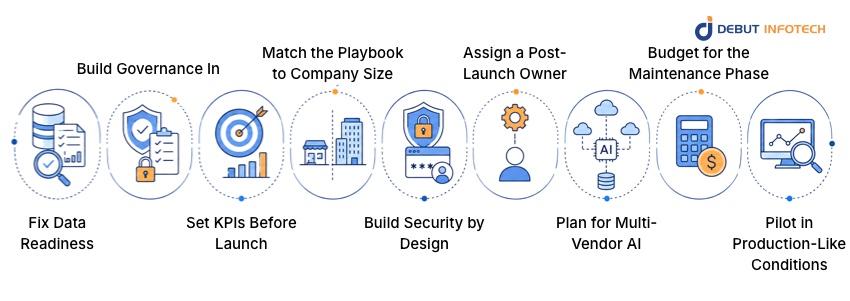
Data should be treated as a core AI dependency. Before scaling a pilot, identify the data required by the system and assess its accuracy, completeness, accessibility, freshness, and ownership.
Organizations should also map where important data resides. Information may be distributed across databases, cloud applications, spreadsheets, documents, CRM platforms, ERP systems, and legacy applications.
Create a data-readiness checklist for each AI use case. Confirm that the required information is available, governed, and accessible before committing significant resources to deployment.
Governance should be designed alongside the AI application. Define acceptable use, data-access rules, model evaluation requirements, human oversight, audit requirements, and escalation procedures during the design stage.
This reduces the risk of discovering major compliance or security problems after the system has already been built.
Governance should also be proportionate to risk. A system that summarizes internal documents does not require the same controls as an AI application that makes financial decisions or initiates transactions.
Every AI initiative should have a measurable objective before deployment. Define what the business expects to improve and establish a baseline for comparison.
Useful targets might include reducing processing costs by a specific percentage, shortening response times, increasing conversion rates, reducing error rates, or improving customer satisfaction.
Avoid vague goals such as “improve productivity.” Define exactly what productivity means for the process and how it will be measured.
Smaller businesses often benefit from existing AI products and managed platforms because they can access advanced capabilities without building large internal teams.
Larger enterprises usually require more integration planning because AI systems must connect to existing infrastructure, security policies, data environments, and multiple business units.
The right strategy depends on the organization’s scale and complexity. A small company does not need the same AI architecture as a multinational enterprise.
Security risks should be assessed before deployment. Identify what data the AI system can access, what actions it can perform, and what could happen if its instructions or credentials are compromised.
Security reviews should include prompt injection, data leakage, unauthorized access, model manipulation, agent permissions, third-party integrations, and AI-enabled fraud.
High-risk actions should have additional controls. AI can automate routine decisions, but sensitive transactions and irreversible actions should have appropriate approval mechanisms.
Every production AI application needs an accountable owner after development is complete. The owner should monitor performance, coordinate improvements, review incidents, and ensure that the system continues to meet business requirements.
Without ownership, AI systems can degrade quietly. Data changes, model updates, new business rules, and changes in user behavior can all affect performance.
Assign ownership before launch. Make responsibility part of the deployment plan rather than deciding who will manage the system after problems appear.
The AI market is changing too quickly for many enterprises to rely blindly on one model provider. Model performance, pricing, availability, licensing, and capabilities can change rapidly.
A flexible architecture allows businesses to introduce alternative models when they offer better performance or economics.
This does not mean every enterprise needs several providers immediately. It means the architecture should avoid unnecessary dependencies that make future changes expensive.
AI deployment is not a one-time expense. Production systems require monitoring, evaluation, data maintenance, security reviews, model updates, infrastructure management, and user support.
These costs can become significant as usage increases. A model that appears inexpensive during a small pilot may become considerably more expensive when thousands of employees or customers use it every day.
Include post-launch operating costs in the original business case. The project budget should cover the period after deployment, not just the initial development phase.
AI pilots often fail because they are tested in environments that are too clean. Sample data, simplified workflows, and limited integrations can hide the problems that appear in production.
A stronger pilot uses representative data, actual system integrations, real users, realistic workloads, and the same security restrictions expected after launch.
This approach makes the pilot more demanding, but it also produces more useful information. Businesses can identify integration problems, data gaps, performance limits, and user adoption issues before committing to full-scale deployment.
Before scaling an AI initiative, enterprises should be able to answer these questions:
| Area | Key question |
| Data | Is the required data accurate, accessible, and governed? |
| Business case | What specific business outcome should AI improve? |
| KPI | How will the improvement be measured? |
| Integration | Can the AI system work with existing business systems? |
| Security | What information and actions can the AI access? |
| Governance | What rules and approval requirements apply? |
| Human oversight | Which decisions require human review? |
| Ownership | Who is accountable after deployment? |
| Infrastructure | Can the system handle expected production workloads? |
| Vendor strategy | Can the organization switch or add models if needed? |
| Maintenance | Has the business budgeted for ongoing monitoring and updates? |
| Scalability | Can the solution support wider adoption without high cost? |
If several of these can’t be answered clearly, the organization may not be ready to scale the use case. Addressing those gaps first can prevent the common cycle of a promising pilot struggling in production and eventually being abandoned.
Having the right AI foundation is only the first step. Turning that foundation into a reliable production system requires the right technical expertise, architecture, integration strategy, and ongoing support.
An experienced AI development company can help businesses move from promising ideas to AI solutions built around measurable business outcomes.
Debut Infotech helps businesses design and develop AI solutions tailored to their operational needs. Our team can support the full development lifecycle, from identifying viable use cases and selecting the right models to integrating AI with existing systems, implementing security controls, and preparing solutions for production.
Whether you are exploring AI agents, generative AI, predictive analytics, or industry-specific applications, our development approach is tailored to match your data, workflows, infrastructure, and business goals.
With the right technical partner, businesses can reduce implementation challenges and build AI systems that are practical, scalable, and easier to manage as their requirements evolve.
AI adoption is now widespread, but scaling it into measurable business value remains difficult. The leading AI trends 2026 point toward more capable agents, smaller and cheaper models, specialized applications, multimodal systems, and deeper integration into business workflows.
Companies that want lasting results should focus on reliable data, clear KPIs, strong governance, security, and long-term ownership.
The key question is no longer whether businesses are using AI. It is whether they can turn AI adoption into measurable improvements in revenue, productivity, customer experience, or operational efficiency.
The biggest AI trends in 2026 include agentic AI, multimodal systems, smaller and more efficient models, AI-powered automation, on-device AI, and domain-specific models. Enterprises are also paying more attention to AI governance, security, and explainability. The focus is shifting from experimenting with AI to putting it into real business workflows.
The future of AI will be more autonomous, embedded, and specialized. AI systems will increasingly handle multi-step tasks, work across different data types, and integrate directly with business software. Rather than using AI as a separate tool, companies will build it into everyday operations, customer experiences, decision-making, and internal processes.
Agentic AI is arguably the most important AI trend in 2026 because it moves AI beyond generating responses to completing tasks. AI agents can plan steps, use tools, access data, and take actions with limited human input. This could significantly change how businesses automate processes and build AI-powered products.
Enterprises should prepare for agentic AI, multimodal AI, AI automation, private and domain-specific models, AI-powered cybersecurity, and stronger governance requirements. They should also review their data infrastructure and integration capabilities. Preparing for these trends means building a solid AI strategy instead of adopting tools one at a time without a clear plan.
Generative AI is becoming more capable, context-aware, and action-oriented in 2026. Models can handle text, images, audio, video, and other data types within the same workflow. They are also becoming better at reasoning and tool use. As a result, businesses are moving from basic content generation toward AI-powered applications and automated workflows.

Our Latest Insights

USA
2501 Chatham, Rd Suite R Springfield, IL 62704
+1-708-515-4004
info@debutinfotech.com
UK
7 Pound Close, Yarnton, Oxfordshire, OX51QG
+44-770-304-0079
info@debutinfotech.com
Canada
154 Eden Oak Trail, Kitchener, ON N2A 0H9
+1-708-515-4004
info@debutinfotech.com
INDIA
Sector 101-A, Plot No: I-42, IT City Rd, JLPL Industrial Area, Mohali, PB 140306
9888402396
info@debutinfotech.com