ON THIS PAGE
Progress0%





Our Global Presence :



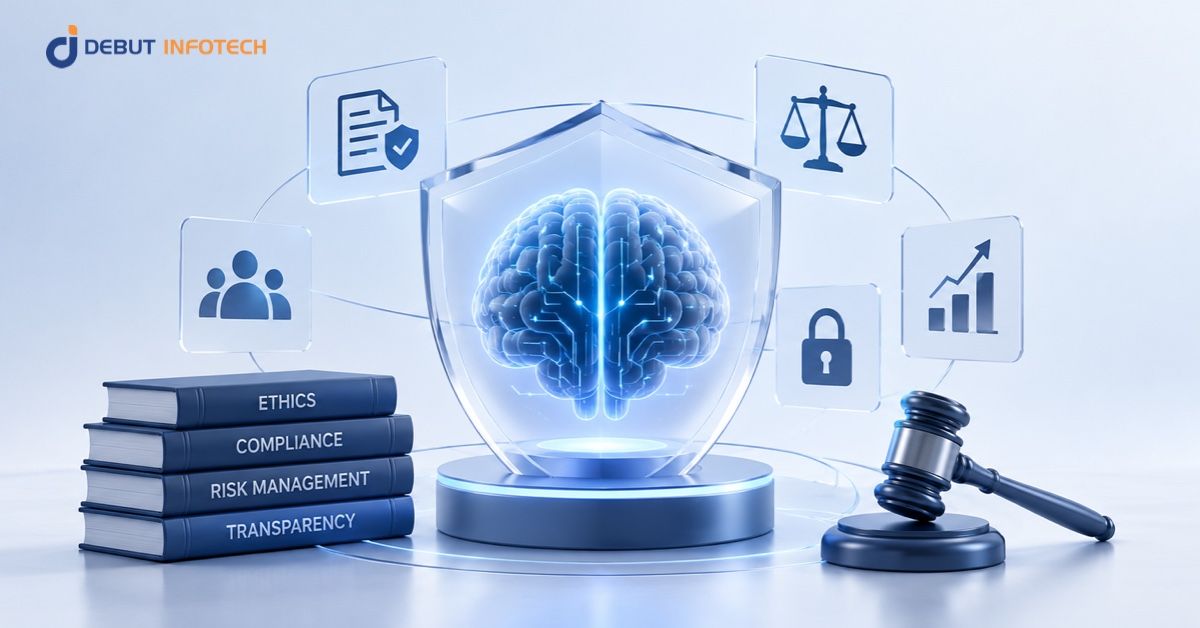


AI governance creates accountability across the organization by defining clear ownership, risk controls, compliance requirements, monitoring processes, and lifecycle responsibilities for AI systems.
Risk-based governance enables responsible AI adoption by helping organizations apply the right level of testing, documentation, human oversight, approval, and monitoring based on each system’s risk.
NIST AI RMF, ISO/IEC 42001, and the EU AI Act support different governance needs with risk-management guidance, AI management system standards, and regulatory requirements respectively.
AI inventories provide visibility into the organization’s AI landscape by tracking models, applications, agents, data sources, risk classifications, and responsible business and technical owners.
Blockchain can improve the integrity of AI governance records through immutable audit trails, model fingerprints, version tracking, and verifiable records where blockchain is appropriate.
Continuous monitoring is necessary as AI systems and regulations change because updates to models, data, autonomy, risks, or regulatory requirements may require governance controls to be reassessed.
AI governance became a legal requirement in 2026. The EU AI Act’s rules for high-risk systems take effect in August 2026. Violations involving prohibited practices carry fines of up to €35 million, or 7% of global annual turnover, whichever is higher.
The risk extends beyond fines. Ungoverned AI creates real operational problems. Shadow deployments go untracked. Sensitive data leaks through uncontrolled model use. Compliance failures surface during board reviews instead of scheduled audits, often too late to fix quietly.
An AI governance framework addresses these problems directly. It is the structured set of policies, controls, and accountability mechanisms an organization uses to manage how AI systems are built, deployed, and monitored. When properly implemented, it reduces risk without slowing down AI adoption.
This guide explains what an AI governance framework requires in 2026 and the standards shaping enterprise programs, such as the NIST AI RMF, ISO 42001 and the EU AI Act.
We will also cover the steps involved in building a governance program, and how blockchain-based tools, including immutable audit trails and on-chain model provenance, are being incorporated into enterprise compliance stacks.
AI governance is the system of policies, controls, processes, and accountability structures an organization uses to manage how artificial intelligence is developed, acquired, deployed, monitored, and retired. A practical AI governance framework connects AI risk management with legal requirements, security controls, ethical standards, business objectives, and clearly assigned ownership.
The scope has expanded as companies move from isolated machine learning models to generative AI, foundation models, AI copilots, and autonomous agents.
Governance now has to answer practical questions such as:
Regulation is also making the AI governance framework 2026 more enforceable. The EU AI Act entered into force in August 2024 and uses a phased implementation model. Prohibited AI practices and AI literacy requirements began applying in February 2025. Governance provisions and general-purpose AI obligations followed in August 2025. From August 2, 2026, enforcement powers and additional transparency requirements apply.
The timeline for AI governance and compliance is more nuanced for high-risk AI. Following the 2026 AI Omnibus, high-risk systems covered by Annex III are scheduled to comply with the relevant rules from December 2, 2027, while high-risk AI embedded in regulated products covered by Annex I has an August 2, 2028 deadline.
The risks usually manifest as operational problems before becoming regulatory problems. Employees may adopt public AI tools without approval. Teams may deploy models without documenting their training data or limitations. Multiple departments may purchase overlapping AI systems. Sensitive information can also be shared with third-party AI services without adequate controls.
These problems create several forms of exposure:
The EU AI Act illustrates the financial stakes. For prohibited AI practices, penalties can reach up to €35 million or 7% of worldwide annual turnover, whichever is higher. Other breaches can attract different maximum penalties depending on the obligation and entity involved.
That does not mean that every governance failure results in a €35 million fine. It does mean that AI risk can now carry consequences far beyond a failed software project.
A strong governance program creates value by reducing avoidable risk while providing development teams with a predictable path from experimentation to production. Instead of reviewing every AI initiative from scratch, organizations can establish reusable policies, risk tiers, approval paths, and technical controls.
Mature governance programs are often associated with lower compliance workloads and fewer AI-related failures. Some industry reports estimate reductions of 40–60% for specific governance or compliance activities. These figures should be treated as benchmarks, not guaranteed outcomes, because results depend on the organization, technology stack, regulatory environment, and the program’s maturity.
The more useful objective is measurable improvement in areas such as:
Governance does not have to slow AI development. A well-designed program can shorten approval cycles by enabling teams to work with predefined controls.
For example, a low-risk internal summarization tool may follow a lightweight approval path. A high-impact decision system may require legal review, bias testing, security assessment, human oversight controls and formal Documentation.
This risk-based approach prevents low-risk projects from receiving the same level of scrutiny as high-risk systems.
Some industry estimates report deployment improvements of around 30% when standardized governance workflows replace ad hoc reviews. The underlying principle matters more than the exact percentage. Teams move faster when they know what evidence is required before development starts.
Governance can prevent financial losses by identifying problems before an AI system reaches customers, employees, regulators, or the wider market.
The financial exposure is already measurable. An EY survey of 975 executives at companies with more than $1 billion in annual revenue found that organizations deploying AI had experienced approximately $4.4 billion in combined financial losses, with compliance failures, flawed outputs, bias, and other AI-related problems contributing to those losses.
Bias testing may reveal that a model produces materially different outcomes for certain groups. Data lineage may expose an unauthorized data source. Security testing may uncover excessive permission. Documentation reviews may identify a missing disclosure.
Finding these problems during development is usually cheaper than discovering them after deployment.
A governance program should therefore measure avoided exposure, not only administrative activity. Useful metrics include:
Under the EU AI Act, penalties for certain violations can reach €35 million or 7% of worldwide annual turnover, depending on the infringement. This gives organizations a concrete financial reason to identify and address AI risks before they become regulatory problems.
Market investment also signals where enterprise priorities are moving.
One 2026 industry analysis estimates that the enterprise AI governance market could grow from approximately $2.2 billion in 2025 to $11.05 billion by 2036, representing a projected 15.8% CAGR. This is an industry forecast rather than an official regulatory statistic, so it should be used as an indicator of market direction rather than a definitive measurement.
The growth reflects several pressures at once. Enterprises are deploying more AI systems, regulators are increasing oversight, and boards want clearer visibility into AI-related risk.
Governance maturity can also influence enterprise procurement, partnerships, and market access. Organizations increasingly need to demonstrate that their AI systems have appropriate controls around security, privacy, risk management, Documentation, and accountability.
A mature governance program can provide evidence such as:
This evidence can make it easier for enterprise customers, partners, auditors, and regulators to assess how AI is managed. Governance therefore becomes part of the organization’s broader trust and risk profile rather than a separate compliance exercise.
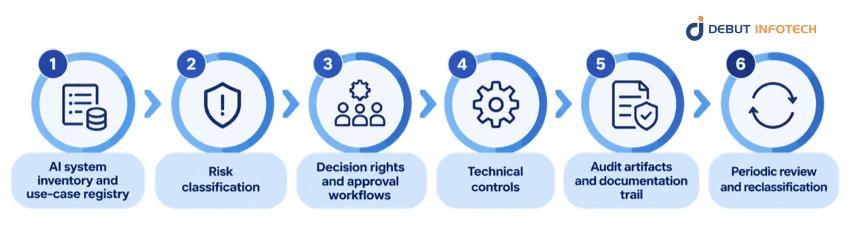
An effective AI governance framework should turn broad principles into operational controls. It needs enough structure to establish accountability without creating a separate approval bureaucracy for every AI experiment.
Every organization needs a reliable record of its AI footprint.
The inventory should capture information such as:
This inventory should include internally developed systems, third-party models, embedded AI features, generative AI applications, and, where applicable, autonomous agents.
Risk classification determines the level of governance a system receives. A practical model can use four broad tiers:
| Risk tier | Typical governance approach |
| Minimal | Basic registration, security and acceptable-use controls |
| Limited | Additional transparency, documentation, and monitoring |
| High | Formal risk assessment, testing, Documentation, human oversight and ongoing monitoring |
| Unacceptable | Prohibited or restricted use where applicable |
The organization should not classify systems solely by the technology used. The purpose, context, users, affected individuals, data, autonomy, and potential impact should also influence classification.
Governance fails when responsibility is shared by everyone and owned by no one. The framework should define who can:
These decision rights should be documented before the organization starts scaling AI.
Policies need technical enforcement where possible. Common controls include identity and access management, data-loss prevention, model monitoring, bias testing, prompt and output filtering, security testing, logging, model version control, and human-approval gates.
The exact control set should reflect the system’s risk profile.
A governance program should generate evidence as part of normal operations. Relevant artifacts may include:
Documentation should not be created only when an auditor asks for it. The better approach is to design workflows so that evidence is produced automatically as AI systems move through development and deployment.
AI risk changes over time. A model may receive new training data, gain new capabilities, be connected to additional systems, or move into a more sensitive business process.
The framework should therefore define review triggers.
A review may be required when:
Monitoring identifies a material performance or bias issue.
Enterprises do not need to create an AI governance program from scratch. Three major reference points can provide a practical foundation: the NIST AI Risk Management Framework (AI RMF), ISO/IEC 42001, and the EU AI Act.
They serve different purposes, so organizations should not treat them as interchangeable.
NIST provides voluntary risk-management guidance, ISO/IEC 42001 establishes requirements for an AI energy management system that can support certification, and the EU AI Act establishes binding legal requirements within its scope.
Mapping these approaches into one governance structure can reduce duplication.
The NIST AI RMF provides a voluntary approach for identifying and managing AI risks throughout the system lifecycle. Its core is organized around four functions:
The framework also identifies seven characteristics of trustworthy AI:
These functions are designed to work together rather than as isolated stages.
ISO/IEC 42001 provides requirements for establishing, implementing, maintaining, and continually improving an Artificial Intelligence Management System (AIMS). It provides organizations with a structured management-system approach to AI governance and applies to those that develop, provide, or use AI systems.
Unlike a voluntary guidance framework, ISO/IEC 42001 can provide a basis for organizational certification through an appropriate conformity-assessment process. Its management-system approach also helps connect AI governance with existing organizational processes for risk, documentation, leadership oversight, performance evaluation, and continual improvement.
The EU AI Act takes a legal, risk-based approach to regulating AI systems. Its framework distinguishes different levels of risk and applies different obligations accordingly.
The main categories include:
The Act uses a phased implementation schedule, so organizations should map obligations to their applicable deadlines rather than treating compliance as a single date.
The three approaches differ mainly in their purpose and authority.
NIST AI RMF is a voluntary reference framework that organizations can adopt to structure AI risk management.
ISO/IEC 42001 is a management system standard that organizations can implement and pursue certification to.
The EU AI Act is a legal requirement for organizations and systems within its scope. They can therefore work together rather than compete.
A company might use NIST to structure risk processes, ISO/IEC 42001 to formalize its AI management system, and the EU AI Act to identify mandatory European obligations.
Table: NIST vs. ISO/IEC 42001 vs. EU AI Act
| Dimension | NIST AI RMF | ISO/IEC 42001 | EU AI Act |
| Primary role | AI risk-management guidance | AI management-system standard | AI regulation |
| Nature | Voluntary | Certifiable | Legally binding within scope |
| Main focus | Identify, measure, and manage AI risks | Establish and improve an AI management system | Regulate AI according to risk and use |
| Certification | No | Yes, through appropriate certification | Not a certification standard |
| Geographic reach | Global guidance | International standard | EU legal framework with defined extraterritorial scope |
| Best use | Structure AI risk management | Demonstrate management-system maturity | Meet applicable legal obligations |
The practical approach is to build one governance operating model and map these requirements into it. This prevents organizations from creating separate processes for every framework and regulation. It also gives leadership a clearer view of which controls are voluntary, which support certification, and which are legally required.
An AI governance framework needs clear principles that guide both business decisions and technical implementation. AI governance principles provide a common standard for evaluating AI systems before deployment and throughout their lifecycle.
Every AI system should have an identifiable owner. Accountability should not disappear because a decision is produced by an algorithm, foundation model, or autonomous agent.
Ownership should cover the full lifecycle. Someone should be responsible for approving the use case, someone should manage the technical implementation, and an accountable business or organizational authority should own the resulting risk.
For autonomous systems, the organization should also define which actions an agent can perform without human approval.
Explainability concerns whether people can understand the basis, limitations, and relevant factors behind an AI system’s outputs.
The level of explanation should match the use case. A low-impact recommendation system may require basic transparency. A system supporting employment, lending, healthcare, or other high-impact decisions may require substantially stronger Documentation and interpretability.
Explainability should also cover the model’s known limitations and conditions under which its outputs should not be trusted.
Bias management should begin before deployment. Teams should identify relevant protected or sensitive characteristics, evaluate datasets, establish appropriate performance metrics, and test outputs across relevant groups.
The testing process should not end at launch. Changes in data, users, prompts, model versions, or operating environments can introduce new forms of bias.
Organizations should be able to establish where important AI data originated, how it was transformed, who accessed it, and how it entered the model or application.
Data lineage supports several governance objectives. It helps teams investigate incidents, validate data rights, identify problematic sources, reproduce assessments, and respond to regulatory or contractual requirements.
Human oversight becomes more important as AI systems gain autonomy or influence decisions with material consequences.
The control should be meaningful. A human should have enough information, authority, time, and competence to intervene.
A nominal approval button does not create effective oversight if the system acts too quickly, the reviewer cannot understand the decision, or the reviewer lacks authority to reject it.
Governance needs an operating model that connects executives, legal teams, security professionals, data scientists, engineers, and business owners. The exact structure depends on organizational size and risk profile, but decision rights should remain clear.
A typical enterprise steering committee may include:
The committee should not approve every AI experiment. Its role is to set policy, resolve high-risk decisions, establish escalation rules, monitor governance performance, and accept or reject risks that exceed delegated authority.
Routine decisions should remain within defined business and technical workflows.
A centralized model places most AI governance responsibilities under one enterprise team.
This can provide consistency and make it easier to maintain a single AI inventory, policy set, risk taxonomy, and reporting process.
It can also become a bottleneck if every AI request requires central approval.
A federated model gives business units or departments more responsibility while maintaining enterprise-wide AI governance standards.
This approach can work well for large organizations with different regulatory environments and AI use cases. Financial services, healthcare, marketing, and engineering teams may require different controls even when they operate under the same enterprise policy.
The main risk is inconsistency. Departments may interpret risk classifications differently or maintain incompatible Documentation.
A hybrid AI model often provides the most practical balance.
Central governance establishes the enterprise policy, risk taxonomy, mandatory controls, reporting standards, and escalation process. Business units manage lower-risk use cases within those boundaries.
This structure can also make cross-border compliance easier by allowing common governance controls to be applied centrally while jurisdiction-specific requirements are mapped locally.
A governance program should define who is responsible and accountable for major lifecycle decisions.
| Decision | Business owner | AI governance | Legal/compliance | Technical owner | Security |
| Register use case | R | A | C | C | C |
| Risk classification | R | A | C | C | C |
| Legal assessment | C | C | A/R | C | C |
| Technical validation | C | C | C | A/R | C |
| Security approval | C | C | C | R | A |
| Production approval | R | A | C | R | C |
| Major model change | R | A | C | R | C |
| Retirement | A/R | C | C | R | C |
The exact assignments should be adapted to the organization’s authority structure.
Companies implement AI governance by first identifying their AI systems, classifying risk, assigning ownership, establishing policies, and creating approval and monitoring workflows. They then introduce regular audits, reporting, and reclassification processes. This structured AI governance strategy helps organizations manage AI throughout its lifecycle while keeping governance practical, scalable, and aligned with changing regulatory and operational requirements.
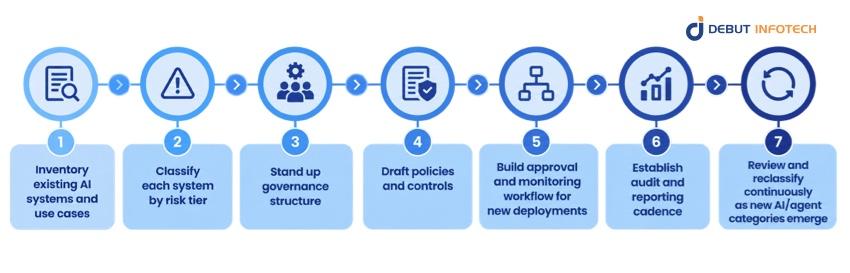
Start by creating a complete inventory of every AI system and use case across the organization.
Do not limit the inventory to models developed internally. Include third-party AI platforms, generative AI tools, embedded software features, predictive models, copilots, and autonomous agents.
Each entry should provide enough information to determine its purpose, ownership, dependencies, and potential risk.
The inventory should capture:
This baseline allows governance teams to identify shadow AI, duplicate systems, undocumented models, and systems requiring immediate assessment.
After creating the inventory, classify each system according to its potential impact and applicable requirements.
A practical framework can use four categories: unacceptable, high, limited, and minimal risk. The classification should consider more than the underlying technology.
A general-purpose model may present limited risk in one application but become high risk when used for employment, credit, healthcare, or other consequential decisions.
Assess factors such as:
The resulting tier should determine the level of testing, Documentation, human oversight, approval, and monitoring required.
Establish the organizational structure responsible for AI oversight before deployment activity scales. Assign an executive sponsor and create a governance committee with representatives from business operations, AI and data teams, legal and compliance, cybersecurity, privacy, and risk.
Most importantly, assign a named owner to every AI system. The governance structure should clearly define who can approve, reject, modify, suspend, or retire an AI system.
Document responsibilities for:
Clear decision rights prevent responsibility from becoming fragmented across departments. They also make escalation faster when an AI system creates unexpected risks.
Convert governance principles into policies that employees, developers, data scientists, and business teams can apply in practice. Policies should explain which AI use cases are permitted, which data can be processed, which systems require approval, and which controls must be in place before deployment.
Each policy should connect to measurable controls rather than relying on broad statements about responsible AI.
Core policy areas can include:
Controls should also vary by risk tier. A low-risk application should not face the same requirements as a high-risk system.
Turn governance requirements into a repeatable workflow that teams can follow before and after deployment. A typical AI governance process can move from use-case submission to risk classification, testing, legal and security assessment, approval, deployment, and continuous monitoring. Automate evidence collection where possible so teams do not have to recreate records for every audit.
Monitoring should track factors such as:
Low-risk systems can follow streamlined workflows, while high-risk systems receive deeper multidisciplinary review.
Define how often AI governance information should be reviewed, reported, and independently assessed. Operational teams may need monthly dashboards, while senior leadership may receive quarterly reports covering major risks and incidents. High-risk systems may require more frequent monitoring and formal reviews.
The reporting structure should show whether controls are operating, not simply whether policies exist.
Useful governance metrics include:
A consistent reporting cadence also creates evidence that management actively oversees AI risk.
AI governance cannot remain fixed after initial approval. Systems can change when models are retrained, new data is introduced, capabilities expand, agents gain additional permissions, or a tool moves into a more sensitive business process. Define specific triggers that require reassessment, rather than relying solely on annual reviews.
Reclassification should be considered when:
This approach keeps the governance and AI compliance framework aligned with each AI system’s actual risk profile.
Blockchain helps AI governance by providing tamper-evident records, model-version tracking, automated policy checks, and verifiable registries for AI agents. These capabilities can strengthen accountability and make governance evidence easier to verify across complex AI environments, which is where dedicated blockchain development services come in to build and maintain the underlying infrastructure.
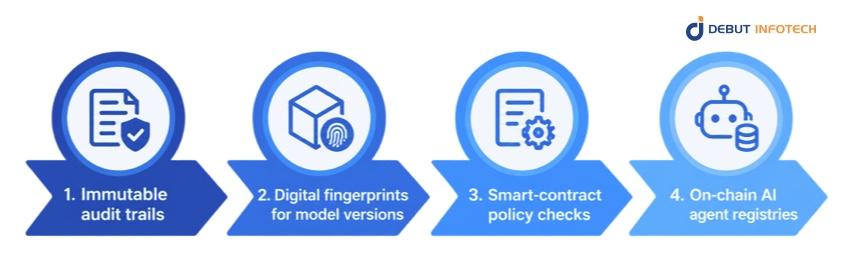
Blockchain works best as a verification and evidence layer alongside existing GRC, security, identity, data-management, and compliance systems.
A blockchain network can record cryptographic proofs of governance events. For example, an organization could record a hash for an AI assessment, approval record, model artifact, or data lineage package.
The underlying documents can remain in conventional storage, while the blockchain stores the fingerprint needed to demonstrate that the recorded artifact has not been altered. This creates a stronger evidence trail without putting sensitive documents directly on-chain.
Blockchain AI compliance can also help organizations verify the integrity of governance records when investigating incidents, reviewing model changes, or responding to internal audit requests.
AI systems change frequently. Model versions can be retrained, fine-tuned, reconfigured, or replaced. A cryptographic fingerprint can associate a particular model artifact with a specific point in time. This can help answer questions such as:
By comparing fingerprints, governance teams can identify discrepancies between approved and deployed versions. This blockchain-based AI governance framework provides an additional layer of accountability without requiring the actual model weights or sensitive intellectual property to be stored on-chain.
Smart contracts can encode deterministic governance conditions. For example, an internal deployment process could require evidence that:
If a required condition is missing, the workflow can block the transaction or deployment request. This can reduce manual verification and create a consistent enforcement mechanism for predefined governance rules.
The approach is particularly useful for repeatable checks that must be satisfied before an AI system enters a controlled environment.
This works best for rules that can be expressed clearly and deterministically. Ethical judgments, contextual assessments, and legal interpretation should not be reduced to rigid smart-contract logic without appropriate human review.
Autonomous and multi-agent systems create another governance problem. Organizations need to know which agents exist, what permissions they hold, what services they can access, and which business processes they can affect. A verifiable agent registry could associate each agent with:
This can provide a shared record for complex agent ecosystems. Governance teams can use the registry to identify unauthorized agents, verify approved capabilities, and track changes across the agent lifecycle. This becomes increasingly useful as organizations deploy multiple autonomous systems across departments and business processes.
Blockchain can support AI compliance by creating verifiable records for Documentation, model changes, identity, approvals, and risk monitoring. It can strengthen evidence management for applicable EU AI Act requirements and help organizations maintain consistent compliance records across jurisdictions.
However, blockchain for AI regulatory compliance supports the processes rather than replacing legal interpretation, governance controls, or regulatory obligations.
For high-risk AI systems, organizations may need extensive technical and governance Documentation, depending on applicable obligations and the implementation timeline.
A blockchain layer can store hashes or verifiable references to relevant documents. It can then establish when a document existed and whether its contents changed.
Blockchain for enterprise AI governance enhances auditability. It is not a substitute for the Documentation itself.
Verifiable credentials can associate governance actions with specific organizations, systems, or authorized individuals.
For example, a credential could attest that a designated team approved a model release or that an evaluator completed a required assessment.
This can reduce reliance on manually reconciled records across multiple organizations.
Oracle systems can bring external information into blockchain-based workflows. For AI governance, this could include changes in model status, vendor risk, jurisdiction, certification status, or predefined monitoring signals.
The important limitation is that an oracle does not make external information true. It only transfers information into the system. Organizations still need trusted sources and validation mechanisms.
Global enterprises face different regulatory expectations across jurisdictions. Blockchain EU AI Act compliance uses a binding, risk-based legal framework, whereas NIST AI RMF is voluntary. Other jurisdictions may impose sector-specific requirements or develop different AI rules.
A shared verification layer can help maintain common evidence across jurisdictions while mapping that evidence to different legal requirements.
For example, one model assessment could be linked to separate compliance mappings for EU, US, and other markets.
The governance layer should therefore separate common controls from jurisdiction-specific obligations.
The main challenges of AI governance include regulatory fragmentation, integration costs, limited AI governance expertise, rigid automation of judgment-based rules, and approval bottlenecks. Companies also need to govern rapidly changing AI and autonomous agents without creating processes that teams end up bypassing.
Addressing these challenges requires risk-based controls, clear ownership, flexible workflows, and continuous regulatory monitoring.
Some governance requirements can be automated. Others cannot.
A rule such as “deployment requires security approval” can be encoded into a workflow. A question such as “does this use case create an unacceptable social impact?” may require legal, ethical, technical, and business judgment.
Organizations should therefore automate deterministic controls while preserving human review for decisions that depend on context.
AI regulation is developing at different speeds across jurisdictions. Requirements may also change as regulators issue guidance, standards, and implementation rules.
This creates a maintenance problem. A governance framework that is accurate today can become incomplete after a regulatory amendment.
The solution is to maintain a regulatory mapping layer rather than rewriting the entire governance program every time a rule changes.
Many enterprises already operate complex GRC, security, identity, data management and software development platforms.
AI governance should connect to these systems instead of creating another isolated database.
Useful integrations may include:
Effective governance requires people who understand more than regulation. Teams need a combination of AI engineering, data governance, cybersecurity, risk management, privacy, legal, and business expertise.
Organizations do not always need a large dedicated governance department. They do need clearly assigned expertise and decision rights.
Slow approval processes can cause employees to bypass governance entirely.
That creates a dangerous feedback loop. The organization adds controls because AI is risky. Teams find the controls difficult to navigate. Employees then use unapproved tools to get work done.
The answer is to improve the workflow rather than weaken the control.
Low-risk systems should move through lightweight pathways. High-risk systems should receive deeper assessment.
Effective AI governance depends on practical controls, clear ownership, continuous monitoring, and risk-based processes.
AI governance best practices 2026 help organizations strengthen compliance, reduce workflow friction, improve accountability, and manage AI risks as systems and regulations evolve.
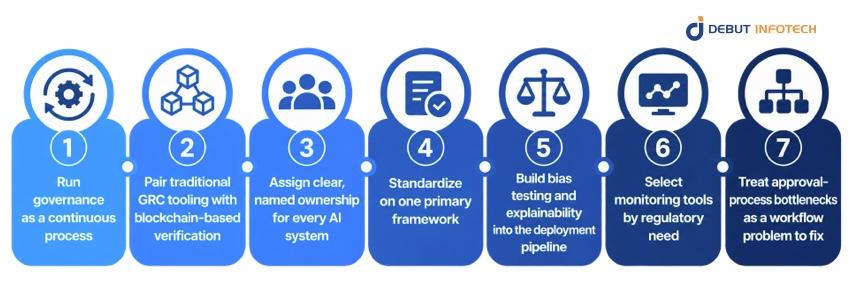
Treat AI governance as an ongoing operating process rather than a one-time compliance exercise. Review risk throughout the AI lifecycle and define reassessment triggers before systems reach production.
This is especially important for generative AI and autonomous agents because their capabilities, data sources, and operating environments can change quickly.
Build governance activities into existing development and operational workflows.
A continuous process should include:
This approach keeps controls aligned with actual AI behavior and changing business conditions.
Traditional GRC platforms should remain responsible for policies, risk registers, approvals, assessments, workflows, and reporting.
Blockchain can complement these systems by providing tamper-evident verification for selected governance records. Organizations can create cryptographic fingerprints of documents, model versions, approval records, and assessment results without storing sensitive information directly on-chain.
Blockchain can help verify:
This approach works best when blockchain is used as a verification layer rather than as a replacement for established GRC infrastructure.
Every AI system should have a clearly identified owner from registration through retirement. The business owner should understand the system’s purpose, users, impact, and business risks.
A technical owner should manage implementation, performance, changes, and remediation. Additional responsibility can be assigned to legal, compliance, security, or privacy teams where the risk requires it.
Ownership should cover:
Third-party AI does not eliminate internal accountability. If an organization deploys a vendor’s model, it still needs an internal owner responsible for its use.
Avoid creating separate governance processes for every regulation, standard, and business unit. Choose one primary framework as the operating foundation, then map other requirements against it.
For example, NIST AI RMF can structure risk-management activities, ISO/IEC 42001 can support an AI management system, and the EU AI Act can define applicable legal obligations.
A unified structure can provide:
This reduces duplicated assessments and helps teams understand which controls satisfy multiple governance requirements.
Bias testing and explainability should be part of the development and deployment process rather than activities performed only after an AI system goes live. Define relevant metrics, thresholds, test datasets, documentation requirements, and escalation procedures before deployment.
Testing should reflect the system’s intended use and the groups that may be affected.
The deployment pipeline can include:
Automated checks can block or flag deployments that fail predefined requirements. Post-deployment monitoring should continue because model performance and fairness can change over time.
Select monitoring and governance tools based on the specific risks the organization needs to manage.
Fiddler can support model monitoring and explainability.
IBM’s AI governance and monitoring capabilities can support model-risk and observability requirements.
Palantir AIP can support enterprise AI workflows, data integration, and operational controls.
Blockchain audit layers can add tamper-evident verification for selected records.
Evaluate tools against requirements such as:
The objective is to build a connected governance stack rather than accumulate disconnected AI tools.
Slow approvals can encourage teams to bypass governance, but reducing oversight is not the right solution. Instead, identify where reviews are creating unnecessary delays and redesign the workflow around risk.
Low-risk AI should move through automated or lightweight checks. High-risk systems should receive more detailed legal, technical, security, and business review.
Track metrics such as:
Clear decision rights and automated evidence collection can reduce delays while preserving meaningful controls. Governance should make responsible deployment easier to follow, not easier to bypass.
Organizations operating in or serving regulated markets should maintain a current AI regulatory compliance matrix that separates mandatory legal requirements from voluntary frameworks and certifiable standards.
The following AI regulatory compliance checklist provides a practical starting point.
The EU AI Act AI governance has a phased implementation schedule. The 2026 AI Omnibus changed some of the previously expected deadlines for high-risk systems. Organizations should therefore work from the current EU Commission timeline rather than older 2024–2025 implementation guides.
| Obligation/area | Current application date | Governance implication |
| Prohibited AI practices | February 2 2025 | Identify and block prohibited use cases |
| AI literacy requirements | February 2 2025 | Establish appropriate AI literacy measures |
| AI Act governance provisions | August 2 2025 | Establish governance structures and responsibilities |
| GPAI obligations | August 2 2025 | Assess applicable provider obligations |
| GPAI enforcement powers | August 2 2026 | Maintain evidence of applicable compliance |
| Article 50 transparency obligations | August 2 2026 | Implement required AI interaction/content transparency |
| Certain high-risk Annex III systems | December 2 2027 | Prepare risk-management and technical controls |
| High-risk AI embedded in regulated products | August 2 2028 | Prepare conformity and product-related controls |
| Pre-existing GPAI models | August 2 2027 | Complete applicable obligations for qualifying models |
The European Commission confirmed that Article 50 transparency obligations apply from August 2, 2026, including requirements covering certain AI interactions, deepfakes, and AI-generated or manipulated content.
Organizations using NIST AI RMF can map their internal controls to its four functions.
| NIST function | Questions to verify |
| Govern | Are AI policies, roles, responsibilities, and risk tolerances defined? |
| Govern | Are legal and regulatory requirements identified and documented? |
| Govern | Are AI risks connected to enterprise risk management? |
| Map | Is every AI system’s intended purpose documented? |
| Map | Are affected users, groups, and potential impacts identified? |
| Map | Are third-party models, data, and software dependencies assessed? |
| Measure | Are performance, bias, security, privacy, and reliability tested? |
| Measure | Are test methods, metrics, and results documented? |
| Measure | Are systems monitored after deployment? |
| Manage | Are identified risks prioritized and treated? |
| Manage | Are incidents and emerging risks handled through defined processes? |
NIST describes Govern, Map, Measure, and Manage as interconnected functions rather than a simple linear checklist. Governance is intended to operate across the AI risk-management lifecycle.
Organizations pursuing alignment with ISO/IEC 42001 should build an AI management system that can be maintained and continually improved.
Key areas to review include:
AI policy and organizational objectives
AI roles and responsibilities
AI risk-management processes
AI impact assessment
Data governance controls
AI system lifecycle controls
Third-party and supplier management
Performance monitoring
Documentation and evidence management
Incident management
Internal review and continual improvement
Management oversight
ISO/IEC 42001 specifies requirements for establishing, implementing, maintaining, and continually improving an AI management system.
The distinction between these categories matters when designing an enterprise AI governance program.
| Requirement type | Example | What it means |
| Mandatory legal requirement | EU AI Act | Applicable organizations must meet the relevant legal obligations |
| Voluntary framework | NIST AI RMF | Organizations can adopt the framework to structure AI risk management |
| Certifiable standard | ISO/IEC 42001 | Organizations can implement the management system and pursue certification |
| Internal policy | Enterprise AI policy | Mandatory within the organization once adopted |
| Contractual requirement | Customer AI requirements | Binding on the parties covered by the contract |
These categories can work together. A company does not have to choose between regulation, standards, and frameworks.
A mature AI governance framework can use NIST to structure risk management, ISO/IEC 42001 to formalize the management system, and applicable laws such as the EU AI Act to define mandatory requirements.
Before scaling AI across the enterprise, leadership should be able to answer five basic questions:
If the organization cannot consistently answer these questions, its governance program is not yet mature enough for large-scale AI deployment.
A strong governance model does not eliminate AI risk. It makes that risk visible, assigns responsibility, establishes controls, and creates a repeatable process for deciding what the organization can safely deploy.
Building AI governance into an enterprise environment requires more than policy documents. It requires technical infrastructure that enforces the standards on paper, from audit-ready data pipelines to model monitoring and, increasingly, a blockchain-based AI compliance framework.
Debut Infotech is a blockchain and software development company that provides AI development services for enterprise clients building these systems. Our team combines AI engineering with blockchain development, allowing organizations to implement governance controls, immutable audit trails, and model-provenance tracking within a single technical stack rather than stitching together separate vendors.
We ensure that governance requirements, such as risk classification, decision workflows, and compliance documentation, are built directly into the AI systems being deployed, not layered on afterward. Our development team works alongside compliance and legal stakeholders to translate governance frameworks into working technical infrastructure, from initial AI system inventory through ongoing audit and monitoring.
AI governance is not a one-time project. It is an ongoing operating discipline that needs to evolve as new AI systems, agent categories, and regulatory obligations emerge.
Organizations that treat governance as infrastructure, not paperwork, avoid the costliest outcomes. They face fewer fines. They catch shadow deployments before they become incidents. They protect their reputation with regulators, partners, and customers.
The AI governance frameworks outlined in this guide (NIST AI RMF, ISO 42001, EU AI Act compliance) provide the structural foundation. NIST AI RMF, ISO 42001, and the EU AI Act define what a sound governance program looks like.
Blockchain-based audit trails and verifiable model provenance enable demonstrating that the structure functions as intended, rather than existing only on paper. Organizations that combine both are better equipped to meet current requirements and regulatory changes ahead.
If you’re starting your AI governance framework from scratch, the first step is simple: build a complete inventory of all AI systems currently in use across your organization. This single step makes every other part of governance possible. Risk classification, decision rights, and audit processes all depend on knowing what you are governing in the first place.
An AI governance framework is the structured set of policies, decision rights, technical controls, and audit artifacts that establishes accountability for how an organization builds, deploys, monitors, and retires AI systems. It combines risk classification, oversight roles, and documentation standards, often built around a reference standard like NIST AI RMF or ISO 42001.
Key components of AI governance include an inventory of AI systems and use cases, risk classification that sorts systems by oversight level, clear decision rights and approval workflows, technical controls like access management and bias testing, an audit trail for Documentation, and a periodic review process that reclassifies systems as risk profiles change.
Mandatory for organizations in scope of the EU AI Act, with obligations for high-risk systems taking effect August 2026. In the US, no single federal law mandates it yet, but state laws, sector regulators (SEC, banking), and enterprise customers increasingly require it contractually. Therefore, organizations should treat it as required, not optional.
Governance is the internal framework of policies, controls, decision rights, and accountability structures an organization builds to manage AI risk. Compliance means meeting specific external legal obligations, such as the EU AI Act documentation requirements. Compliance is a subset of governance, forming one output of the broader governance system.
No. Most enterprises adopt a single primary framework, typically NIST AI RMF or ISO 42001, and map other regulatory requirements onto it. Running parallel, uncoordinated programs for each regulation multiplies audit work and creates gaps. A single framework with mapped crosswalks covers multiple jurisdictions more efficiently.
Governance shifted from voluntary best practice to enforceable obligation as EU AI Act rules phased in. Programs now must address autonomous AI agents, not just static models. Blockchain-based tools for immutable audit trails and model provenance have also moved from research concepts into mainstream enterprise governance tooling.
No single person owns it. Responsibility sits with a steering committee made up of a chair (COO/CIO), who holds final accountability; an AI governance lead, who manages daily operations; legal and compliance, which handles regulatory mapping; and the CISO, who covers security and data protection. Business units lead their own risk for their own systems.

Our Latest Insights


USA
2501 Chatham, Rd Suite R Springfield, IL 62704
+1-708-515-4004
info@debutinfotech.com
UK
7 Pound Close, Yarnton, Oxfordshire, OX51QG
+44-770-304-0079
info@debutinfotech.com
Canada
154 Eden Oak Trail, Kitchener, ON N2A 0H9
+1-708-515-4004
info@debutinfotech.com
INDIA
Sector 101-A, Plot No: I-42, IT City Rd, JLPL Industrial Area, Mohali, PB 140306
9888402396
info@debutinfotech.com