ON THIS PAGE
Progress0%






Our Global Presence :



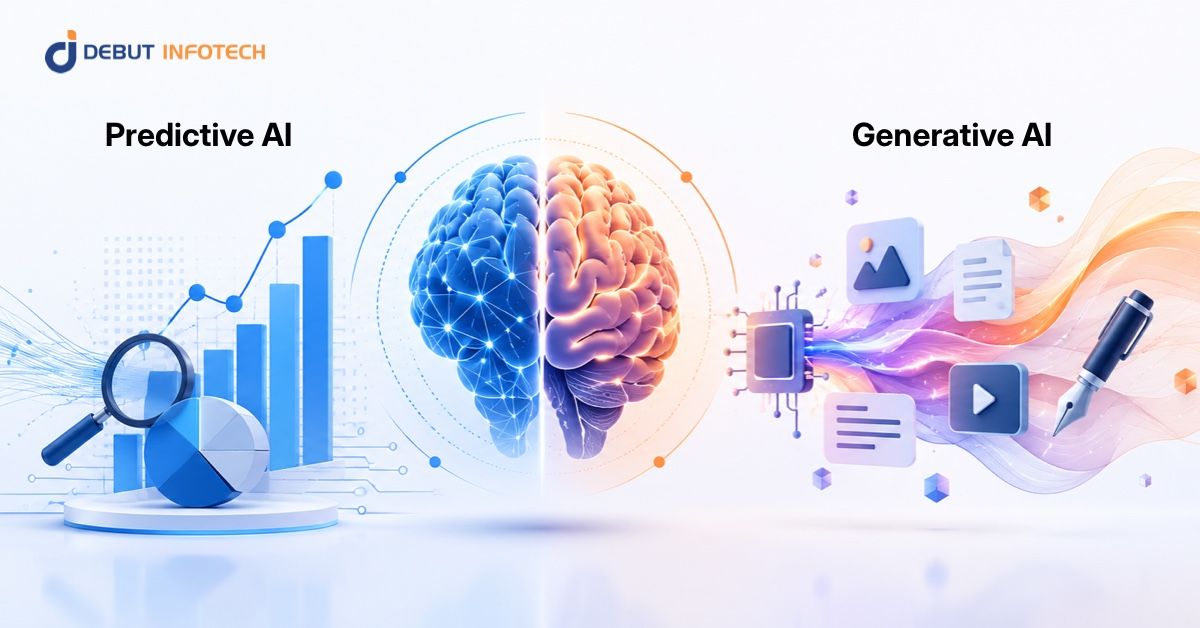


Predictive AI forecasts outcomes, while Generative AI creates content. Predictive systems produce scores, probabilities, rankings, or forecasts, whereas generative systems produce text, code, images, audio, or other content.
Business objectives should determine the AI approach. Use predictive AI for forecasting, classification, risk scoring, or anomaly detection, and generative AI for content creation, transformation, summarization, or conversational workflows.
Data readiness directly affects AI implementation. Predictive AI typically depends on reliable historical data and target variables, while generative AI may require enterprise knowledge, RAG, approved examples, or fine-tuning data.
Hybrid AI can combine prediction with generation. Businesses can use predictive models for scoring or forecasting and generative AI for explanations, summaries, or personalized responses while keeping the two responsibilities separately evaluated.
Evaluation and governance are essential for both approaches. Predictive systems require monitoring for accuracy, calibration, drift, and error costs, while generative systems need controls for grounding, safety, relevance, and unsupported outputs.
AI costs and implementation timelines depend on architecture and lifecycle requirements. Data engineering, model training, inference, RAG, integrations, security, monitoring, usage volume, and ongoing maintenance can all influence the overall investment.
When considering predictive AI vs generative AI, always begin with what you are looking to produce in your workflow. Use predictive AI when predicting a probability, score, class or future value based on available data. Use generative AI when generating or modifying text, images, code, audio or other content. Use them together where a forecast needs to be explained, personalized or expressed as a user facing response.
Other factors that affect how the right approach is taken include integration effort, acceptable error, evaluation criteria, data quality, security, and ongoing monitoring. This guide discusses the two methods and how each provides business value, when to use a hybrid architecture and when to use a simpler, non-AI approach.
Predictive artificial intelligence is a method that estimates an unknown or future prediction based on past and present observations. It’s different from descriptive analytics which tells you what happened; it’s used to answer a specific question such as How much demand should a retailer expect? Which accounts may churn? Does a transaction resemble known fraud? The answer is typically a probability, numerical forecast, ranking, or class, not a guaranteed fact.
Development begins by translating the business decision into a target variable and measurable acceptance criteria. Data teams gather relevant records, correct errors, handle missing values, and create useful features. They separate training, validation, and test data, checking that future or held-out information does not leak into training. Performance on unseen examples guides model selection. The selected model learns a relationship between the inputs and target. Once deployed, an API, dashboard or workflow displays the result, while thresholds and human review rules determine the next action.
Regression is used to estimate numerical values, like revenue or delivery time. Classification assigns a category or probability and supports fraud screening or customer behavior prediction. Time-series techniques predict data that is measured over time, such as sales or workload. Decision trees and ensemble models can be used to recognize nonlinear relationships, and neural networks can be used in more complicated pattern recognition tasks. Anomaly detection is used to identify observations that are significantly different from a pattern.
Choose metrics according to the decision and the consequences of error. MAE or RMSE can evaluate numerical forecasts. Precision, recall, F1, ROC-AUC and calibration show different pieces of classification performance. For instance, a fraud screen might focus on recall to capture more fraudulent activity, but a lot of false positives could cause customer friction. Google’s classification guidance explains why F1 can be more informative than accuracy when classes are imbalanced.
Production evaluation must also track latency, coverage, data drift, concept drift, and the business outcome affected by each prediction. Effective predictive AI solutions document thresholds, escalation paths, retraining triggers, and ownership after launch.
Generative AI is a type of artificial intelligence that generates or modifies content by learning patterns from data. The output may be text, code, images, audio, video, designs or synthetic data. “New” does not mean factually correct, legally original, or ready for release; the output remains probabilistic and requires controls suited to its use.
Most business applications start with a pretrained foundation model instead of training a new one from scratch. A prompt provides instructions and context, while the model generates an output, step by step. To adapt to the system, teams can add approved examples, fine-tuning, or incorporate retrieval-augmented generation (RAG). RAG retrieves relevant enterprise information before generation, improving grounding without eliminating unsupported claims. Guardrails, permission checks, and human review control what information enters the model and how its response is used.
Transformers process relationships across sequences. Large language models use transformer architectures to generate text or code and perform natural language processing tasks such as summarization and question answering. Diffusion models progressively turn noise into images or other media. Generative adversarial networks use a generator and discriminator, while variational autoencoders learn compressed representations that can produce variations. These are distinct model families, not mandatory stages in one pipeline.
Evaluation must reflect the intended task. A knowledge assistant may require relevant, grounded, and complete answers; a code generator may require functional correctness and security testing. Teams should also assess safety, instruction adherence, latency, cost, and consistency across representative test cases. Microsoft’s evaluation guidance describes relevance as how directly a response addresses a question and its context. Automated scores should be backed up by a qualified human review, red team testing and post launch monitoring.
Some of the most common applications of enterprise AI are knowledge assistants, document summarization, code generation, product concepts, and synthetic data. Implementation should cover data access, evaluation, integration, security, monitoring, and ownership, not model selection alone.
The main similarities between predictive AI and generative AI begin with their foundations. Both are forms of artificial intelligence that commonly use machine learning to identify relationships in data and apply them during inference. Both can use neural networks, embeddings, and other mathematical representations for pattern recognition, although their training objectives and architectures may differ.
Both approaches also produce probabilistic outputs. A forecast or a risk score is not a guarantee, it is merely a prediction, and generated text is not verified truth. Therefore, task-specific evaluation, representative data, security controls, monitoring and clear acceptance thresholds are required for predictive models and generative AI models. The value of either system can be diminished due to data quality, bias, privacy, drift, and misuse. The NIST AI Risk Management Framework offers a cross-sector framework for the governance, mapping, measurement, and management of such risks.
The two approaches can be used as components within a larger application, instead of as separate ones. They can share access controls, APIs, data pipelines, cloud infrastructure, human review processes, and observability. But they are not the same as common technical bases cannot overcome the distinction between the prediction of an outcome and production of an output.
A useful predictive AI vs. generative AI comparison must go beyond “forecasts versus creates.” These methods vary in problem framing, data preparation, data validation, uncertainty, integration and continuous control. Those differences help to decide whether a system can accommodate an intended business decision safely, consistently and at an acceptable lifecycle cost.
| Decision factor | Predictive AI | Generative AI |
| Objective | Estimate a value, class, probability, ranking, or event | Create or transform content, representations, or scenarios |
| Output | Structured score, forecast, label, recommendation, or alert | Text, code, image, audio, summary, design, or synthetic data |
| Typical data | Task-specific historical or real-time data; labels when supervised | Pretrained knowledge plus prompts, retrieved context, examples, or fine-tuning data |
| Starting point | Defined target variable, baseline, and error tolerance | Defined generation task, model choice, context, and output policy |
| Common models | Regression, classification, time-series, trees, ensembles, neural networks | Transformers, large language models, diffusion models, GANs, VAEs |
| Adaptation | Feature engineering, training, tuning, calibration | Prompting, RAG, fine-tuning, tool use, guardrails |
| Evaluation | Forecast error, discrimination, calibration, threshold cost | Relevance, groundedness, completeness, task success, safety, human judgment |
| Uncertainty | Probability or error range can often be quantified | Quality varies across prompts and contexts; fluency can mask unsupported claims |
| Explainability | Varies by model; feature-level explanations may be possible | Model reasoning is often opaque; sources and audit trails improve transparency |
| Infrastructure | Data pipelines, training or scoring services, integration | Model APIs or hosting, retrieval, orchestration, inference controls |
| Principal risks | Leakage, overfitting, bias, drift, poor calibration | Confabulation, prompt injection, leakage, unsafe output, provenance concerns |
| Post-launch work | Monitor data, thresholds, calibration, and outcomes | Monitor prompts, retrieval, quality, safety, latency, usage, and cost |
Predictive AI models begin with a target that can be observed or estimated. A probability becomes useful only when a threshold, workflow, or person converts it into action. Generative AI models begin with a creation or transformation task, and their output usually needs validation before release or downstream use.
Predictive projects often build task-specific models from owned operational data. Generative applications often adapt existing foundation models through prompts, retrieval, or fine-tuning. These are tendencies, not rules: either approach can process structured or unstructured inputs. Google Cloud’s selection guidance recommends aligning the method with the use case and available data.
Predictive evaluation can use numerical error and threshold metrics, but a high aggregate score may hide costly failures or subgroup bias. Generative evaluation is multi-dimensional and is frequently based on a combination of automated and human assessment. Both systems are not necessarily explainable by itself, as the level of transparency will be determined by architecture, documentation, evidence, and decision context.
There is no universal answer as to which is cheaper or quicker. Predictive costs may concentrate in data engineering, labeling, training, and retraining. Generative costs may concentrate in inference volume, retrieval, evaluations, safety controls, and latency. Hybrid applications add orchestration, dual monitoring, and integration overhead.
Predictive controls should be able to handle costly classification errors, fairness, leakage, calibration and drift. Generative controls should address unsupported output, sensitive-data exposure, prompt injection, unsafe content, and provenance. The NIST Generative AI Profile and OWASP’s LLM and GenAI guidance provide useful risk-management and security references.
The business applications of predictive AI center on estimating what is likely, how much may occur, or which item needs attention. The business applications of generative AI center on producing, transforming, or presenting information. The more useful predictive AI vs. generative AI applications connect these capabilities to a specific decision and control point. The workflows below are illustrative; they are not verified Debut Infotech projects or promised results.
| Business objective | Predictive role | Generative role | Hybrid opportunity |
| Reduce customer churn | Estimate each account’s churn likelihood and surface relevant signals through customer behavior prediction | Summarize account context and draft outreach within approved tone and offer rules | Rank cases for action, prepare a message, and require an employee to approve any customer-facing communication |
| Balance inventory | Forecast unit demand across products, regions, channels, or periods | Turn approved forecasts into scenario summaries or plain-language planning notes | Let planners question forecast data conversationally while preserving the underlying figures and uncertainty |
| Triage suspicious activity | Score events according to defined fraud or operational-risk indicators | Assemble supporting records and produce a reviewer-facing case summary | Route higher-priority cases, explain available evidence, and reserve the final decision for an authorized reviewer |
| Prevent equipment downtime | Estimate failure likelihood or remaining useful life from sensor and maintenance records | Convert approved manuals and diagnostic data into technician instructions or work-order drafts | Trigger a controlled maintenance brief that includes the alert source, confidence, and escalation path |
| Personalize marketing | Estimate conversion propensity, segment affinity, timing, or channel preference | Generate campaign variations that follow brand, consent, and content rules | Select an eligible audience, create controlled variants, and review them before activation |
| Improve customer support | Predict intent, urgency, routing destination, or escalation probability | Retrieve approved knowledge and draft a relevant response using natural language processing | Route the request, prepare a grounded answer, and transfer sensitive or low-confidence cases to a person |
| Inform product planning | Forecast feature adoption, demand, or usage patterns | Generate concepts, interface text, prototypes, or research summaries | Use demand signals to guide ideation while product teams assess feasibility, evidence, and strategic fit |
Hybrid value emerges when prediction and generation remain separate, testable responsibilities. A churn score should retain its model version, contributing data, confidence, and threshold when passed to a content generator. Likewise, a generated explanation should not alter the underlying score or imply greater certainty. This separation supports auditing, troubleshooting, and safer human review.
Google Cloud’s documentation gives comparable examples: predictive analysis can identify churn, risk, or customer segments, while generative systems can support conversational analysis, mitigation scenarios, or tailored content. The source also emphasizes starting with business outcomes and user needs rather than selecting technology first.
Evaluation should cover three layers. Measure the predictive component through calibration, error cost, drift, and its target business outcome. Evaluate generative components in terms of grounding, relevance, safety, completeness, and task success. Lastly, stress tests the entire workflow for latency, overrides, adoption, auditability and unexpected side effects. A good use case will contain an action, approved data, clear handling of failure and an accountable handler once it is deployed.
How do I choose between predictive AI and generative AI? Begin with the business decision, not the preferred model or platform. The Outcome–Data–Control framework tests what the workflow must produce, whether the organization has usable and permitted data, and how errors will be measured and governed. Google Cloud’s selection guidance similarly begins with business priorities, the use case, and available data.
| Framework axis | Question to answer | Selection signal |
| Outcome | What must the system deliver, and what action follows? | Forecast, score, class, or anomaly suggests predictive AI; new or transformed content suggests generative AI; both outputs suggest a hybrid |
| Data | Which representative, permitted, and maintainable sources are available? | Historical targets support prediction; enterprise knowledge or multimodal content supports generation; weak inputs may require data work first |
| Control | What happens when the output is wrong? | Error cost, evidence requirements, explainability, human review, and regulation determine whether the use case is deployable |
Describe the deliverable without naming a technology. A probability, numerical forecast, classification, ranking, or anomaly points toward a predictive method. Text, images, code, audio, summaries, simulations, or conversation point toward a generative method. If a forecast must be explained, personalized, or presented conversationally, evaluate a hybrid. Record the downstream action so the model does not become an experiment without an operational purpose.
A supervised predictive project may require reliable historical records, meaningful targets, and enough representative examples. A generative application may require approved source content, retrieval data, examples, or fine-tuning material. Both need documented ownership, provenance, privacy permissions, retention rules, and an update path. If the target is unstable, records are biased, or content cannot be used lawfully, fix the data foundation before selecting a model.
Establish acceptance criteria prior to development. When making predictions, consider false positive and false negative costs, calibration, forecast error and downstream impact. For relevance, safety, task success, test grounding and generation. Use representative cases and a non-AI baseline. High-impact decisions require qualified review, meaningful human authority, escalation rules, and stronger evidence; a polished interface cannot compensate for inadequate validation.
Assess data pipelines, model training or API access, retrieval, orchestration, CRM or ERP integration, security review, observability, support, and ownership. Choose a platform by data location, privacy, model availability, latency, portability, integration fit, internal skills, and vendor dependence, not market familiarity. Cost and timeline depend on data readiness, evaluation depth, integration complexity, approval requirements, usage volume, and monitoring.
Use deterministic rules, BI, search, templates, optimization, or human analysis when the process is stable, the answer must be exact, reliable data is unavailable, volume does not justify lifecycle effort, or required oversight is absent. Sometimes the real constraint is fragmented data or poor workflow integration. In that situation, adding predictive AI solutions or generative AI solutions increases complexity without resolving the underlying problem.
Selecting a model category does not create a production system. Implementation must connect the model to trusted data, measurable acceptance criteria, real workflows, accountable people, and a controlled operating lifecycle. The following sequence applies whether a team is deploying predictive AI models, generative AI models, or a hybrid architecture.
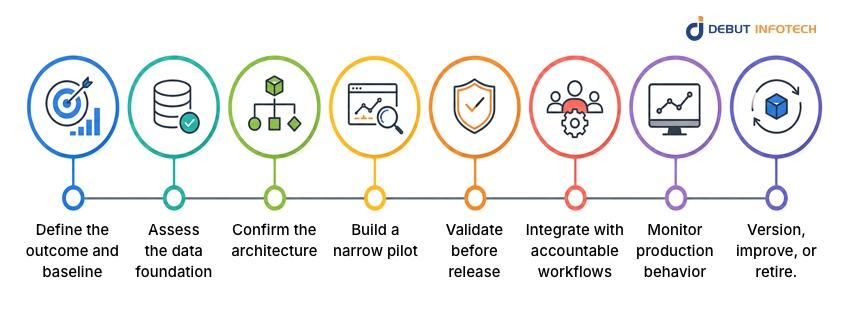
Governance should span the lifecycle. The NIST AI Risk Management Framework organizes work through Govern, Map, Measure, and Manage, while the NIST Generative AI Profile addresses additional generative risks. ISO/IEC 42001 provides an AI energy management-system structure, and OWASP’s LLM and GenAI guidance supports application-security planning. These resources do not replace legal or specialist review; obligations vary by role, industry, use case, and jurisdiction.
An implementation partner should demonstrate production integration, data engineering, model-specific evaluation, security, governance, MLOps or LLMOps, transparent architecture choices, and post-launch support. Ask who owns monitoring and incidents after deployment, not only which models or tools appear in the proposal.
The right system begins with a defined business decision. Use predictive AI when the workflow needs a forecast, probability, classification, ranking, or anomaly alert. Use generative AI when it needs new or transformed content. Combine them only when each component has a distinct purpose, acceptance test, and accountable owner. If the data, action, or failure controls remain unclear, resolve those gaps before implementation.
Debut Infotech’s AI development services provider can help map your intended outcome, available data, integrations, and risk constraints to a predictive, generative, hybrid, or simpler architecture. The next step is a focused assessment and practical pilot scope, not a predetermined technology recommendation.
The practical distinction is the output a workflow needs. Predictive AI estimates a value, class, probability, ranking, or likely event from available data. Generative AI creates or transforms text, images, code, audio, or other content. Choose by defining the business action, evidence requirements, error tolerance, and evaluation method before comparing models or vendors.
No. They are related categories with different optimization goals. Both may use neural networks and probabilistic inference, but predictive systems are designed around target variables and decision thresholds, while generative systems produce new outputs. A business application may contain either model type, both, or neither, depending on the workflow.
Start with Outcome, Data, and Control. Specify whether the workflow needs a forecast, classification, generated asset, or combination. Confirm that suitable data and usage rights exist. Then define acceptable errors, evidence, human review, integration needs, and lifecycle cost. Use rules, search, analytics, or automation when they can meet the requirement more reliably.
Both learn patterns from data, perform inference, and can improve or degrade as their operating context changes. Each requires representative data, task-specific evaluation, access controls, monitoring, accountable ownership, and a fallback when confidence or quality is inadequate. Neither produces guaranteed truth, and neither creates business value until its output supports a defined action.
Yes. In a governed hybrid workflow, a predictive model can score churn risk, forecast demand, or flag an anomaly. A rules layer then checks thresholds and permissions before passing approved facts to a generative model, which prepares an explanation or response. Separate monitoring should assess predictive drift and generative quality, safety, latency, and cost.

Our Latest Insights
USA
2501 Chatham, Rd Suite R Springfield, IL 62704
+1-708-515-4004
info@debutinfotech.com
UK
7 Pound Close, Yarnton, Oxfordshire, OX51QG
+44-770-304-0079
info@debutinfotech.com
Canada
154 Eden Oak Trail, Kitchener, ON N2A 0H9
+1-708-515-4004
info@debutinfotech.com
INDIA
Sector 101-A, Plot No: I-42, IT City Rd, JLPL Industrial Area, Mohali, PB 140306
9888402396
info@debutinfotech.com