ON THIS PAGE
Progress0%






Our Global Presence :


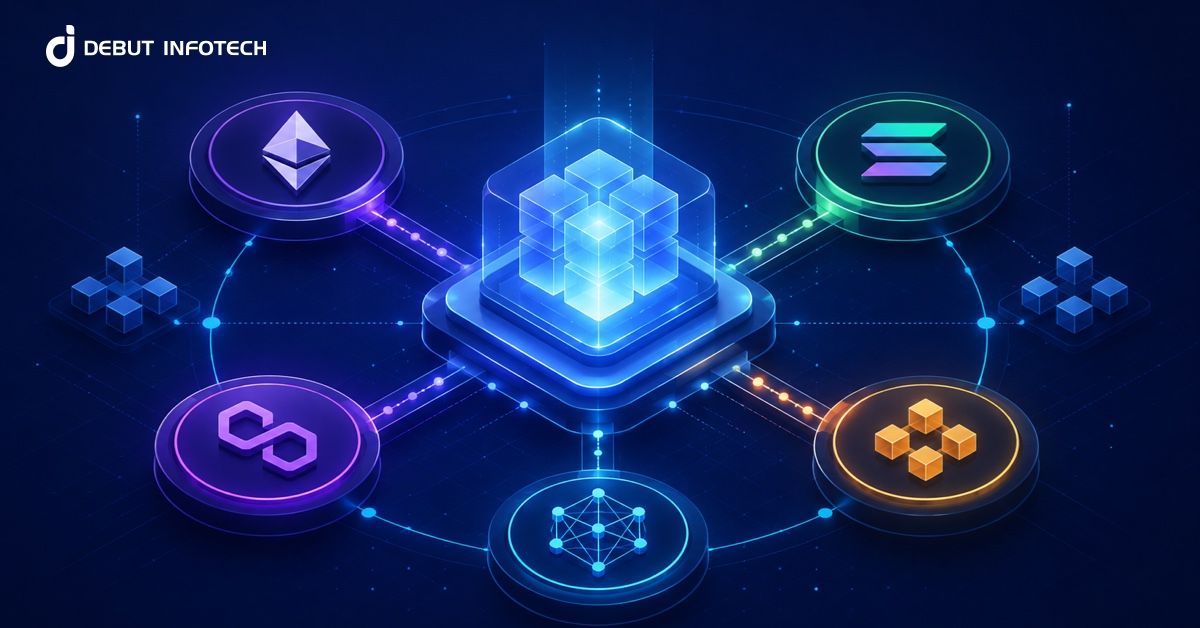


Blockchain selection impacts long-term project success, affecting development costs, security, liquidity access, hiring, interoperability, and future scalability.
Ethereum and Ethereum Layer 2s remain the safest default for most business applications, offering mature tooling, institutional trust, strong security, and deep DeFi liquidity.
Solana is best suited for high-throughput consumer applications, including payments, gaming, and real-time experiences that require low transaction costs and fast execution.
Platform decisions should be driven by business requirements rather than transaction fees, as audits, compliance, infrastructure, and maintenance typically represent larger lifecycle costs.
EVM-compatible ecosystems such as Ethereum, Polygon, Arbitrum, and Avalanche provide greater portability, enabling easier multi-chain expansion and access to a larger developer talent pool.
Compliance, governance, and data privacy requirements can outweigh performance considerations, making platforms like Hyperledger Fabric, R3 Corda, or Avalanche suitable for regulated enterprise environments.
The strongest blockchain strategy starts with the use case, evaluating public vs. private deployment, throughput needs, security tolerance, liquidity requirements, and future growth plans before selecting a platform.
Choosing a blockchain can be one of the most costly choices you make before coding a single line of code, because all your costs, hiring, security, liquidity, and the ease of migrating later depend on the chain you choose.
In 2026, for the majority of projects, the default choice for liquidity, institutional trust, and the most widely audited tooling is Ethereum or an Ethereum Layer 2 (Arbitrum, Base, or Polygon). Solana is the best option for high-throughput consumer applications, gaming, and payments, and Polygon is the value option for low-cost EVM applications, NFTs, and enterprise pilots. In addition, it depends on your use case, budget, compliance requirements, and the developers you can actually find.
This blockchain platform comparison is built to help make that decision rather than just admire the technology. We will discuss what really matters, compare the main platforms with current data, provide platform-to-chain correlations for typical use cases, discuss the cost implications of platform selection, and then give a simple roadmap to execute a project.
It can be easy to think of the blockchain as a secondary element that will be replaced in the future. In reality, it is often not possible or not affordable. This is because a smart contract compiled in Solidity for Ethereum will not work on Solana until it’s rewritten in Rust. The liquidity, users, and integrations built on the chain at launch are transferred when pulling them to a new one, thereby rebuilding the relationships that have been budding for months.
The wrong choice presents itself as a real pain: if a consumer app is too slow on the chain, it becomes inefficient; if a DeFi application is open to any public chain, but not the one where it was launched, it gets no capital; if the chain is public, and data privacy is required for enterprise pilot projects, they stall during legal review.
The right choice does the opposite. It gives your team tooling they already know, puts you next to the liquidity or users you need, keeps transaction costs sustainable at scale, and leaves you a clean path to expand. That’s why platform selection deserves a structured evaluation, not a decision based on whichever chain is trending this quarter.
Before comparing named chains, clarify what you’re optimizing for. Six factors drive most decisions about blockchain platforms.
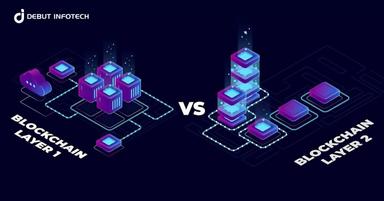
Measurements are reported in transactions per second (TPS), and the advertised TPSs reported by the chains are typically their maximum in a lab setting, not what you would get in production. Solana has been cited as having a throughput of 65,000 transactions per second, though it usually hovers in the thousands. The base layer of Ethereum achieves approximately 15-30 TPS, a compromise for high-volume activity that’s driven to Layer 2 rollups that bundle transactions and leverage Ethereum’s security.
The real issue is not which chain has more transactions, but whether this chain can handle my transaction volume at the cost and speed my users are looking for. A payments app processing millions of micro-transactions has very different throughput needs than a tokenization platform settling a few high-value transfers a day.
Fees are where 2026 looks very different from a couple of years ago. Etherscan data shows that Ethereum’s average transaction fee has dropped significantly since the Dencun upgrade, which is expected to bring most activity onto Layer 2 solutions, from USD several per transaction to USD 0.16 in mid-2026, and that fee surges during times of congestion. Layer 2s, such as Arbitrum and Base, typically charge a few cents or less; Polygon PoS charges under a cent per transaction; and Solana charges about $0.00025 per transaction.
Two cautions. First, fees are volatile. A memecoin frenzy or an NFT mint can push any chain’s costs sharply higher, so design for spikes, not just averages. Second, the per-transaction fee is just the tip of the iceberg. Gas becomes a small component of total project costs over the lifetime of a project, compared to audit, wallet infrastructure, KYC/AML tooling, custody, and monitoring.
Security has two dimensions: the cryptographic and economic security of the chain itself, and its track record of staying online. The Ethereum network has been running since 2015 with no unplanned outages on its mainnet, and has more than 1 million validators, a significant trust signal for any network that carries substantial value. The newer high-performance chains tend to have fewer, shorter, and less battle-tested histories. Solana had multiple network disruptions from 2021 to 2023 but has become much more reliable since, with no major outages since the beginning of 2024.
In cases like exchanges, custody, large DeFi positions, or regulated financial products, a longer security track record and an established audit ecosystem will be worth the price for projects that would be irreparable in the event of downtime or an exploit.
The more complex and mature the developer ecosystem of a chain, the quicker you can build, the easier it will be to hire, and the more battle-tested code you can use. The Electric Capital Developer Report shows that Ethereum has approximately 31,900 active developers, compared to Solana’s ~17,700, and Ethereum’s developers are also the most numerous to join it in 2025. However, while Solana is the fastest-growing major ecosystem, the gap is closing with a number of on-chain activity metrics now in its favor.
The deep dive from the builder’s point of view: EVM chains (Ethereum and compatibles) have a common language – Solidity and an established toolchain of frameworks, audit houses, and libraries. That common ecosystem is the least cumbersome initial choice for pretty much any team. Solana’s Rust-based development is strong and based on a smaller talent pool.
Very few serious projects stay on a single chain forever. How locked-in you are is influenced by interoperability, a capability of moving assets and messages between chains via bridges or messaging protocols, and how easy it is to expand where your users are headed next. The most useful form of optionality here is the ability to build on one EVM chain and deploy the same codebase to Ethereum, Polygon, Arbitrum, Base, Avalanche, or BNB Chain with minimal modifications. Chain alternatives that aren’t EVM chains, such as Solana, sacrifice some of that portability for performance.
If you operate in a regulated industry or sell to enterprises, compliance and data control can outrank raw performance. Public chains are transparent by default, which is a feature for auditability but a problem when you’re handling sensitive or proprietary data. In some cases, it might be better to use a purpose-built enterprise platform such as Hyperledger Fabric or R3 Corda rather than public chains for consortium and enterprise use cases that require permissioned access, including known participants, private data, and governance controls. Today, scaling for public products remains the most obvious regulatory roadmap, and the most significant institutional uptake exists on Ethereum.
Here’s a high-level snapshot of the major platforms a typical project chooses between. Figures are approximate and reflect mid-2026 conditions; treat fees and throughput as typical ranges rather than fixed values.
| Platform | Type | Real-World TPS (approx.) | Typical Fee | Language | EVM? | Best For |
| Ethereum | Layer 1 | ~15–30 | ~$0.16 avg (spikes higher) | Solidity | Yes | DeFi, tokenization, institutional |
| Solana | Layer 1 | ~1,000–5,000+ | <$0.001 | Rust | No | Consumer apps, gaming, and payments |
| Polygon PoS | Ethereum sidechain | ~1,000s | <$0.01 | Solidity | Yes | Low-cost EVM apps, NFTs, enterprise |
| Arbitrum | Ethereum L2 (rollup) | Very high | ~$0.02–0.10 | Solidity | Yes | DeFi, DEXs, perps |
| Avalanche | Layer 1 (+ subnets) | ~1,000s | ~$0.02–0.10 | Solidity | Yes | Custom chains, institutional |
| BNB Chain | Layer 1 | ~1,000s | ~$0.01–0.05 | Solidity | Yes | Retail Web3, GameFi |
A note on Layer 2s: Base, Coinbase’s Ethereum L2, has grown rapidly and now holds the largest share of Layer 2 DeFi value (roughly 47% of L2 TVL, ahead of Arbitrum’s ~31%). If your project is consumer- or DeFi-facing and wants Ethereum security with low fees, Base belongs on your shortlist alongside Arbitrum.
The table is a starting point. Here’s what actually separates these platforms when you have to commit.
Ethereum is the default settlement layer of the on-chain economy. It hosts the deepest liquidity of over $55 billion in DeFi TVL, and the largest concentration of institutional activity, from BlackRock’s tokenized funds to corporate stablecoin settlement. Its strengths are gravitational: the most mature tooling, the largest set of audit firms that know the codebase intimately, the clearest regulatory pathway, and a decade-long security record with no mainnet downtime.
Mainnet fees have plummeted (around $0.16 in 2026), and the network has become a safe layer-2 relay for most user activity, with cheaper Layer 2s rolling back to it. The trade-off for Ethereum today is lower fees and greater base-layer throughput and transparency for a fully public chain. If you value liquidity, security, and institutional trust over speed, then select Ethereum (or L2).
Solana is the performance chain. Designed for applications that need speed and low-cost transactions at scale, it delivers real-world throughput in the thousands of TPS, sub-second finality, and transactions at a fraction of a cent. It currently ranks among the top lists of the most important activity indicators (active addresses per day, DEX volume), and its developer ecosystem is the most dynamic of the major chains.
The compromises: Solana isn’t EVM-compatible, which means you can only build on it using Rust, but you lose the ability to port to other chains; its security history is shorter than Ethereum’s; and the developer community is smaller but expanding rapidly. For applications focused on consumers or payments, with low-cost, high-throughput requirements, use Solana.
Polygon is the workhorse of the EVM. It is built on the same Solidity codebase and tooling as Ethereum, and is cheaper to use than Ethereum (under a cent per transaction), so it is the preferred choice for projects looking to get the EVM experience without paying the mainnet fees. It has the best chain of enterprise and consumer brands. It has been used by Starbucks, Reddit, Nike, and others for big pilots and is a low-risk option for branded and enterprise pilots.
The downside of this is that Polygon’s roadmap is constantly changing (the team is consolidating their stack of scaling solutions), so it’s best to double-check that you are using the most current infrastructure recommended on their roadmap. For low-cost deployments that are EVM compatible and are already used in enterprise and consumer deployments, use Polygon.
What sets Avalanche apart is its unique subnet (now “L1”) design, which allows users to deploy their own application-specific chain with unique rules, validators, and compliance requirements while still maintaining EVM compatibility. This is an attractive feature to regulated institutions and enterprises requiring their own governed environment instead of a public chain.. Choose Avalanche when you need a custom, EVM-compatible chain with network-level control over rules and compliance.
Arbitrum is one of the leading Ethereum Layer 2s — an optimistic rollup that gives you Ethereum’s security with dramatically lower fees and high throughput. It has long been a hub for DeFi, DEXs, and perpetuals, with a deep ecosystem of protocols. For teams that want to build on Ethereum’s trust and liquidity but can’t accept mainnet costs, Arbitrum (and its peers Base and Optimism) is the natural home.
In 2026, the L2 landscape is competitive and shifting. Base has overtaken Arbitrum as the largest L2 by DeFi TVL, so evaluate the current ecosystem fit for your specific use case rather than assuming any single L2 dominates. Choose Arbitrum when you want Ethereum security and an established DeFi ecosystem at L2 costs.
BNB Chain vs Ethereum comes up often for retail-focused projects. BNB Chain is EVM-compatible with low fees and high activity, making it popular for retail Web3 apps and GameFi, particularly in regions where the Binance ecosystem is strong. It trades some decentralization and institutional credibility for throughput and a built-in retail user base. This is a reasonable choice for consumer products targeting that audience.
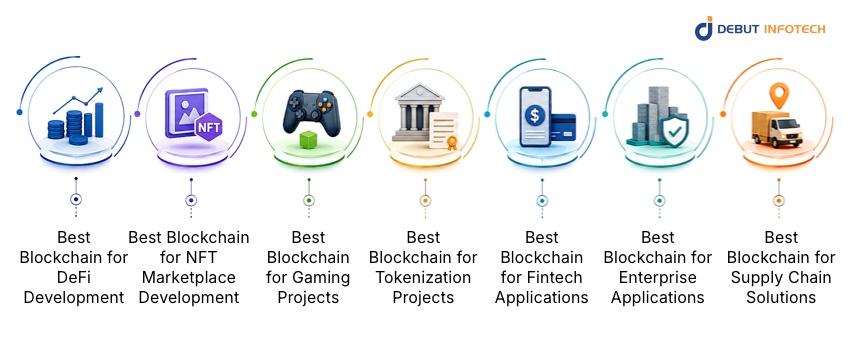
The best chain is the one that fits your specific application. Here’s how the major use cases map.
For DeFi, liquidity and composability win, which points to Ethereum or an Ethereum L2 (Arbitrum, Base). That’s where the existing capital lives ($55B+ in TVL), where protocols like Uniswap, Aave, and Curve are already integrated, and where the audit ecosystem is deepest. Solana is a strong second choice for consumer-facing, high-frequency DeFi where speed and cost dominate. If you’re building a protocol, also see Debut Infotech’s defi development work for how chain choice shapes a DeFi build.
NFTs are split by tier. Ethereum remains the home of premium, blue-chip collections and the deepest pool of high-value buyers, while Polygon dominates high-volume, low-cost minting (often under $0.05 per mint), which is why so many brand NFT programs run on it. Solana is the choice for consumer and gaming NFTs where speed and near-zero cost matter. Match the chain to whether you’re optimizing for prestige and value or volume and accessibility — Debut’s nft marketplace development team can advise on the trade-off.
Gaming needs high throughput and negligible per-action cost, which favors Solana for in-game transactions and Polygon for EVM-based games and NFT item ownership. For studios that want a fully custom environment, an Avalanche subnet lets you run your own game chain with tailored economics. The deciding factor is usually transaction frequency: the more on-chain actions per player, the more you lean toward Solana or a dedicated chain.
Real-world asset (RWA) tokenization rewards regulatory clarity and institutional infrastructure, which currently means Ethereum — it has the most developed security-token standards, the deepest institutional custody support, and the clearest compliance pathway. Polygon is a sensible, lower-cost alternative to tokenization that doesn’t require mainnet-level settlement. This is a fast-moving, compliance-heavy area where platform choice and architecture matter a lot.
Fintech depends on the product. For payments and high-volume, low-value transactions, Solana or Polygon offer the speed and cost profile you need. For products built around stablecoin settlement or that require institutional trust, Ethereum (or an L2) is the safer base. Regulated fintech should weigh compliance and custody infrastructure heavily — the chain with the best raw performance isn’t always the one that clears your legal review. For exchange-style fintech, our guide on cryptocurrency exchange architecture goes deeper, and Debut’s cryptocurrency exchange development team builds these end-to-end.
Enterprise use cases involving known participants and private data often call for a permissioned platform such as Hyperledger Fabric or R3 Corda rather than a public chain. Where an enterprise wants public verifiability with control, an Avalanche subnet or Polygon can work. The first enterprise question is always whether you need a public, private, or consortium chain answer before evaluating named platforms. Debut’s enterprise blockchain development practice focuses on exactly this.
Supply chain typically means multiple known partners sharing data they don’t fully trust each other with a textbook fit for Hyperledger Fabric (permissioned, enterprise-supported) or, where public auditability is valued, Polygon. The classic example is provenance tracking, where a permissioned chain gives partners shared, tamper-evident records without exposing data to the public.
Platform choice affects cost in ways that go well beyond gas fees. The biggest cost drivers are your team and your tooling, not your transactions.
EVM chains (Ethereum, Polygon, Arbitrum, Avalanche, BNB) tend to be cheaper to build on if you have or can hire Solidity developers, because the talent pool is large and there’s an enormous library of audited, reusable code and mature frameworks. Building the same product across multiple EVM chains is far easier than porting between EVM and non-EVM chains.
Solana can incur higher build costs despite its near-zero transaction fees because Rust developers are scarcer, and you’re drawing from a smaller pool of reusable code and audit expertise. The runtime savings are real, but they show up in operations, not in your initial development budget.
Enterprise- and app-specific chains (Hyperledger, Corda, Avalanche subnets) incur setup costs for governance, identity, and infrastructure that public-chain deployments don’t.
Across all of them, the costs that often matter most are audits, wallet infrastructure, KYC/AML, and custody, and ongoing monitoring — these are driven more by your application’s complexity and risk profile than by the chain itself.
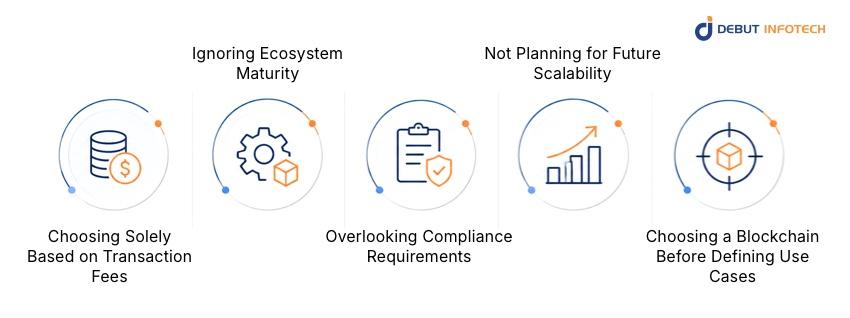
The same avoidable errors keep occurring.
The most common mistake. A chain with sub-cent fees looks attractive until you account for a thin developer pool, shallow liquidity, or a less mature audit ecosystem. Gas is rarely the dominant cost — optimize for total cost of ownership and ecosystem fit instead.
A newer chain may post impressive benchmarks but lack the tooling, audit firms, integrations, and reusable code that let you ship safely and fast. Ecosystem maturity directly affects your timeline, security, and hiring difficulty.
Building on a fully public, transparent chain can stall a project in legal review—or force an expensive re-architecture —when your use case involves sensitive data or regulated workflows. Settle your compliance and data-privacy requirements before you pick a platform, not after.
Choosing a chain that meets today’s volume but can’t handle tomorrow’s — or that leaves you no clean expansion path — is a slow-motion mistake. Think about where your transaction volume and user base will be in two years, and favor platforms that give you room (and interoperability) to grow.
The biggest mistake of all is starting from the chain rather than the problem. “We’re building on Solana” is not a strategy; “we need sub-second, sub-cent transactions for a consumer payments app, which points us to Solana” is. Define your use case, constraints, and requirements first — the right platform will emerge from that analysis.
Here’s a simple framework. Work through these questions in order, and the field narrows quickly.
If you want a second opinion on this analysis for a specific project, that’s exactly what an experienced blockchain solutions provider does – pressure-test the requirements before any code is written.
A quick decision summary.
Choose Ethereum if you’re building DeFi, tokenization, or any product where deep liquidity, institutional trust, and a long security track record matter most — and you’ll likely pair it with a Layer 2 for low-cost user transactions.
Choose Solana if you need maximum throughput and minimal cost for a consumer app, game, or payments product, and you’re comfortable building in Rust without EVM portability.
Choose Polygon if you want low-cost, EVM-compatible deployment with a proven enterprise and consumer-brand track record — a strong default for NFTs, branded programs, and cost-sensitive EVM apps.
Choose Avalanche if you need your own custom, EVM-compatible chain with network-level control over rules, validators, and compliance — common for regulated and institutional deployments.
Choose Arbitrum if you want Ethereum’s security and liquidity at Layer 2 costs for a DeFi or DEX-style product (and evaluate Base and Optimism alongside it, since the L2 landscape is competitive).
Choosing a platform is a decision you want to get right once. As a blockchain solutions provider, Debut Infotech works with founders and enterprises to do exactly that, starting from your use case, constraints, and budget rather than a chain we happen to prefer.
That typically means a use-case and feasibility assessment, a platform recommendation backed by the trade-offs that matter for your project, architecture, and security planning, a realistic cost and timeline estimate, and a path to MVP. Because our teams build across Ethereum, Solana, Polygon, Avalanche, and Layer 2s, the recommendation isn’t tied to a single ecosystem — it’s tailored to what your product actually needs.
If you’re weighing a decision now, get a blockchain platform recommendation, and we’ll help you pressure-test the options before you commit.
Our recommendations are grounded in delivery across public blockchains, private blockchain networks, hybrid ledgers, EVM-compatible ecosystems, tokenization platforms, exchange infrastructure, provenance systems, and regulated digital asset workflows. This includes hands-on experience across Ethereum, Solana, Polygon, Avalanche, BNB Smart Chain, Layer 2 networks, Hyperledger Fabric, Chainlink oracle integrations, and Bitcoin-anchored provenance models.
1. For iFinca, we developed a blockchain-enabled coffee supply chain traceability platform focused on origin verification, provenance, batch-level tracking, and stakeholder visibility. The architecture aligns with a private or hybrid blockchain model, where operational data can remain permissioned while critical proofs support auditability and trust.
2. For NDAX, our work involved crypto exchange infrastructure with public blockchain integrations across Ethereum and Binance Smart Chain. The platform required wallet connectivity, transaction processing, asset movement, backend ledger controls, and secure interaction between off-chain exchange systems and public-chain settlement.
3. For OKX, the operating model reflects multi-chain exchange architecture, where support for Ethereum, Solana, Polygon, Avalanche, BNB Smart Chain, and Layer 2 networks is less about preference and more about liquidity coverage, token standards, wallet compatibility, transaction monitoring, and custody operations.
4. For PRC, also known as Pioneer Realty Capital, we worked on real estate tokenization, ICO development, smart contracts, KYC/AML workflows, and Chainlink oracle integration. This required a public blockchain tokenization model where investor eligibility, asset data, compliance checks, and off-chain inputs connect with on-chain contract logic.
5. For RVA, we developed a real estate tokenization platform using Solidity, Ethereum, ERC-3643, Polygon, React.js, Node.js, and MongoDB. Ethereum supported smart contract maturity, Polygon improved transaction efficiency, and ERC-3643 enabled permissioned transfer behavior for regulated asset ownership.
6. For IntegraLedger, we worked with Hyperledger Fabric, chaincode, Node.js, and REST APIs to support enterprise records, legal workflows, and document verification. This is a private blockchain architecture designed for known participants, access control, governance, endorsement policies, and confidential business data.
7. For Everledger, the focus was high-value asset provenance and verification. The architecture is best understood as a hybrid model, where blockchain-based proofs and verification events support trust while proprietary systems manage sensitive asset metadata and business workflows.
8. For KoreConX, the work centered on regulated digital securities and investor workflows, where blockchain selection must support KYC/AML, controlled transfers, cap table logic, investor permissions, compliance rules, and auditability.
Together, these projects help us evaluate blockchain choices with implementation discipline. If you are deciding between Ethereum, Solana, Polygon, Avalanche, BNB Smart Chain, Layer 2 networks, Hyperledger Fabric, Chainlink-enabled architecture, or a hybrid model, Debut Infotech can help you make that decision with technical clarity before engineering investment begins.
Start from your use case, not the chain. Decide whether you need a public or private network, whether EVM compatibility matters, your throughput and cost profile, your liquidity needs, and your compliance environment. Those answers narrow the field fast — then compare the remaining platforms on security track record, ecosystem maturity, and the developers you can realistically hire.
Among major chains, Solana is typically the cheapest at a fraction of a cent (around $0.00025), with Polygon PoS close behind at under a cent. Ethereum Layer 2s like Arbitrum and Base usually cost a few cents or less. Ethereum mainnet has fallen to roughly $0.16 on average in 2026, but it still spikes during periods of heavy demand. Treat all fees as volatile.
By raw real-world throughput, Solana leads among the major Layer 1s, processing thousands of transactions per second. Ethereum scales differently through Layer 2 rollups (Arbitrum, Base, Optimism, Polygon) that collectively handle the vast majority of its activity at high throughput and low cost. Be skeptical of advertised “theoretical” TPS figures, which rarely match production performance.
For DeFi, tokenization, and institutional use cases, Ethereum remains the default because of its liquidity, security record, and ecosystem depth. Its old cost disadvantage has largely disappeared as fees dropped and activity moved to Layer 2s. It’s not the best choice for every project, though: high-throughput consumer apps and payments are often better served by Solana, and cost-sensitive EVM apps by Polygon. “Best” depends on your use case.
For public chains holding significant value, Ethereum offers the strongest combination of a decade-long outage-free track record, over a million validators, and the deepest audit ecosystem. For business applications involving private data and known participants, a permissioned platform like Hyperledger Fabric or R3 Corda is often safer, in terms of controlled access and data privacy.
Ethereum is generally the strongest choice for real-world asset tokenization, thanks to its mature security-token standards, institutional custody support, and the clearest regulatory pathway. Polygon is a reasonable lower-cost alternative. Because tokenization is compliance-heavy, platform choice should be made alongside a compliance and custody plan, not in isolation.
It depends on the product. For payments and high-volume, low-value transactions, Solana or Polygon offer the right speed and cost. For stablecoin settlement or products needing institutional trust, Ethereum or an Ethereum L2 is the safer base. Regulated fintechs should weigh compliance, custody, and security infrastructure heavily in their decisions.
Solana is well-suited to high-frequency in-game transactions thanks to its speed and near-zero fees, while Polygon works well for EVM-based games and NFT item ownership. Studios wanting a fully custom environment can launch an Avalanche subnet. The deciding factor is how many on-chain actions your game generates per player.
Ethereum leads for premium, high-value collections and the deepest buyer base, while Polygon dominates high-volume, low-cost minting (often under $0.05 per mint), which is why most brand NFT programs run on it. Solana is strong for consumer and gaming NFTs. Choose based on whether you’re optimizing for prestige and value or for volume and accessibility.
Mature teams run a structured evaluation: define the use case and requirements, decide public vs. private, assess throughput/cost/compliance needs, shortlist platforms that fit, and compare them on security, ecosystem maturity, interoperability, and total cost of ownership — not just gas fees. Many bring in a specialist partner to pressure-test the choice before committing engineering resources.
Our Latest Insights
USA

2501 Chatham, Rd Suite R Springfield, IL 62704
+1-708-515-4004
info@debutinfotech.com
UK

7 Pound Close, Yarnton, Oxfordshire, OX51QG
+44-770-304-0079
info@debutinfotech.com
Canada

154 Eden Oak Trail, Kitchener, ON N2A 0H9
+1-708-515-4004
info@debutinfotech.com
INDIA

Sector 101-A, Plot No: I-42, IT City Rd, JLPL Industrial Area, Mohali, PB 140306
9888402396
info@debutinfotech.com

9001:2015
Quality Certified

ISO 27001
Security Certified

A+ Rating
Accredited Business

Certik
Security & Audit


Copyright © 2026, Debut Infotech. All rights reserved. | Privacy Policy