ON THIS PAGE
Progress0%





Our Global Presence :





For an AMIE-inspired healthcare application built using an existing AI model, healthcare chatbot development cost may range from $40,000 to $250,000 or more.
Custom, SaaS, and hybrid solutions have different upfront and ongoing costs. Compare setup, subscription, integration, and support expenses before choosing an approach.
Clinical complexity, AI model selection, medical data preparation, EHR integration, and security requirements influence development costs. Usage volume also affects infrastructure requirements and operating expenses.
AI usage, hosting, content updates, monitoring, integration maintenance, and staff support require a separate ongoing budget.
Security controls, vendor assessments, clinician review, and escalation workflows should reflect the chatbot’s intended use and the information it handles.
A focused chatbot may take 3 to 5 months to develop and pilot, while a more complex solution may take 6 to 9 months or longer.
Starting with one measurable workflow and reusing suitable existing systems can help control costs. Pilot results can guide decisions about expanding the solution.
In a feasibility study published in The Lancet, primary care physicians found Google AMIE helpful for visit preparation in 75% of cases where they reviewed its transcript before the appointment. That represents 33 of 44 cases in a single-center study with physician-supervised AI conversations, offering early evidence of its potential to support clinical workflows.
AMIE, short for Articulate Medical Intelligence Explorer, is a research AI system developed by Google for medical conversations and reasoning. Its work on gathering patient histories and supporting clinicians raises a practical question for healthcare leaders: what would it cost to develop an AMIE-inspired healthcare chatbot for their organization?
For initial budgeting, healthcare chatbot development cost may range from $40,000 to $250,000 or more, depending on scope. This planning range covers a custom application built with existing AI models. Ongoing operating expenses are budgeted separately.
This guide breaks down development costs, compares custom, SaaS, and hybrid approaches, and explains how integrations, security, clinical evaluation, and support affect the investment.
The budget for AI chatbots in healthcare reflects the work they perform and the systems they connect with. To estimate the cost to develop a healthcare chatbot like Google AMIE, begin by defining the workflow, the assistant’s clinical role, and the requirements for deployment.
For custom healthcare chatbot development, use the following comparison to match your planned capabilities with an initial budget.
| Complexity Level | Estimated Development Cost | Expected Scope |
| Basic Healthcare Chatbot | $40,000 to $80,000 | Approved FAQs, administrative appointment preparation, limited patient intake with appropriate access and data protection, staff handoff, and a simple administrative dashboard |
| Advanced Healthcare Chatbot | $80,000 to $160,000 | Authenticated patient workflows, approved knowledge retrieval, structured intake, draft clinician summaries, and selected EHR or scheduling integrations |
| Enterprise Healthcare Assistant | $160,000 to $250,000+ | Multiple departments or locations, complex integrations, granular permissions, centralized governance, performance monitoring, defined availability targets, failover, and recovery capabilities |
These estimates assume an average delivery-team rate of $50 per hour and approximately 800 to 5,000+ team hours. They cover application development using an existing AI model, including the preparation of approved information for the chatbot to use.
Projects with broader integration, validation, or availability requirements can exceed $250,000. Data protection and access controls should reflect the information handled at every complexity level.
The following breakdown shows how a project budget may be distributed across delivery workstreams. The exact allocation will depend on the intended workflow and the systems involved.
| Development Stage / Workstream | Estimated Cost Range | What It Covers |
| Discovery and Technical Planning | $3,000 to $15,000 | Requirements, workflow mapping, architecture, and delivery planning |
| UI, UX, and Conversation Design | $4,000 to $20,000 | Patient and staff interfaces, prototypes, conversation flows, and handoff design |
| AI/NLP and Knowledge Preparation | $10,000 to $65,000 | Model integration, content preparation, retrieval, and response controls |
| Backend and Healthcare Integrations | $10,000 to $65,000 | Application services, authentication connections, storage, and agreed system interfaces |
| Security Controls and Compliance Support | $5,000 to $30,000 | Access controls, encryption configuration, audit records, retention settings, and supporting documentation |
| Testing, QA, and Workflow Evaluation | $6,000 to $40,000 | Functional, integration, security, and response-quality testing, with clinician review of relevant scenarios |
| Deployment and Handover | $2,000 to $15,000 | Production setup, monitoring, release procedures, and staff orientation |
| Initial Development Total | $40,000 to $250,000+ | Actual allocations depend on the agreed scope; broader requirements can exceed the listed allowances |
When reviewing an estimate for AI medical chatbot development, confirm who supplies approved content, reviews clinical scenarios, and provides access to the systems being integrated.
Your development approach also shapes the investment. Custom, SaaS, and hybrid models distribute spending differently between implementation and ongoing platform fees.
Your choice of development approach for conversational AI in healthcare affects both the launch budget and the bills that follow. SaaS puts more spending into subscriptions. Custom development funds an application built around your requirements. Hybrid combines platform fees with a smaller custom build.
For custom healthcare chatbot development, budget $40,000 to $250,000 or more for the interfaces, AI functionality, integrations, and controls your application needs. The final estimate depends on implementation complexity.
This approach gives you flexibility when patient workflows or system connections require substantial customization. Ongoing hosting, model usage, maintenance, and support remain part of your operating budget. Confirm ownership, documentation, and handover terms before signing.
For initial budgeting, allow $5,000 to $20,000 for setup and $500 to $5,000 per month for the platform subscription. Setup may include configuration, content loading, and onboarding. Integration work and premium support can require additional funding.
SaaS is attractive when the platform already supports your intended workflow. Check which features and usage volumes the subscription includes, and confirm whether model usage, hosting, and support are included or billed separately. Enterprise contracts or complex healthcare integrations can exceed these estimates.
A hybrid implementation extends an existing chatbot platform with custom functionality. Budget $20,000 to $100,000 or more for implementation, depending on the configuration, tailored interface, and healthcare integrations required.
You continue paying platform fees and maintaining the custom components. This approach can reduce initial engineering costs when the platform supplies capabilities you would otherwise need to build. Extensive customization can bring the total closer to a fully custom application.
Use these estimates as a starting point for comparing proposals. Confirm the vendor’s usage limits, integration changes, security terms, and support coverage before setting your final budget.
Compare each option over the same operating period and expected usage volume. Include setup, subscriptions, integrations, model usage, hosting, maintenance, and support, counting bundled services only once.
The largest budget differences come from the assistant’s clinical role, data readiness, and operating requirements. These factors explain why two projects with similar interfaces can have different development costs.
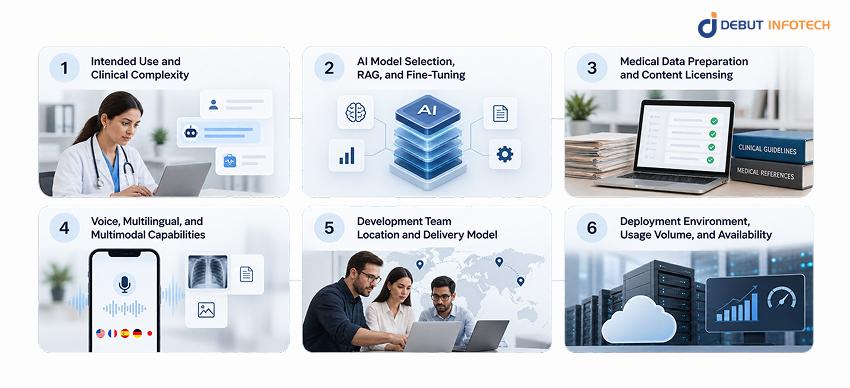
Appointment support and patient-specific clinical assistance require different levels of investment.
Architecture choices influence both implementation effort and ongoing model expenses.
Information quality determines how much preparation is needed before the chatbot can use the information reliably.
Each communication format adds functionality that must be built and tested.
When choosing an AI development company, compare the team’s technical expertise, delivery responsibilities, and support coverage alongside its hourly rate.
Operating requirements influence the build budget and recurring expenses.
Features affect the budget through the functionality users see and the engineering needed to make it dependable. Use these estimates to prioritize capabilities within custom healthcare chatbot development.
The assistant handles follow-up questions and retrieves information from approved healthcare resources, with supporting references where appropriate.
Estimated implementation cost: $8,000 to $25,000
Multiple knowledge sources, scanned documents, permission-based retrieval, and citation checks increase costs. Test responses against approved sources because retrieval alone does not guarantee accuracy.
Patients can check availability, book or change appointments, and receive reminders through connected scheduling and messaging services.
Estimated implementation cost: $4,000 to $15,000
Scheduling rules and the actions supported by the connected system determine the effort. Budget separately for message delivery and vendor access fees.
The application authenticates users and restricts access to permitted information and actions, with separate permissions for patients, staff, and caregivers.
Estimated implementation cost: $4,000 to $12,000
Portal integration, patient-account matching, proxy access, and session management affect costs. This estimate covers application access functionality. Broader security and compliance work belongs in the overall project budget.
The chatbot collects patient information through guided questions and prepares draft summaries for clinician review.
Estimated implementation cost: $8,000 to $25,000
Speciality-specific questions, branching conversations, and summary evaluation increase clinical AI chatbot development cost. Review summaries for missing details, patient corrections, and unsupported statements.
The assistant routes unresolved requests to staff with relevant conversation context and escalates situations outside its supported role.
Estimated implementation cost: $4,000 to $12,000
Multiple departments and staffed queues add routing complexity. Define fallback actions when a transfer is delayed, unavailable, or unsuccessful.
Administrators manage users, permissions, and settings, while authorized teams review activity records and system actions.
Estimated implementation cost: $5,000 to $15,000
Granular roles, searchable logs, approval history, retention settings, and audit exports increase implementation effort.
Content owners update approved information, while operational teams track completed tasks, failed requests, and handoff outcomes.
Estimated implementation cost: $5,000 to $18,000
Publishing approvals, version history, and rollback add functionality. Tracking confirmed bookings or completed intake also requires feedback from connected systems.
Prioritize features around your first workflow. These estimates form part of the overall development budget, so confirm where shared integration, security, and testing work is included.
Connecting a chatbot to healthcare systems turns conversations into actions. The budget depends on what information moves between systems, whether the assistant can make changes, and how the application handles unsuccessful transactions.
The estimates below cover initial implementation for a defined integration scope. Confirm the systems, transactions, testing, and vendor charges included before setting your budget.
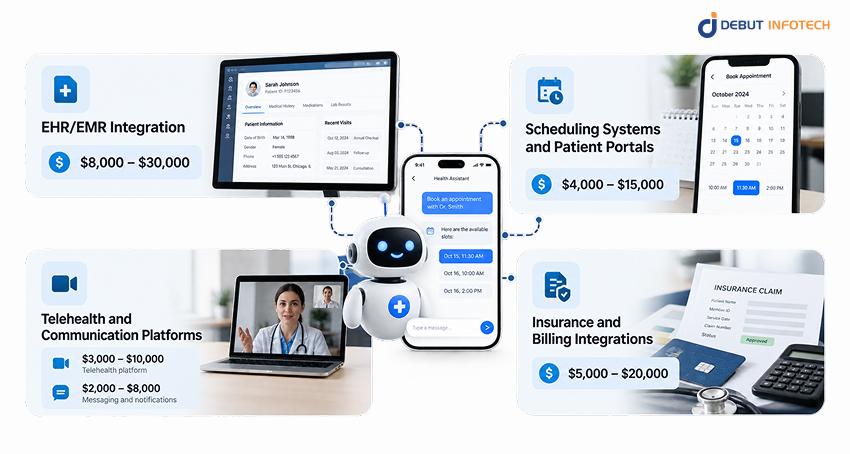
Estimated integration cost: $8,000 to $30,000
Through medical data integration, the assistant can retrieve authorized patient information or submit intake details for review.
Patient matching and local configuration affect the effort. Support for FHIR does not guarantee access to every operation your workflow requires. Multiple EHR environments, custom interfaces, or extensive write-back requirements can push costs above this range.
Estimated integration cost: $4,000 to $15,000
Portal connections let patients use the assistant within an existing account. Scheduling connections support availability checks, bookings, and appointment changes.
What changes the price? Provider-specific rules, multiple locations, proxy access, and real-time updates. The team must also prevent duplicate bookings and confirm that each requested change succeeded.
When the EHR already supplies scheduling and identity services, one integration layer may support several functions.
Budget separately for telehealth connectivity and messaging integration:
Sending a consultation link requires less work than creating sessions and transferring patient context. Message preferences, delivery failures, and staff transfers expand the implementation. Calls, messages, and video sessions also generate recurring provider charges.
Estimated integration cost: $5,000 to $20,000
Budget this amount for a defined billing, eligibility, or payment integration. Connecting several systems or supporting multiple transaction types requires separate scoping.
Each connection carries different access, validation, and exception-handling requirements. Broad claims processing needs separate scoping and can exceed this allowance.
An integration proposal should name the systems, transactions, and vendor dependencies included. These costs form part of the earlier backend and integration budget. Confirm whether scheduling, authentication, and messaging connections are already included in the feature estimates.
Security and clinical safety influence how a healthcare chatbot is designed, tested, and approved for release. For initial planning, the development budget includes $5,000 to $30,000 for security controls and compliance support. Clinical and workflow evaluation falls within the broader $6,000 to $40,000 testing budget.
The investment depends on what the assistant is allowed to do. A chatbot answering public appointment questions may need fewer controls than one accessing patient records or preparing clinical summaries.
| Area | Work Included | Main Cost Drivers |
| Privacy and vendor review | Map data flows and review how providers handle patient information. | Number of vendors, data flows, and agreements |
| Access and data protection | Configure authentication, permissions, encryption, retention, and audit records. | Data sensitivity and reuse of existing controls |
| Clinical validation | Evaluate responses, summaries, and escalation workflows. | Number of specialties, languages, and scenarios |
| Security testing | Test access controls, integrations, and application behavior. | Testing depth and independent assessments |
| Regulatory assessment | Assess requirements based on intended use and jurisdiction. | Clinical function and specialist advice |
For HIPAA-compliant chatbot development, assess applicable obligations, vendor responsibilities, and business associate agreements where required. Include both technical controls and operating procedures in the scope.
Confirm which reviews and assessments the development estimate includes. Budget separately for internal clinician time and any external legal, regulatory, or independent security assessments excluded from the proposal.
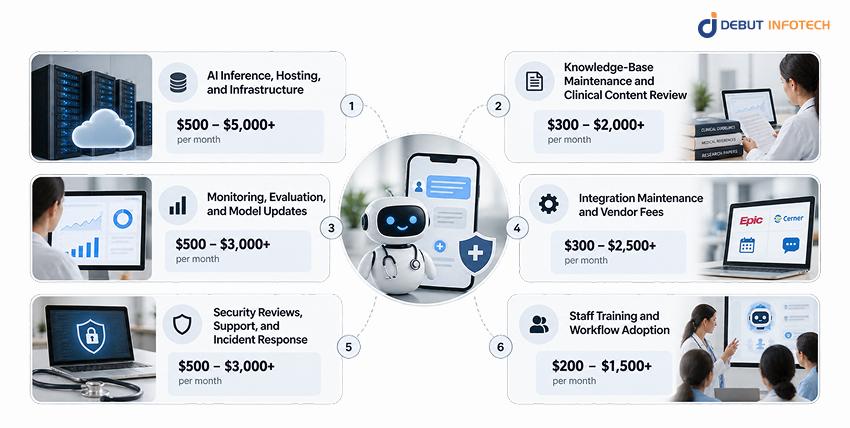
Launching the chatbot is only the first part of the investment. After deployment, healthcare organizations need to budget for the technology that runs the assistant and the people who maintain its content, integrations, and safeguards.
Model usage and infrastructure may cost $500 to $5,000 or more per month, depending on conversation volume and hosting requirements. AI model inference costs also depend on the model selected, conversation length, and the number of calls needed to complete a task.
Allow $300 to $2,000 or more per month to review, update, and approve source content. The workload depends on the number of sources and how often they change. Include internal clinical review time where your provider’s fee excludes it.
Monitoring and evaluation may require $500 to $3,000 or more per month, depending on the number of workflows and the level of review. Ongoing healthcare conversational AI development includes checking failed requests, incomplete summaries, unanswered questions, and handoff outcomes.
Maintaining connections to EHRs, scheduling tools, and messaging platforms may cost $300 to $2,500 or more per month. The expense depends on the number of systems connected and the support included in each vendor agreement.
Security and support may require $500 to $3,000 or more per month for activities such as access reviews, updates, issue investigation, and user assistance. Service hours affect the cost; independent assessments and incident remediation may require additional funding.
Training and adoption may require an average allowance of $200 to $1,500 or more per month over a year. Spending may occur around rollout, staff onboarding, or workflow changes. Include staff time for learning the systems, reviewing outputs, and reporting problems.
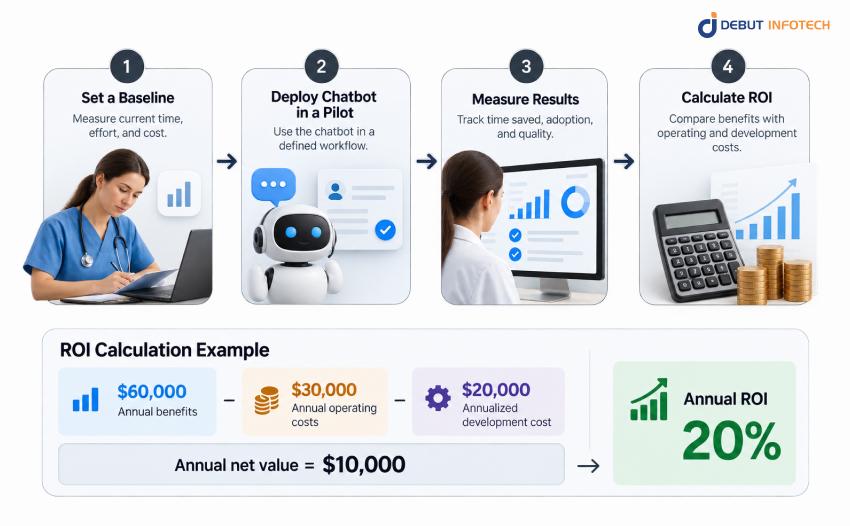
A healthcare chatbot’s return depends on the value it creates in a defined workflow. Before launch, establish a baseline for the work the assistant will support. Then compare those results with performance during the pilot.
For example, if the chatbot prepares patient intake summaries, measure how long staff spend collecting and reviewing the same information without it. After deployment, track both the time saved and the time clinicians spend correcting or completing the summaries.
Use these measures to assess the investment:
For an annual planning comparison, use:
Annual net value = measurable annual benefits − annual operating costs − annualized development cost
Annual ROI (%) = annual net value ÷ (annual operating costs + annualized development cost) × 100
For example, assume development costs $60,000 and you allocate that investment over three years for planning purposes. With $60,000 in annual benefits and $30,000 in annual operating costs, annual net value would be $10,000 and annual ROI would be 20%.
The result depends on benefits the organization can substantiate. Time saved may increase staff capacity rather than reduce payroll, so avoid counting both outcomes as separate savings. Compare the estimate with pilot results before expanding clinical AI chatbot development to additional workflows.
A focused healthcare chatbot may take approximately 3 to 5 months to develop and pilot. An assistant supporting multiple clinical workflows or complex integrations may take 6 to 9 months or longer.
For AI healthcare chatbot development, the expected timeline depends on scope:
| Healthcare Chatbot Scope | Estimated Timeline | Capabilities |
| Focused Assistant | 3 to 5 months | Approved FAQs, limited intake, staff handoff, and straightforward system connections |
| Integrated Assistant | 6 to 9 months | Authenticated patient workflows, approved knowledge retrieval, draft clinician summaries, and selected EHR or scheduling integrations |
| Enterprise Assistant | 9 months or longer | Multiple departments or locations, extensive integrations, and broader clinical evaluation and availability requirements |
Confirm system access, content readiness, vendor dependencies, and clinician availability early. These factors can extend the schedule, while pilot results determine readiness for wider rollout.
A lower development budget starts with a clear understanding of what the assistant needs to do. These decisions can help healthcare organizations control spending during custom healthcare chatbot development while keeping the safeguards required for their intended use:
Reducing the healthcare chatbot development cost through scope and reuse while retaining the security controls and clinical evaluation required for the assistant’s role.
Debut Infotech combines healthcare application experience with AI engineering to help organizations define their assistant’s features, integrations, and development budget.
Our healthcare portfolio includes WellPop, a care-coordination platform implemented across four medical facilities, with more than 3,000 patients enrolled and over 80 doctors registered. The project involved patient engagement, EHR integration, and care-team collaboration.
Through our healthcare app development services, we help organizations build the interfaces and system integrations the assistant needs. This can include patient-facing workflows, authorized access to information, and integration with existing healthcare applications.
For the AI layer, our team can assess an existing model, connect approved information, and design the conversation around the assistant’s intended use. We also plan for clinician review and escalation where the workflow calls for them. As an AI chatbot development company, we can translate those requirements into a defined development scope and cost estimate.
Budget $40,000 to $250,000 or more for a custom application built using an existing AI model. Features, integrations, and clinical evaluation determine the estimate. This covers selected AMIE-inspired capabilities, with operating costs budgeted separately.
A focused healthcare chatbot may take approximately 3 to 5 months to develop and pilot. A more complex assistant with multiple integrations or clinical workflows may take 6 to 9 months or longer. These are planning estimates. The schedule depends on system access, data readiness, clinical review, testing, and the organization’s release approval process.
Fine-tuning is not necessary for every chatbot. An existing model combined with approved knowledge retrieval may meet the needs of some workflows. When AI model fine-tuning for healthcare is required, costs depend on the availability of training examples, preparation effort, model provider, and evaluation. It should be estimated separately based on the use case and delivery scope.
Plan $500 to $5,000 or more per month for model usage and infrastructure. Content updates, evaluation, integration maintenance, security, and support may add to this amount. Confirm what your provider includes to avoid counting bundled services twice.
No. Where HIPAA applies, compliance depends on the complete application, operating procedures, vendor arrangements, and ongoing safeguards. Choosing a particular AI model or cloud provider alone does not make the chatbot compliant.
Yes, a chatbot can connect to an EHR or EMR when the required interfaces and permissions are available. Depending on the agreed workflow, it may retrieve authorized information or submit intake details for review. Medical data integration costs depend on the vendor, available operations, patient matching, and whether information must be written back to the system.
Using an existing large language model can reduce development effort because the organization does not need to train a foundation model from scratch. The application still requires conversation design, integration, testing, and safeguards suited to its intended use. Model selection also affects ongoing expenses, so compare usage charges and performance alongside the initial AI medical chatbot development cost.
Look for a provider that can explain its approach to healthcare workflows, integrations, security, and clinical evaluation. Ask for a detailed scope identifying responsibilities, assumptions, and exclusions. A suitable healthcare chatbot development company for hospitals should also explain how it will test the assistant, support it after launch, and handle changes to connected systems or AI models.
Google AMIE is a research system developed for medical conversations and reasoning. An AMIE-inspired assistant can apply selected concepts, such as conversational intake or clinician summaries, to an organization’s specific workflow. Its capabilities and evaluation depend on the project. Building an inspired application does not mean recreating AMIE or reproducing the results reported in Google’s research.

Our Latest Insights
USA
2501 Chatham, Rd Suite R Springfield, IL 62704
+1-708-515-4004
info@debutinfotech.com
UK
7 Pound Close, Yarnton, Oxfordshire, OX51QG
+44-770-304-0079
info@debutinfotech.com
Canada
154 Eden Oak Trail, Kitchener, ON N2A 0H9
+1-708-515-4004
info@debutinfotech.com
INDIA
Sector 101-A, Plot No: I-42, IT City Rd, JLPL Industrial Area, Mohali, PB 140306
9888402396
info@debutinfotech.com